Team
Faculty
Dr. Dan Cabanes-Cruelles

Biological Sciences Building
Room 203A
1 Chemistry Drive
New Brunswick, NJ, 08901, U.S.A.
t. +1 (848) 932 – 9393
Biography
Dr. Dan Cabanes is an associate professor in the Department of Anthropology at Rutgers University and the leading faculty at the Department of Anthropology Laboratory for MicroArchaeology (ALMA). He is also a full faculty member of the Center for Human Evolutionary Studies (CHES).
His research aims to understand the association between environment and human cognitive and cultural evolution. He investigates biological, social, and economic changes using microarchaeological remains
Dan is a phytolith and FTIR expert, with a formation background in archaeobotany and geoarchaeology. He has completed research in sites from the Lower Paleolithic to the Iron Age, and he also has lead groundbreaking research on phytolith preservation and collaborated in the development of a fast method of phytolith analyses.
Currently, he is studying the role of fire technology in the demise of Neanderthals and the arrival of Modern Humans into Europe. His research interests also include the deep roots of the Anthropocene and the impact of human activities in the fossil sedimentary record, which has implications beyond the field of Human Evolution and can contribute to other exciting topics such as the current climatic change and its effects on migrations and health.
Postdoctoral Researchers
Dr. Isaac Ogloblin

Email: ogloblinisaac@gmail.com
Dr. Isaac Ogloblin-Ramirez is an underwater and coastal archaeologist. His research focuses on the study of formation processes of submerged and coastal settings, applying micro-geoarchaeological techniques to investigate the interaction of humans and dynamic coastal environments through time. He has been conducting pioneering research on the micro-archaeological record of the earliest coastal settlements dating to the Neolithic period, found off the Eastern Mediterranean coast. He is also taking part in projects across the Mediterranean, leading the application of geoarchaeological techniques in marine and coastal contexts in Spain, Italy, Greece, and Israel. His work on coastal sites, shipwrecks, and submerged prehistoric sites is aimed at reconstructing anthropogenic activities associated with the sea to explore the entanglement between human behaviors and environmental dynamics at the coast. Actually, he is working at ALMA on the outgoing phase of the Marie Skłodowska-Curie Actions, PUMA (Paleolithic Underwater Micro-Geoarchaeology).
Graduate Students
Marc Ramrekha

Biography
I received my B.A. in Anthropology and Political Science from Rutgers University in 2022. During my undergrad, I did research at ALMA for my senior honors thesis titled Where’s the fire? Using FTIR to determine occupation at Abrigo de la Boja. I reconstructed the environmental conditions of the rock shelter site by determining its mineral composition and explored the use of fire by Neanderthals and Anatomically Modern Humans, both by using Fourier-Transform Infrared Spectroscopy, and then discussed the implications on Neanderthal extinction.
While I’m still interested in researching the extinction of the Neanderthals and the MP-UP Transition, I shifted focus both spatially and temporally for my dissertation. Now, I am primarily interested in the role of the environment in societal collapse. I am investigating the use of phytolith analysis as both means of high resolution environmental reconstruction and a direct record of human-environment interaction at tell sites. As part of my dissertation, I am looking at phytoliths from destruction layers and earth-based construction materials at my primary field site, Tell es-Safi/Gath and exploring its potential use as a way to reconstruct the environment at the human scale at multilayered sites.
Dimitri Papavasiliou
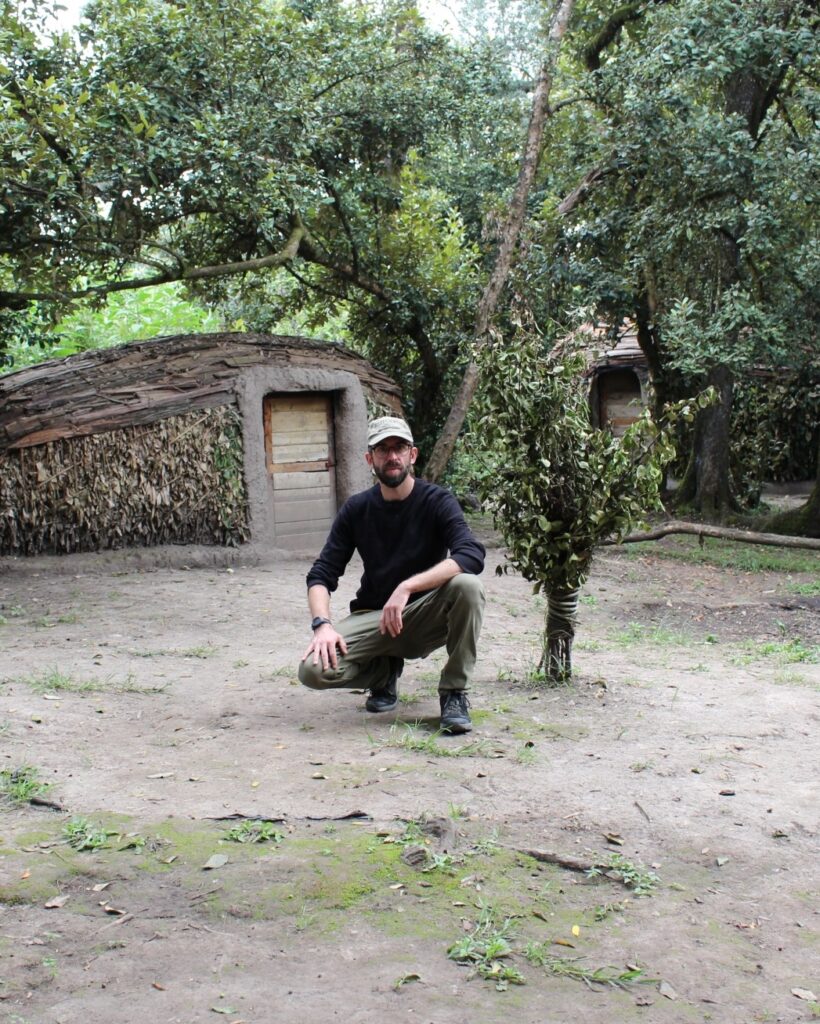
Biography
My project, A Microarchaeological Approach to Paleolithic Fire and Bedding Technology, examines the social and technological development of early human groups by exploring how they organized and maintained domestic living areas. Focusing on two critical elements, fire use and the placement of bedding materials, this research offers insight into cognitive complexity, changing social structures, and survival strategies in our evolutionary past. By incorporating ethnoarchaeology, experimental archaeology, and microarchaeology, this study presents a novel approach to understanding domestic behavior in ancient human societies.
Kyra Johnson

Biography
I am a PhD candidate in the Department of Anthropology at Rutgers. I received a BA in Anthropology from the University of Minnesota-Twin Cities in May of 2019 and my MA from Rutgers in 2023. For my dissertation I am interested in understanding how bones are altered under variable heating conditions. I use multiple data collection techniques like Color Analysis with a spectrophotometer, Surface Texture Analysis, Fourier Transform Infrared Spectroscopy, and X-Ray Diffraction on experimental bones created in the lab and in the field. With the results of her experiments I am going to study fire exploitation patterns in the Iberian Peninsula at the sites of Gruta da Aroeira (Torres Novas, Portugal), Cova del Gegant (Sitges, Barcelona, Spain), and Abrigo do Lagar Velho (Leiria, Portugal).
Alessandra Dominguez

Email: aledomz@sas.upenn.edu
Alessandra Dominguez (she/her) received her B.A. in Anthropology and Honors Art History with minors in Archaeology and Italian, in addition to a Bridging Disciplines Program certificate in Museum Studies from the University of Texas at Austin (Spring 2023). She has excavated at Sədərək in Azerbaijan, Morgantina and Motzia in Sicily, Bat in Oman, Qach Resh in Iraqi Kurdistan, Molyvoti in Greece, and Lagash in southern Iraq. Alessandra has held various positions in museum institutions and art galleries concerning DAEI, curation, education, and provenance. In addition to leading tours of the Penn Museum, she is currently the Lab Manager of the Archaeobotany Lab in the Center for the Analysis of Archaeological Material.
Alessandra’s areas of research are concentrated in the ancient Middle East, where she focuses on human-environmental interactions and how changing environments influence ideas of landscape and material production. Her undergraduate senior thesis focused on how the volatile paleoclimate of southern coastal Peru influenced the Nasca culture’s perception of landscape, which presented as naturalism on ceramic iconography. Her dissertation research focuses on the development and management of oasis agriculture in southeastern Arabia during the 3rd millennium BCE. For this research, she is specializing in archaeobotany (macrobotany and phytoliths), as well as microarchaeology.
Undergraduate Students
Sanjana Yerva

Biography
I’m a Senior majoring in Forensic Chemistry and Criminal Justice, and I hope to be a forensic pathologist one day. Currently, I’m working on the HEISL project to help determine what the paleoclimate was like in the Levant. My research focuses on phytoliths, and how measurements and quantification of phytoliths can help us determine the paleoclimate by comparing those results with archaeological samples.
Jerry Reaves

Biography
I am a Pre-Med Senior pursuing a B.S. in Health Administration. I am currently assisting in research centered around using phytoliths to identify changes in human activity from the Bronze to Iron ages. With my background in healthcare, I look to participate in research centered around the past population’s health and their healthcare techniques.
Maeve Koreck

Biography
I am an Evolutionary Anthropology student with an Archaeology minor pursuing a B.S. in Evolutionary Anthropology on the PhD track. I am working on an honors thesis that focuses on FTIR analysis of sediment samples taken from El Salt to further understand site formation processes.
Megan Kruse

Biography
I am a Junior pursuing a B.S in Evolutionary Anthropology with an Archaeology minor on the PhD track. I am currently working on an honors thesis that focuses on the phases of phytolith production in leaves to study seasonality in human behavior.