Surface Phonons
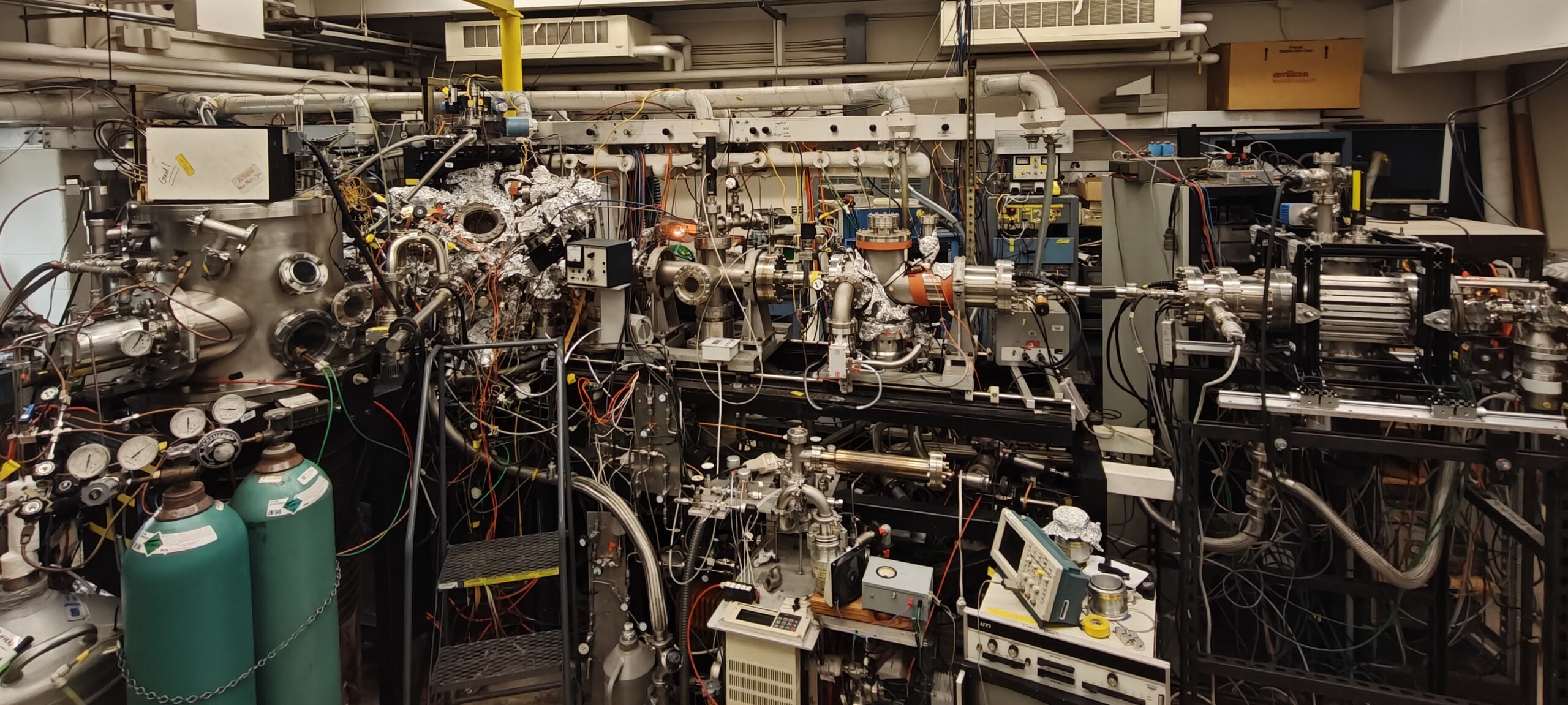
Helium atom scattering (HAS) is a uniquely powerful, non-destructive probe of crystalline surfaces and interfaces. In HAS, a beam of neutral helium atoms (chemically inert and carrying only a few tens of meV of kinetic energy) scatters from the outermost atomic layer of a material. Because helium does not penetrate the bulk and does not damage sensitive surfaces, HAS provides a truly surface-specific view of structure and dynamics, enabling measurement of surface order, reconstructions, adsorbate phases, and, critically, surface phonons: the quantized lattice vibrations that are often distinct from bulk vibrational modes. By analyzing energy and momentum transfer in inelastic scatting, HAS can map full surface phonon dispersions with high sensitivity to the near-surface force constants and symmetry-breaking effects that emerge at surfaces.
Surface phonons are not just “vibrations,” they are the language by which surfaces mediate heat flow, atomic diffusion, catalysis, film growth, and interfacial stability. Even more fundamentally, these vibrational modes can couple strongly to electronic degrees of freedom through electron-phonon coupling (EPC), a central interaction that shapes electrical resistivity, carrier mobility, charge-density waves, and, in some materials, superconductivity. EPC is especially important at surfaces and in low-dimensional materials, where reduced symmetry and enhanced correlations can amplify coupling and generate emergent behavior absent in the bulk. HAS offers a direct route to EPC by revealing phonon softening, linewidth broadening, and features such as Kohn anomalies; all which are quantitative signatures of how electrons interact with lattice motion. HAS provides a rare window into microscopic interactions that govern device-relevant properties, making it an essential tool to understand and engineer next-generation quantum, electronic, and energy materials.