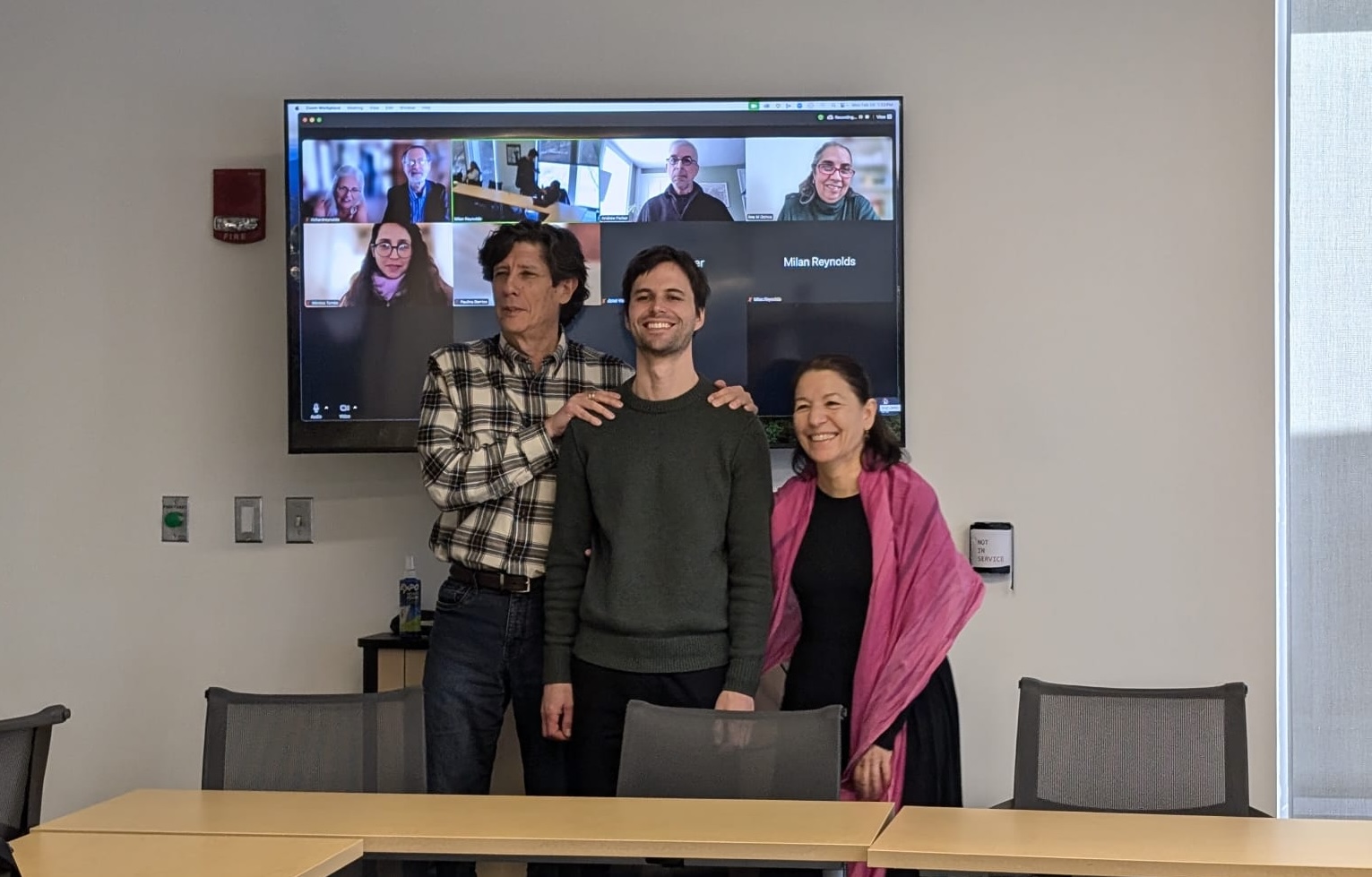
An ending, a beginning, a ceremony, a defense… I was lucky to “defend” in the company of
friends, family, colleagues, and a generous committee whose work inspires me. It was an
opportunity to share and tie together the research I had done over the past five years of my PhD.
It offered me new perspective on the chapters I had written piece by piece; to go from the
microscopic scale of words and sentences to the constellation of a book-to-be.
Even a few months prior, this kind of public summation had seemed far out of reach. I was still
editing, reading out loud the transitions between subsections and adding in citations, context, and
more examples. In the weeds, I remember wondering how anything this long could be explained,
let alone defended. I must thank my advisor, Professor Paola Gambarota, for convincing me I
was ready to finish this stage of the project.
My dissertation is called “Decomposing the Voice: Tape Poetics and the Politics of Listening in
Cold War Italy and Latin America”. I argue that magnetic tape is a crucial part of recent cultural
history and the expansion of who and what is heard as “having” a voice. Tape recording
challenged literary styles and forms by revealing the imbrication of writing and listening. It
produced new ways of negotiating the nature of political collectivity. As a musician and
sonically inclined tinkerer, tape has fascinated me for a long time. Here was an opportunity to
delve into its materiality and sociality from multiple perspectives: from post-war electronic
music in Italy, to Chilean performance art, to a contemporary Colombian novel. I found tape
speaking to a set of overlapping questions that negotiate the boundaries of music and noise,
history and fiction, subject and object.
I was more excited than nervous the morning of the defense. I felt prepared (five years after all!).
If anything, imagining explaining what I’d been doing to my friends and family was the most
clarifying approach of all. It forced me to be specific in my answers and definitions, concise in
my examples and methods. The best part, besides the feeling of being done with something
(ceremonies are important), was getting to hear the eloquent feedback of my committee,
Professors Jorge Marcone, Andy Parker, and Ana María Ochoa. I thank all the Comparative
Literature faculty and my fellow colleagues who supported me.
Milan Reynolds
Dissertation Defense – Feb 24, 2025