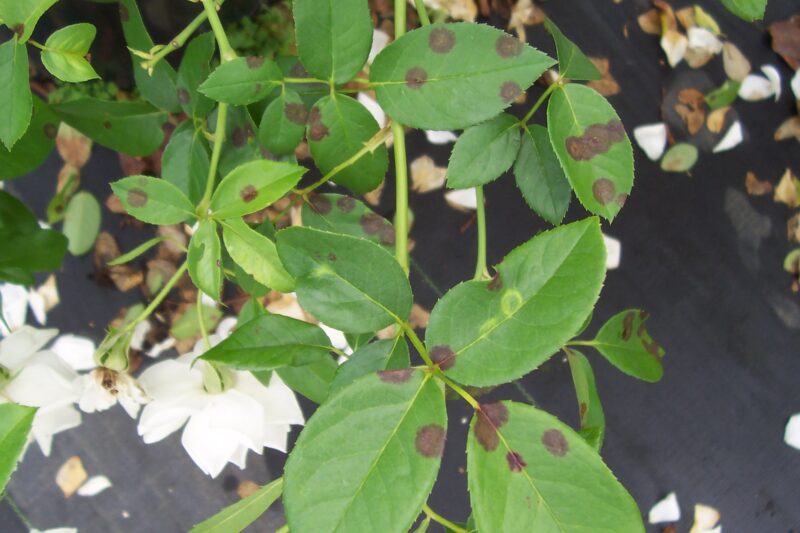
Black Spot of Rose (Diplocarpon rosae)
Overview:
- Fungal disease that created black, circular spots with fringed edges on rose leaves, causing yellowing and defoliation
- Overwinters on infected canes and fallen leaves
- Leaves must be wet for at least 7 hours to be infected
- Symptoms can appear 3 days to two weeks after infection
- Spread via splashing water
- Appears on upper leaf surfaces as raised, purplish-red blotches that blister
- Spots can be up to ½” in diameter and may coalesce to form irregular lesions
- Yellow halos form around the spots
- Entire leaves may turn yellow and drop prematurely
- (this repeated in the landscape weakens the plants)
- Reduced flower production
- Host plants: Rosa spp.
Management:
Cultural Practices:
- Avoid winter injury, poor vigor, and stem wounds
- Prune diseased branches when foliage is dry
- Sanitize pruning tools after working with diseased plants
- Prevent creating further wounds with pruning tools
- Maintain plant health and reduce unnecessary plant stress
- Avoid excess water and fertilization
- Maintain proper air circulation
- Keep area around plants clean, destroy debris
- Choose well drained soil , avoid overhead watering
Materials:
- Contact fungicides:
- Chlorothalonil [M05]
- Mancozeb [M03]
- Systemic fungicides:
- Thiophanate methyl [1]
- Propiconazole [3]
- Azoxystrobin [11]
- Considerations:
- Spray fungicides as soon as the season begins
- Spray every 7-12 days, shortening the interval during wet weather and lengthening it during dry weather
- Spray fungicides as soon as the season begins
- Biorationals:
- Neem oil
- Potassium bicarbonate [NC]
- Copper hydroxide [M01]
- Copper sulfate [M01]
Resources:
Landscape Pest Notes for Early June 2023 – PPA
Disclaimer – Materials do not cover all possible control scenarios and are intended for licensed professionals. Tradenames do not imply endorsement and are used as examples. You must strictly follow the label for each compound prior to use. Rutgers is not responsible form is used materials or damages thereof. The label is the law. Labels will provide detailed information on use and restrictions. Additionally, application intervals, compatibility, surfactant use, PHI, PPE, important and other key information is described in detail. Always discuss treatments with your local agents. Note: Neonicotinoids can only be legally applied in commercial agriculture settings by licensed applicators. Guidelines and recommendations made in this presentation are specific to the state of New Jersey.