
Azalea Whitefly (Pealius azaleae)
GDD Window (base 50): 448-700 (1st gen), 1250-1500 (2nd gen), 2032-2150 (3rd gen)
Overview:
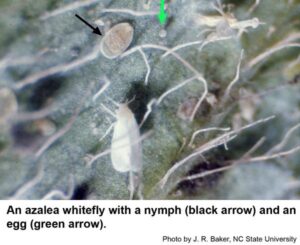
- Tiny, 1/16” long, powdery white insects that look like very small moths
- Adults emerge in the spring and females lay their eggs in the lower surfaces of new leaves
- Eggs are initially creamy white and translucent but turn gray with time
- Crawlers are tiny and yellow, looking like pollen grains
- Crawlers suck sap from the plant using threadlike mouthparts
- Crawlers molt into yellowish-orange, scale-like nymphs
- Overwinter as nymphs on leaves
- Crawlers and nymphs secrete honeydew, which can grow sooty mold
- Infested plants become unattractive
- Clouds of adults may fly up when a plant is disturbed
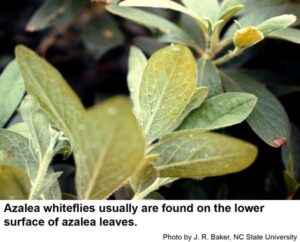
- Primarily feed on the underside of leaves, sucking sap, causing leaves to yellow and curl
- Can cause premature leaf drop
- Host plants: all azalea cultivars, rhododendrons, especially those with hairy leaves
Management:
Cultural Practices:
- Natural predators: parasitic wasps (Encarsia formosa), lady beetles, lacewings, predatory mites
- Yellow sticky traps
- Reduce plant stress
- Improve air circulation between plants
- Syringing
Materials:
- Contact insecticides:
- Pyrethroids [3]: –thrins
- Carbamates [1A]: Carbaryl
- Systemic insecticides:
- Neonicotinoids [4A]: imidacloprid
- Abamectin
- Acephate (translaminar)
- Considerations:
- Will harm non-target species
Biorationals:
- Buprofezin (IGR)
- Pyriproxyfen (IGR)
- Spiromesifen
- Lipid & cell membraneinhibitor
- Pymetrozine
- (select feeding blocker)
- Horticultural oils & soaps
- One treatment in the fall and another after new growth emerges in the spring

Disclaimer – Materials do not cover all possible control scenarios and are intended for licensed professionals. Tradenames do not imply endorsement and are used as examples. You must strictly follow the label for each compound prior to use. Rutgers is not responsible form is used materials or damages thereof. The label is the law. Labels will provide detailed information on use and restrictions. Additionally, application intervals, compatibility, surfactant use, PHI, PPE, important and other key information is described in detail. Always discuss treatments with your local agents. Note: Neonicotinoids can only be legally applied in commercial agriculture settings by licensed applicators. Guidelines and recommendations made in this presentation are specific to the state of New Jersey.