
Orange-Striped Oakworm (Anisota senatoria)
GDD Window (base 50): 1917 (egg hatch)
Overview:
- Moths are brown with a white spot and a dark stripe down each wing
- Male moths are smaller with transparent forewings
- Eggs hatch about a week after being laid
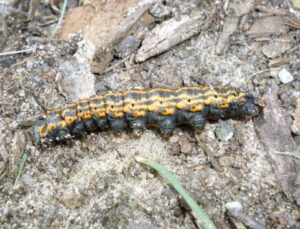
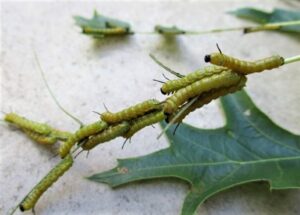
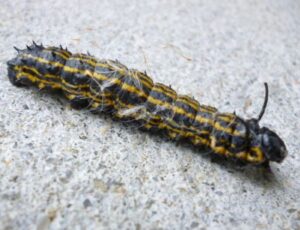
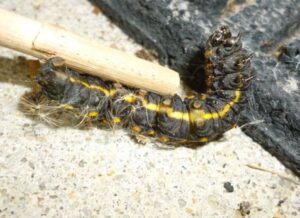
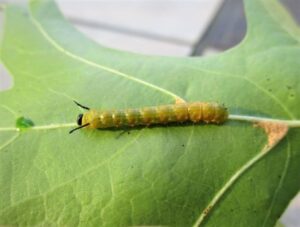
- Caterpillars are tiny, greenish-yellow with a pair of horns behind their heads, and eventually grow to become black worms with yellow stripes
- Young worms feed together and alone when they grow older
- One generation per year
- Late season defoliators are less harmful to large trees
- Worms produce frass pellets that can dropdown from infested trees
- Mature worms can be found outside of the trees, on the sidewalk or near yards
- Caterpillars dig into the soil to pupate about three inches down, where worms overwinter as pupae
- Defoliation causes twig dieback and can be made worse due to sun scald or other stressors
- Small trees can be defoliated by mid to late summer
- Host plants: Mostly oaks, but can be found on birch, hazelnut, hickory, maple, and other hardwood trees
Management:
Cultural Practices:
- Natural predators: birds, paper wasps, parasitoids
- Shake branches of small trees to make the caterpillars fall to the ground and squish them
- Install wasp nest boxes nearby to enhance predator populations
Materials:
- Contact insecticides:
- Pyrethroids [3A]: -thrins
- Carbamates [1A]: Carbaryl
- Systemic insecticides:
- Avermectins [6]:
- Abamectin
- Emamectin benzoate
- Avermectins [6]:
- Considerations:
- Most trees are too large to fully treat with sprays
Biorationals:
- Bt [11] var. kurstaki
- Spinosad [5]
- Chlorantraniliprole [28]
- Diflubenzuron (IGR)
- Horticultural oils/soaps
- young larvae with good coverage




Disclaimer – Materials do not cover all possible control scenarios and are intended for licensed professionals. Tradenames do not imply endorsement and are used as examples. You must strictly follow the label for each compound prior to use. Rutgers is not responsible form is used materials or damages thereof. The label is the law. Labels will provide detailed information on use and restrictions. Additionally, application intervals, compatibility, surfactant use, PHI, PPE, important and other key information is described in detail. Always discuss treatments with your local agents. Note: Neonicotinoids can only be legally applied in commercial agriculture settings by licensed applicators. Guidelines and recommendations made in this presentation are specific to the state of New Jersey.