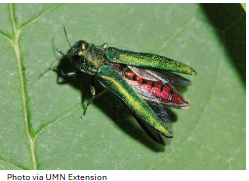
Emerald Ash Borer (Agrilus planipennis)
GDD Window (base 50): 450-500
Overview:
- Adults are wood-boring beetles that are bright metallic green in color, bullet-shaped, and 1/3” long with two pairs of wings
- Larvae are 1-1.25” long, and white to cream colored with ten abdominal segments. The last segment has two brown pincers.
- One-year long life cycle
- Adults emerge in early summer through a D-shaped exit hole, with adult activity peaking in mid-summer
- Adults feed on ash foliage for multiple days before beginning to mate
- Eggs are laid in the bark and hatch in 7-10 days, when larvae tunnel through the bark and into the phloem
- Larvae feed on phloem, creating S-shaped galleries which widen as the larvae grow, and leaving frass under the bark of the tree
- Prepupal larvae overwinter in the bark
- Initial infestations may not be apparent for two or more years
- Look out for jagged holes made by woodpeckers searching for larvae
- Bark can split vertically over larval galleries
- Causes foliage to wilt, branch dieback, thinning canopy, and eventually death after 3-5 years of infestation
- Epicormic shoots appear on the tree trunk
- Host plants: Fraxinus spp. (white ash, black ash, green ash)
Management:
Cultural Practices:
- Natural predators: woodpeckers (downy, hairy, and red-bellied), parasitoid wasps (Tetrastichus planipennisi, Spathius agrili, and Oobius agrili)
- Encourage plant health
- Remove infested trees
- Do not move ash wood
- EAB will usually only travel 0.5-1 miles per year, but humans can make the problem worse by carrying firewood and other products
Materials:
- Contact insecticides:
- Pyrethroids [3]: –thrins
- Systemic insecticides:
- Avermectins [6]: emamectin benzoate (trunk-injection)
- Neonicotinoids [4A]: imidacloprid(soil drench), dinotefuran (bark spray)
- Considerations:
- Treat large trees before they become infested
- See Bronze Birch Borer
Biorationals:
- Azadirachtin [UN] (trunk injection)
Resources:
- 2nd Edition North Central IPM Insecticide Options for Protecting Ash Trees from Emerald Ash Borer
- Herms, D. (2014, Mar 20). 2014 Research Update on Emerald Ash Borer [Webinar]
- Emerald Ash Borer Website


Disclaimer – Materials do not cover all possible control scenarios and are intended for licensed professionals. Tradenames do not imply endorsement and are used as examples. You must strictly follow the label for each compound prior to use. Rutgers is not responsible form is used materials or damages thereof. The label is the law. Labels will provide detailed information on use and restrictions. Additionally, application intervals, compatibility, surfactant use, PHI, PPE, important and other key information is described in detail. Always discuss treatments with your local agents. Note: Neonicotinoids can only be legally applied in commercial agriculture settings by licensed applicators. Guidelines and recommendations made in this presentation are specific to the state of New Jersey.