Bacterial Shot Hole and Fungal Look-a-Likes
Overview:
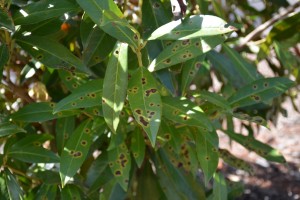
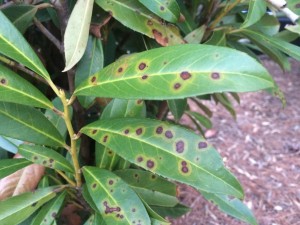
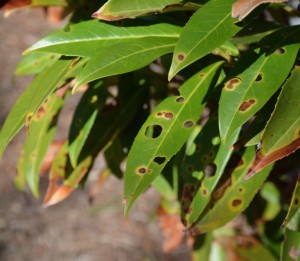
- Bacterial infection caused by [mostly] Xanthomonas arbicola pv. pruni or [lesser] Pseudomonas syringae pv. syringae. creating uniform holes in leaves after spots drop out
- Spots turn red, purple, and brown and eventually drop out, leaving holes
- Yellow or red halos begin to surround the lesions, and spots can coalesce
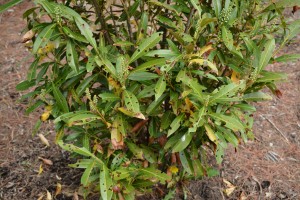
- Prunus sp. trees: Severely infected leaves yellow and drop
- Cherry Laurels: Develop shothole and stay attached
- Most Common Hosts in nursery:
- Prunus sp. trees
- Prunus laurocerasus ‘Otto Luyken‘
- Prunus laurocerasus ‘Schipkaensis‘
- Fungal look-a-likes: (some cases pycnidia are present)
- Blumeriella jaapii
- Cercospora sp.
- Wilsonomyces carpophilus (Coryneum blight)
Management:
Cultural Practices:
- Avoid winter injury, poor vigor, and stem wounds
- Prune diseased branches when foliage is dry
- Sanitize pruning tools after working with diseased plants
- Prevent creating further wounds with pruning tools
- Maintain plant health and reduce unnecessary plant stress
- Avoid excess water and fertilization
- Maintain proper air circulation
- Keep area around plants clean, destroy debris
- Choose well drained soil , avoid overhead watering
Materials:
- Pay close attention to DIAGNOSTICS before treatment (Treatment for right issue Bacteria Vs Fungus)
- Reduce leaf wetness and humidity
- Space plants adequately / increase airflow
- Plant resistant varieties
- “Chesnut Hill” reported to be more resistant compared to “Otto Luyken“
- REMOVE FALLEN LEAF LITTER
- Tree Prunus sp. typically drop mid-summer
- Suppress Bacteria AND fungi shot hole
- Coppers (sulfate [M01], hydroxide [M01])
- Cu hydroxide [M01] + Mancozeb [M03]
- Mancozeb [M03]
- Bacterial suppression
- Oxytetracycline (antibiotic) [FRAC41]
- Bacillus amyloliquefaciens strain D747 [44]
- Fungal suppression
- Azoxystrobin [11]
- Chlorothalonil [M05] + T-methyl [M1]
- Important Notes:
- Shot hole is a symptom – can be caused by bacteria, fungi, physiological responses, leafcutter bees (but does look different)
- Some growers report growing in-field, then pot up before sale year greatly decreases occurrence of shot hole
- Coppers at too high of rates can cause curling and localized phytotoxicity mimicking shot hole symptoms
- (do not use when a [P07] has been used within 14–20-day window)
- Many of these materials have long (24-48hrREI), but may be the better choice in a management strategy
Resources:
Why are There Holes in My Cheese? – PPA

Disclaimer – Materials do not cover all possible control scenarios and are intended for licensed professionals. Tradenames do not imply endorsement and are used as examples. You must strictly follow the label for each compound prior to use. Rutgers is not responsible form is used materials or damages thereof. The label is the law. Labels will provide detailed information on use and restrictions. Additionally, application intervals, compatibility, surfactant use, PHI, PPE, important and other key information is described in detail. Always discuss treatments with your local agents. Note: Neonicotinoids can only be legally applied in commercial agriculture settings by licensed applicators. Guidelines and recommendations made in this presentation are specific to the state of New Jersey.