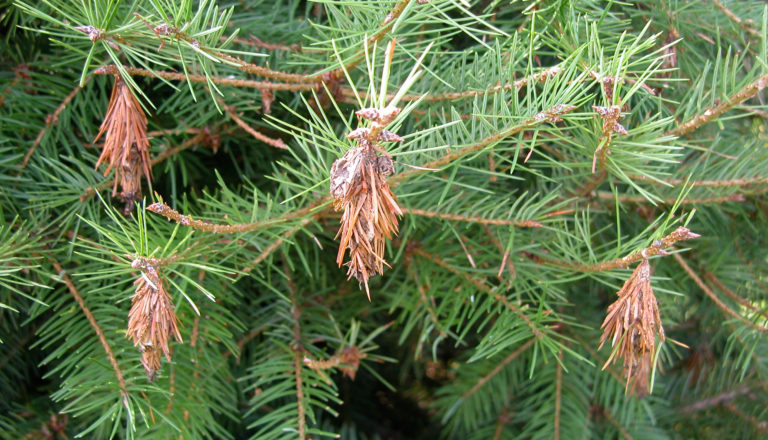
Bagworm (Thyridopteryx ephemeraeformis)
GDD Window (base 50): 600-900
Overview:
- Eggs overwinter in 1-2.5″ pinecone-shaped cases or “bags” that the caterpillar forms and suspends from host plants
- Small black/gray and amber larvae hatch in the early summer and immediately begin feeding while constructing their cases, in which they reside
- Growth and molting continue through summer, until larvae stop feeding around mid-August, when they close the case with silk to pupate
- During early to mid-fall, pupation ends and 1-inch long, fur-covered, black adult male moths with clear wings emerge
- Adult females remain in their bags and release pheromones to attract males
- Females deposit 500-1000 eggs in their bag, and adults die after reproduction
- One generation per year
- Causes complete defoliation, brown spots on leaves, and leaf skeletonization, as well as canopy thinning
- Host plants: over 125 trees and shrubs
- Evergreen – arborvitae, juniper, cedar, fir, pine, spruce
- Deciduous – birch, boxelder, elm, willow, sycamore, black locust, honey locust,persimmon, poplar, maple, sweet gum
Management:
Cultural Practices:
- Natural predators: birds, parasitoids, insects, fungi (Apergillus parasiticus, Beauveria bassiana, Parcilomyceslanosum)
- Most often spread by transporting infested nursery stock – check plants before moving or planting
- Early detection is important to prevent spread
- Reduce plant stress
- Remove egg cases and drop them into soapy water
- Pheromone traps
Materials:
- Contact insecticides:
- Carbamates [1A]: carbaryl
- Pyrethroids [3A]: –thrins
- Oxadiazine [22A]: indoxacarb
- Systemic insecticides:
- Diamides [28]: chlorantraniliprole ,cyantraniliprole, cyclaniliprole, cyclaniliprole +flonicamid [29]
- Considerations:
- Will harm non-target species
Biorationals:
- Spinosyns [5]: spinosad
- Bacillus thuringiensis var kurstaki (Bt)
- Mechanical removal of bags: before egg hatch or throughout season
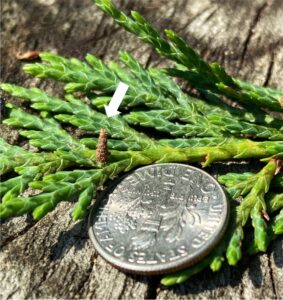

Photo by Steven K. Rettke of RCE

Photo by Steven K. Rettke of RCE

Photo by Steven K. Rettke of RCE

Photo by Steven K. Rettke of RCE

Photo by Steven K. Rettke of RCE

Photo by Steven K. Rettke of RCE
Disclaimer – Materials do not cover all possible control scenarios and are intended for licensed professionals. Tradenames do not imply endorsement and are used as examples. You must strictly follow the label for each compound prior to use. Rutgers is not responsible form is used materials or damages thereof. The label is the law. Labels will provide detailed information on use and restrictions. Additionally, application intervals, compatibility, surfactant use, PHI, PPE, important and other key information is described in detail. Always discuss treatments with your local agents. Note: Neonicotinoids can only be legally applied in commercial agriculture settings by licensed applicators. Guidelines and recommendations made in this presentation are specific to the state of New Jersey.