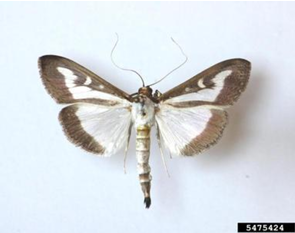
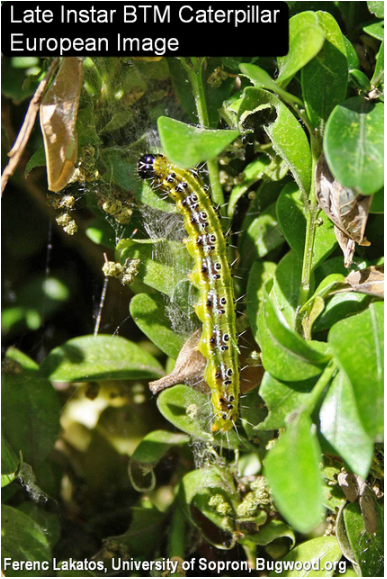
Box Tree Moth (Cydalima perspectalis)
Overview:
- Invasive Lepidoptera native to eastern Asia
- Now found throughout most of Europe
- First detection in North America – Toronto 2018 (USA NY2021)
- BTM has been detected in the Great Lakes Region (OH, PA,MI, NY) and DE, MA.
- There are NO native caterpillars that DEFOLIATE boxwoods
- In Europe they also feed on: burning bush (Euonymus alatus), Japanese spindle tree (E. japonicus), purple holly(Ilex chinensis), and orange jessamine (Murraya paniculata) once all nearby boxwoods are completely defoliated
- Federal Quarantines in Effect NOW
- Monitor boxwoods April – October
- Preventative pesticide applications= not recommended

Management:

Box Tree Moth Compliance Agreement Explained
Resources:
- Prior PPA post regarding expanding quarantines
- Video: Click here for- “Demystifying Box Tree Moth” – HRI
- Factsheet: Box Tree Moth: Fact Sheet, Management & Visual Guide
- OSU Guide: What to look for with Box Tree (Boxwood) Moth
- PPA – Box Tree Moth on the Horizon – BE VIGILANT NOW, like right now
- 2024 Updates on Box Tree Moth | VCE Publications
Disclaimer – Materials do not cover all possible control scenarios and are intended for licensed professionals. Tradenames do not imply endorsement and are used as examples. You must strictly follow the label for each compound prior to use. Rutgers is not responsible form is used materials or damages thereof. The label is the law. Labels will provide detailed information on use and restrictions. Additionally, application intervals, compatibility, surfactant use, PHI, PPE, important and other key information is described in detail. Always discuss treatments with your local agents. Note: Neonicotinoids can only be legally applied in commercial agriculture settings by licensed applicators. Guidelines and recommendations made in this presentation are specific to the state of New Jersey.