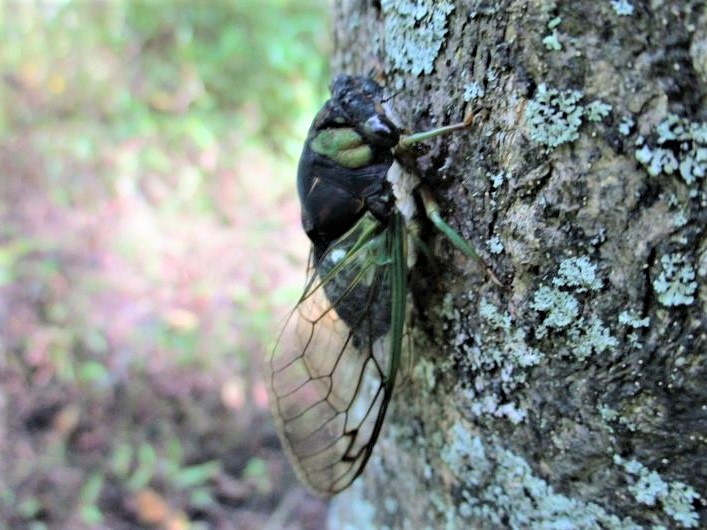
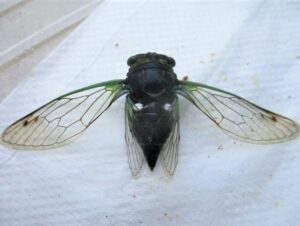
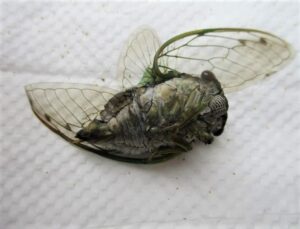
‘Dog-day’ Cicada (Neotibicen canicularis)
GDD Window (base 50): 1500 (approx.) adult emergece
Overview:
- Often overlooked because periodical cicadas are more publicized
- Emerge early July and die by mid-September
- Can be heard throughout NJ singing their “electric buzz-saw” screams
- Screams are not synchronized, and less loud than periodical cicadas
- Each male sings for 15 seconds
- Less dense populations than periodical cicadas
- 2–3-year life cycles: Emergence is not synchronized, and so some will emerge every year
- Mated females use their ovipositors to insert eggs through the bark of small terminal twigs on trees
- Females create slits in the twigs to deposit their eggs
- Causes flagging – twigs and small branches turn brown and wither before dying back
- Splits and punctures in the branches can appear as straight lines or rows of puncture marks
- Can cause broken branches
- Nymphs feeding on roots can weaken or stunt plant growth
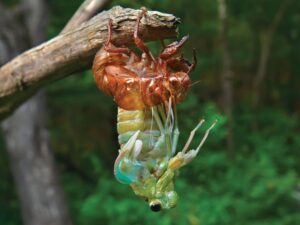
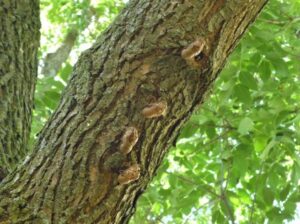
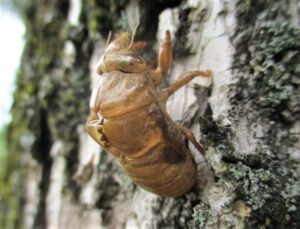
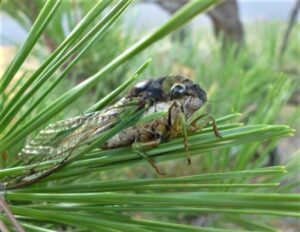
- Look for shed exoskeletons on trees and other surfaces
- Host plants: A variety of woody plants, including common trees & shrubs
Management:
Cultural Practices:
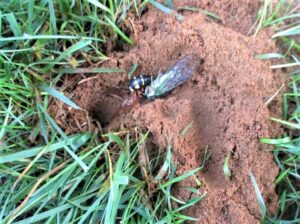
- Natural predators: cicada killer wasps (Sphecius speciosus), birds, bats, spiders, mantises, rodents
- Protect young trees and shrubs with netting or cheesecloth
- Delay planting new trees until cicada season is over
- Prune and remove damaged twigs within three weeks of egg laying
Materials:
- Contact insecticides:
- Carbamates [1A]: Carbaryl
- Pyrethroids [3]: –thrins
- Organophosphates [1B]: Chlorpyrifos
- Considerations:
- Will harm non-target species
Biorationals:
- Horticultural oils
- Insecticidal soaps
- Water and vinegar solution
- 1 cup vinegar to 4 cups water
Resources:
Dog-Day Cicadas Are Still Singing, but Cicada Killer Wasps Aren’t Fans – PPA

Disclaimer – Materials do not cover all possible control scenarios and are intended for licensed professionals. Tradenames do not imply endorsement and are used as examples. You must strictly follow the label for each compound prior to use. Rutgers is not responsible form is used materials or damages thereof. The label is the law. Labels will provide detailed information on use and restrictions. Additionally, application intervals, compatibility, surfactant use, PHI, PPE, important and other key information is described in detail. Always discuss treatments with your local agents. Note: Neonicotinoids can only be legally applied in commercial agriculture settings by licensed applicators. Guidelines and recommendations made in this presentation are specific to the state of New Jersey.