
Dogwood Sawfly (Macremphytus tarsatus)
GDD Window (base 50): 1151-1500
Overview:
- Adults are slender, shiny, black, wasp insects & emerge May to July
- Females insert up to 100 eggs into a leaf using an ovipositor
- Eggs cause bumps in the leaves which turn brown
- Young larvae feed in groups along the margins of the leaves
- First instar larvae resemble small, greenish-yellow tadpoles
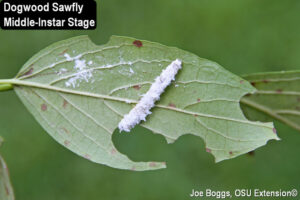
- Second and third instar larvae have a smooth, amber-colored body with black rectangular markings along the top and sides
- Maturing larvae have a white powdery coating over the surface of their bodies
- Final instar larvae are about an inch long, and cream in color with black spots, they eventually stop feeding in groups and disperse throughout the tree to feed individually
- Larvae and shed skins can resemble bird droppings or caterpillars
- Mature larvae bore into soft wood, forming cells
- One generation per year
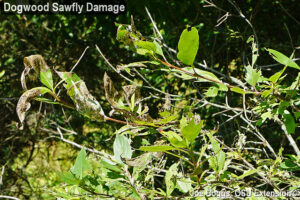
- Young larvae will initially skeletonize leaves
- Larger larvae will consume the entire leaf area except for the mid-veins
- Host plants: dogwoods
Management:
Cultural Practices:
- Natural predators: birds, spiders, predatory stink bugs, wasps
- Prune out or handpick when within reach
- Encourage natural predators by providing food, water, and shelter
- Reduce plant stress
- Dispose of fallen leaves
- Allow for air circulation and sunlight penetration
Materials:
- Contact insecticides:
- Pyrethroids [3]: –thrins
- Carbamates [1A]: carbaryl
- Systemic insecticides:
- Neonicotinoids [4A]: imidacloprid, dinotefuran, acetamiprid
- Organophosphates [1B]: acephate (translaminar)
- Considerations:
- Will harm non-target species
Biorationals:
- Horticultural oil
- Insecticidal soap
- Spinosad
- Azadirachtin
- Acetamiprid
Resources:
Landscape Pest Notes for July 2023 – PPA
Disclaimer – Materials do not cover all possible control scenarios and are intended for licensed professionals. Tradenames do not imply endorsement and are used as examples. You must strictly follow the label for each compound prior to use. Rutgers is not responsible form is used materials or damages thereof. The label is the law. Labels will provide detailed information on use and restrictions. Additionally, application intervals, compatibility, surfactant use, PHI, PPE, important and other key information is described in detail. Always discuss treatments with your local agents. Note: Neonicotinoids can only be legally applied in commercial agriculture settings by licensed applicators. Guidelines and recommendations made in this presentation are specific to the state of New Jersey.