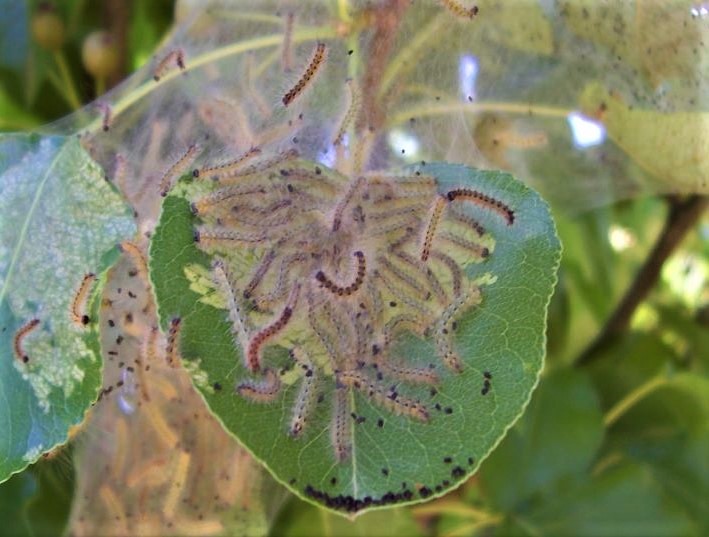
Fall Webworm (Hyphantria cunea)
GDD Window (base 50): 1266-1795
Overview:
- Mostly visual concerns
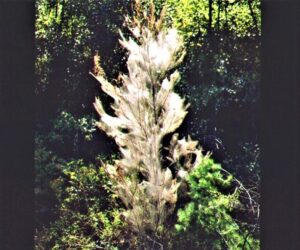
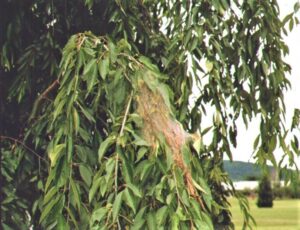
- Feeds within silken webs which encircle branches, twigs, and leaves
- Similar web to eastern tent caterpillars
- Fall webworm makes webs at the tips of branches, and never leaves the protective webbing
- When more food is needed, the boundaries of the web are extended
- Larvae may feed for a few weeks before webs become apparent
- Webs are most noticeable near the end of the larvae feeding periods
- Pupate in late summer/early fall and overwinter in the soil
- First generation is in late May and June, and is usually small, while the second generation can cause outbreaks
- Caterpillars are pale yellow to greenish, with dark spots or stripes, covered in hairs, and either a black or red head
- When disturbed, exhibit a synchronized jerking motion
- Leave behind frass and skeletonized leaves within the webs
- Cause defoliation
- Host plants: more than 100 species of trees
- Mulberry, ash, elm, linden, sweetgum, willow, walnut, hickory, oak, apple, other fruit trees
Management:
Cultural Practices:
- Natural predators: fall webworm is native, so has many natural predators and parasitoids to keep populations in check
- Encourage beneficial insect populations
- Food and water sources
- Use less pesticides
- Prune out nests
- Prune out unsightly webs or rip them open with a stick or jet stream of water to destroy the caterpillars
Materials:
- Contact insecticides:
- Pyrethroids [3]: – thrins
- Lambda-cyhalothrin, cyfluthrin
- Carbamates [1A]: carbaryl
- Pyrethroids [3]: – thrins
- Systemic insecticides:
- Chlorantraniliprole [28]
- Acephate (translaminar)
- Considerations:
- Most will harm non-target species
Biorationals:
- Horticultural oils & soaps
- Young instars only
- Bt [11]: Bacillus thuringensis
- Young instars only
- Spinosyns [5]: spinosad
Resources:
Landscape Pest Notes for July 2023 – PPA
Disclaimer – Materials do not cover all possible control scenarios and are intended for licensed professionals. Tradenames do not imply endorsement and are used as examples. You must strictly follow the label for each compound prior to use. Rutgers is not responsible form is used materials or damages thereof. The label is the law. Labels will provide detailed information on use and restrictions. Additionally, application intervals, compatibility, surfactant use, PHI, PPE, important and other key information is described in detail. Always discuss treatments with your local agents. Note: Neonicotinoids can only be legally applied in commercial agriculture settings by licensed applicators. Guidelines and recommendations made in this presentation are specific to the state of New Jersey.