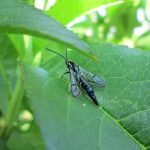
Greater Peach Tree Borer (Synanthedon exitosa)
GDD Window (base 50): 600-1800
Overview:
- Overwinters as various larvae stages
- Adults are often mistaken for wasps when flying
- Females are dark blue with a broad orange band around the body, dark forewings, and clear hind wings
- Male is smaller and has three to four narrow, yellowish bands across the body with two pairs of clear wings, black scales on top of their head between their eyes, and yellow scales between the antennae
- Larvae are white with a brown head, reaching up to 1.5″ long
- Larvae become active and feed from April to July, working their way into the trunk as they grow
- Adults emerge and lay up to 500 eggs during mid to late summer on tree trunks, in the bark, and in the soil near the trunk
- Eggs hatch in 10 days
- First sign is a mass of gum protruding from the trunk base
- Causes lower fruit production, twig and branch dieback, and can lead to death
- Host plants: Prunus spp. (peaches, plums, cherries, nectarines)
Management:
Cultural Practices:
- Natural predators: beneficial nematodes (Steinernema carpocapsae)
- Reduce plant stress and maintain healthy trees
- Pheromone traps
- Avoid using mulch around the bases of tree trunks
- Avoid damaging the bark
- Remove and destroy severely infested trees
Materials:
- Contact insecticides:
- Pyrethroids [3]: –thrins, esfenvalerate
- Systemic insecticides:
- Diamides [28]: Cyantraniliprole, chlorantraniliprole
- Neonicotinoids [4A]: dinotefuran
- Avermectins [6]: Emamectin benzoate
- Considerations:
- Will harm non-target species
Biorationals:
- Azadirachtin [UN]
- Spinosyns [5]: spinosad


Disclaimer – Materials do not cover all possible control scenarios and are intended for licensed professionals. Tradenames do not imply endorsement and are used as examples. You must strictly follow the label for each compound prior to use. Rutgers is not responsible form is used materials or damages thereof. The label is the law. Labels will provide detailed information on use and restrictions. Additionally, application intervals, compatibility, surfactant use, PHI, PPE, important and other key information is described in detail. Always discuss treatments with your local agents. Note: Neonicotinoids can only be legally applied in commercial agriculture settings by licensed applicators. Guidelines and recommendations made in this presentation are specific to the state of New Jersey.