
Hemlock woolly adelgid (Adelges tsugae)
GDD Window (base 50): 10% of eggs – 150, 50% – 350, 100% – 1000; 1001-2200 (nymphs)
Overview:
- Overwinter as wingless adults
- Lay brownish orange eggs in early spring under the body of the female covered in woolly white wax
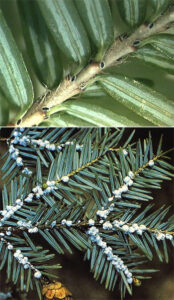
- Reddish brown crawlers hatch in late spring and remain present throughout the summer on branch terminals at the base of needles
- Crawlers are spread by wind, birds, animals, and humans
- Settled crawlers are black with a white fringe around their bodies
- Growing adelgids cover themselves in a woolly white wax
- Two generations per year
- Cause needles to turn grayish-green or yellow, and drop early, branch dieback, thinning crown, bud and shoot dieback, dieback of major limbs from the base of the trunk upwards
- Host plants: hemlock (Eastern and Carolina), spruce trees
Management:
Cultural Practices:
- Natural predators: Laricobius nigrinus beetle
- Avoid using nitrogen fertilizers
- Remove nearby birdfeeders, birds spread HWA
- Avoid pruning when eggs and crawlers are present
- Reduce plant stress
Materials:
- Contact insecticides:
- Pyrethroids [3]
- Carbamate [1A]: carbaryl
- Glycosides [6]: abamectin
- Systemic insecticides: (larvae only, ~June application):
- Neonicotinoids [4A]: imidacloprid, dinotefuran, acetamiprid
- Glycosides [6]: abamectin
- Considerations:
- Will harm non-target species
Biorationals:
- Horticultural oil
- Insecticidal soap
- Spray once before egg laying begins
- Another spray during summer after eggs hatch


Disclaimer – Materials do not cover all possible control scenarios and are intended for licensed professionals. Tradenames do not imply endorsement and are used as examples. You must strictly follow the label for each compound prior to use. Rutgers is not responsible form is used materials or damages thereof. The label is the law. Labels will provide detailed information on use and restrictions. Additionally, application intervals, compatibility, surfactant use, PHI, PPE, important and other key information is described in detail. Always discuss treatments with your local agents. Note: Neonicotinoids can only be legally applied in commercial agriculture settings by licensed applicators. Guidelines and recommendations made in this presentation are specific to the state of New Jersey.