
Maple Spider Mites (Acer rubrum)
GDD Window (base 50): variable
Overview:
- Overwinter in bark crevices as adults and eggs
- Some also seek refuge under dead armored scale insects
- Migrate to the underside of the leaves in the spring
- Adults are 0.25-1mm in length, multiple hairs along their back, and
- reddish brown in color
- Eggs are spherical, and red to clear in color
- Found in bark crevices, along leaf veins, or near branch buds
- Larvae have six legs, adults have eight
- Larvae and nymphs have lighter colorations or a green hue
- Have needle-like mouthparts that rupture plant cells
- Feeds on cell mesophyll
- Multiple years of damage can reduce plant vigor and growth
- Damage increases in hot weather
- 2-3 weeks to complete one generation, and many generations
- occur per season
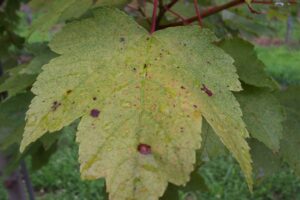
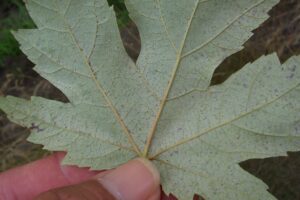
- Causes brown flecking or stippling of the foliage
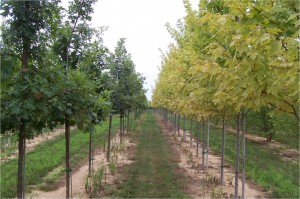
- Entire leaves can become yellow, silver, or bronzed
- Host plants: maple trees (Acer spp.), particularly red maples
- (Acer rubrum) and Freeman maples (Acer x freemanii)
Management:
Cultural Practices:
- Natural predators: lady beetles, thrips, predatory mites, lacewing larvae, minute pirate bugs
- Cultivate an environment that attracts natural predators
- Diverse flowers, water sources
- Scout in the spring
- Spider mites are small, slowly moving, brown or black dots
- Predatory mites are fast moving
- Scout on susceptible cultivars or trees that were the most damaged the previous year
- Reduce plant stress
- Proper planting, spacing, and water
- Avoid excessive nitrogen fertilization
- Do not spray carbaryl (aphrodisiac)
Materials:
- Contact insecticides:
- Pyrethroids [3]: –thrins
- Systemic insecticides:
- Avermectins [6]: abamectin
- Acephate (translaminar)
- Bifenazate [20D] (reduced risk)
- Acequinocyl [20B] (reduced risk)
- Considerations:
- May harm non-target species
Biorationals:
- Horticultural oils
- Insecticidal soaps
- Hexythiazox (MGR)
- Spiromesifen (MGR)
- Beauvaria bassiana
Resources:
Cool Season Mites Fade, As Warm Season Mites Surge
Disclaimer – Materials do not cover all possible control scenarios and are intended for licensed professionals. Tradenames do not imply endorsement and are used as examples. You must strictly follow the label for each compound prior to use. Rutgers is not responsible form is used materials or damages thereof. The label is the law. Labels will provide detailed information on use and restrictions. Additionally, application intervals, compatibility, surfactant use, PHI, PPE, important and other key information is described in detail. Always discuss treatments with your local agents. Note: Neonicotinoids can only be legally applied in commercial agriculture settings by licensed applicators. Guidelines and recommendations made in this presentation are specific to the state of New Jersey.