
Mimosa Webworm (Homadaula anisocentra)
GDD Window (base 50): 880-1200 (1st gen egg hatch), 1800-2100 (2nd gen egg hatch)
Overview:
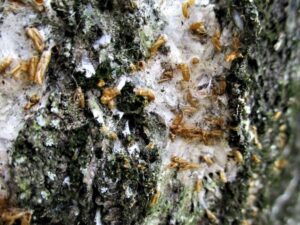
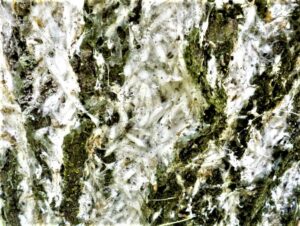
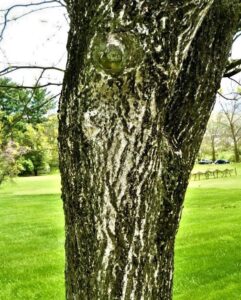
- Overwinters as pupae in cocoons, and within bark flaps and cracks of the trunk
- Cocoons are bright white and have the appearance of puffed rice, often occurring in masses
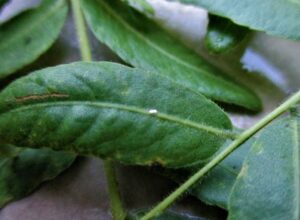
- Emerge as adults in June and lay small, pearly-white, oval-shaped eggs on leaflets or small twigs of honeylocust trees
- Adults are silver-gray moths and have black speckles, growing to 3/8” long, and are mostly nocturnal
- Early instar larvae feed by etching the undersides of leaflets, and begin as only 2mm long
- Mature caterpillars reach about ¾” long, and have a brownish body with five white stripes running along the length of their bodies
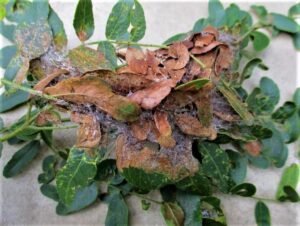
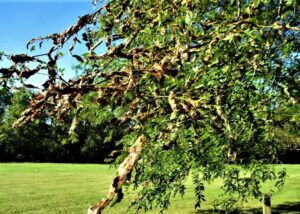
- They use webbing to bring leaflets together to create protective feeding areas. The webbing becomes larger and denser as the larvae grow.
- Mature first generation larvae will pupate within the webbing where they will emerge as adults
- The 1st generation does most of its feeding in July
- When 1st generation adults emerge, they will lay eggs within the previous webbing and the 2nd generation will expand the damage
- Webbings form at the outer edges of the leaf canopy, and can expand throughout the entire crown
- Late instars skeletonize leaves and eventually consume entire leaflets
- Feeding symptoms are more pronounced during the 2nd generation in August/September
- Cause leaf browning, and the tree may appear to be scorched by a fire
- Host plants: mimosa and honey locust trees
Management:
Cultural Practices:
- Natural predators: parasitoids, stink bugs, assassin bugs, green lacewings, birds, lizards
- Killed by cold temperatures, and urban environments can enhance survival
- Trees located along streets and paved areas will experience the highest populations
Materials:
- Contact insecticides:
- Spinosyns [5]: spinosad
- Pyrethroids [3A]: –thrins
- Carbamates [1A]: carbaryl
- Systemic insecticides:
- Diamides [28]: chlorantraniliprole
- Acephate (translaminar)
- Abamectin
- Considerations:
- Successful suppression of 1st generation will reduce the emergence of the 2nd generation
Biorationals:
- Bt [11] Bacillus thuringiensis
- Work best against young instars
- Spinosyns [5]: spinosad
- Azadiractin
- Diflubenzuron (IGR)
Management:
Mimosa Webworm Activity Begins – PPA
Landscape Pest Notes for Late June 2023 – PPA



Disclaimer – Materials do not cover all possible control scenarios and are intended for licensed professionals. Tradenames do not imply endorsement and are used as examples. You must strictly follow the label for each compound prior to use. Rutgers is not responsible form is used materials or damages thereof. The label is the law. Labels will provide detailed information on use and restrictions. Additionally, application intervals, compatibility, surfactant use, PHI, PPE, important and other key information is described in detail. Always discuss treatments with your local agents. Note: Neonicotinoids can only be legally applied in commercial agriculture settings by licensed applicators. Guidelines and recommendations made in this presentation are specific to the state of New Jersey.