
Red-headed flea beetle (Systena frontalis)
GDD Window (base 50): 242-600 (egg hatch) & 517-1028 (adults)
Overview:
- Overwinter as tiny, pale yellow, oval-shaped eggs
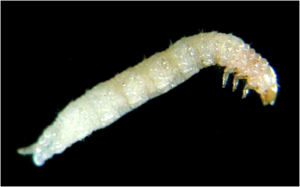
- Grubs hatch during the second half of May
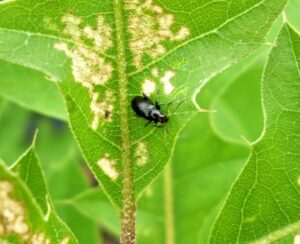
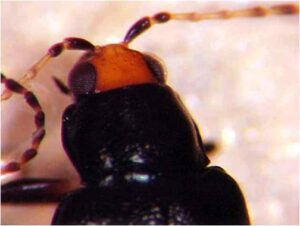
- Reddish head with shiny black thorax and abdomen
- Enlarged femur at the hind legs allows the beetle to “hop”
- 2-3 generations per season
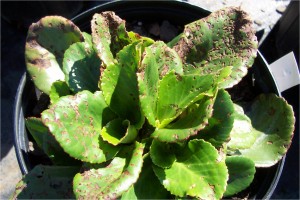
- Feeding on thinner leaves produces skeletonized symptoms or a shredded appearance
- On thicker leaves, feeding symptoms can mimic the light-colored leaf patterns seen from leaf miners
- Host plants: Extensive host range
- Itea, Weigela, Hydrangea, Rudbeckia, Salvia, Buddleia, Veronica, Coreopsis
- Corn, soybean, potatoes, cranberries, blueberries, smartweed, jewelweed, Joe-Pye weed
Management:
Cultural Practices:
- Natural predators: solider beetle larvae, lacewing larvae, big-eyed bugs, damsel bugs, beneficial nematodes, entomopathogenic fungi
- Avoid placing susceptible plants in the same area year after year
- Avoid placing new crop next to ‘hold-overs’ from previous season
- Systemic applications 3-4wk prior to1st generation adults is effective
- Please refer to this RHFB materials and timing chart. Refer to the link for material considerations at various life stages.
Materials:
- Contact insecticides:
- Pyrethroids [3]: –thrins
- Carbamates [1A]: carbaryl
- METI [21A]: Tolfenpyrad
- Systemic insecticides: (larvae only, ~June application):
- Translaminar systemics:
- Organophosphates [1B] – Acephate
- Diamides[28]: Cyclaniliprole, + Flonicamid [29]
- Systemics:
- Neonicotinoids [4A]: imidacloprid, dinotefuran
- Diamides [28] (see biorationals)
- Translaminar systemics:
- Considerations:
- Apply systemic 3-4wk prior to adult emergence (Adults = 517 GDD50)
- Knock-down contact insecticides will harm non-target species, and will require regular applications
Biorationals:
- Horticultural oil
- Insecticidal soaps
- Azadirachtin [UN] – larval treatments
- Diamides [28]:
- Cyantraniliprole
- Chlorantraniliprole

Disclaimer – Materials do not cover all possible control scenarios and are intended for licensed professionals. Tradenames do not imply endorsement and are used as examples. You must strictly follow the label for each compound prior to use. Rutgers is not responsible form is used materials or damages thereof. The label is the law. Labels will provide detailed information on use and restrictions. Additionally, application intervals, compatibility, surfactant use, PHI, PPE, important and other key information is described in detail. Always discuss treatments with your local agents. Note: Neonicotinoids can only be legally applied in commercial agriculture settings by licensed applicators. Guidelines and recommendations made in this presentation are specific to the state of New Jersey.