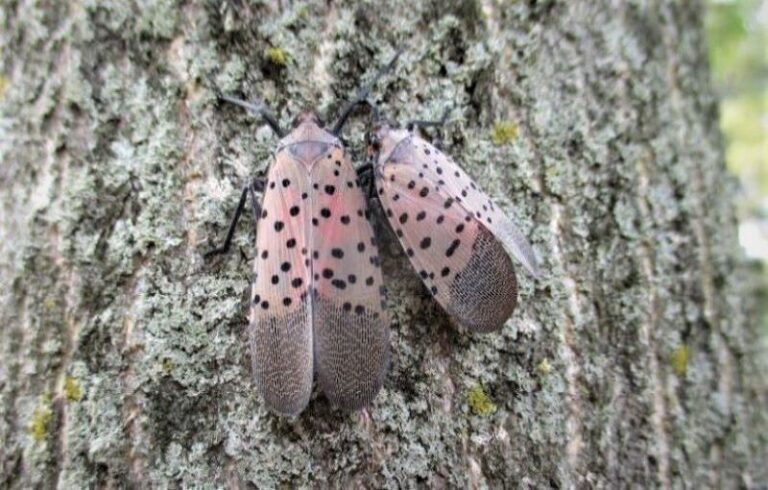
Spotted Lanternfly (Lycorma delicatula)
GDD Window (base 50): Adult emergence at 1100-1700
Overview:
- Overwinter as egg masses on smooth surfaces, looking like a patch of mud
- In mid-May, juveniles hatch from eggs and are black with white spots
- Nymphs grow and become red and black with white spots
- Nymphs mature into adults in July and August, with a black head, gray/black spotted forewings, and reddish black spotted hind wings
- Adults feed primarily on trunk and limbs of plants from August to October using sucking mouthparts
- Considered plant hoppers
- Excrete honeydew during feeding, which grows sooty mold
- Causes reduced photosynthesis and plant vigor, leaves may wilt or curl, sap may ooze from wounds
- Leads to reduced crop yield, branch die-off, weeping wounds (grayish black trails along the trunk)
- Host plants: Over 70 species (grapes, fruit trees, hardwood trees)
- Tree of Heaven is the main host
Management:
Cultural Practices:
- Natural predators: spined soldier bugs, Carolina and Chinese mantises, birds
- Crush nymphs and adults, or use a shop vacuum
- Syringing
- Pay attention to quarantines in your area
- Check your vehicles, tools, and plants before transplanting
Materials:
- Contact insecticides:
- Pyrethroids [3]: –thrins
- Carbamates [1A]: carbaryl
- Systemic insecticides:
- Neonicotinoids [4A]: imidacloprid, dinotefuran
- Considerations:
- Will harm non-target species
Biorationals:
- Tree of Heaven Trap Trees
-
- Bring in potted Tree of Heaven as a SLF trap tree by treating trees with dinotefuran [4A]
Photo via Steve Rettke, RCE -


Disclaimer – Materials do not cover all possible control scenarios and are intended for licensed professionals. Tradenames do not imply endorsement and are used as examples. You must strictly follow the label for each compound prior to use. Rutgers is not responsible form is used materials or damages thereof. The label is the law. Labels will provide detailed information on use and restrictions. Additionally, application intervals, compatibility, surfactant use, PHI, PPE, important and other key information is described in detail. Always discuss treatments with your local agents. Note: Neonicotinoids can only be legally applied in commercial agriculture settings by licensed applicators. Guidelines and recommendations made in this presentation are specific to the state of New Jersey.