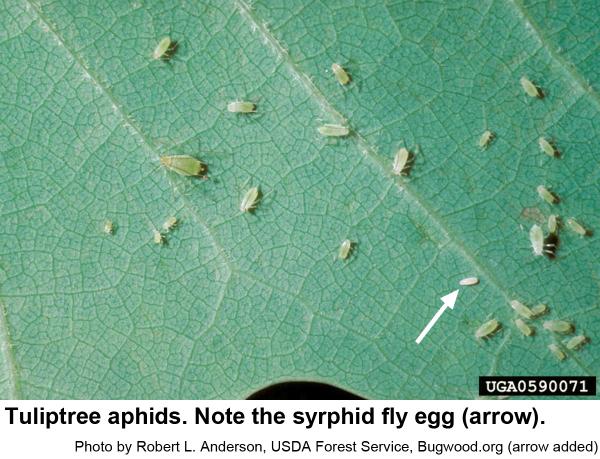
Tulip Tree Aphid (Illinoia liriodendri)
GDD Window (base 50): 1151-1514, 1917-2033
Overview:
- Wingless aphids are 1/8” long, spindle-shaped, and pale greenish-yellow or pinkish-red, with black antennae that are longer than the body
- Winged aphids have translucent wings, a green abdomen, and a reddish-brown thorax and head
- Females give birth to tiny, green aphids in the spring and summer months
- Feed on the underside of leaves
- Large populations lead to honeydew buildup
- Females lay overwintering eggs in cracks in the bark near buds
- Eggs hatch at bud break
- Causes distortion of buds and foliage
- Honeydew can grow sooty mold and attracts flies and wasps
- Host plants: tulip tree
Management:
Cultural Practices:
- Natural predators: lacewings, lady beetles, parasitic wasps, syrphid flies, Cephalosporium lecanii fungus
- Support beneficial insects
- Syringing
- Reduce plant stress
Materials:
- Contact insecticides:
- Pyrethroids [3A]
- Carbaryl [1A]
- Systemic Materials:
- Neonicotinoids [4A]: imidacloprid
- Organophosphates [1B]: acephate (translaminar), diazinon
- Abamectin [6]
- Considerations:
- Water the tree before spraying, spray early in the morning or in the evening
- Will harm non-target species
Biorationals:
- Insecticidal soaps (suppression)
- Horticultural oils
- Acetamiprid [4A] (spray only)
- Reduced risk neonicotinoid
- Pymetrozine [9B]
- Reduced risk (disrupts feeding behavior)

Disclaimer – Materials do not cover all possible control scenarios and are intended for licensed professionals. Tradenames do not imply endorsement and are used as examples. You must strictly follow the label for each compound prior to use. Rutgers is not responsible form is used materials or damages thereof. The label is the law. Labels will provide detailed information on use and restrictions. Additionally, application intervals, compatibility, surfactant use, PHI, PPE, important and other key information is described in detail. Always discuss treatments with your local agents. Note: Neonicotinoids can only be legally applied in commercial agriculture settings by licensed applicators. Guidelines and recommendations made in this presentation are specific to the state of New Jersey.