
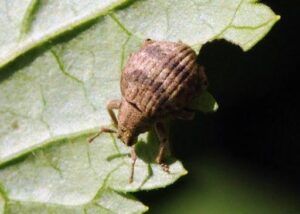
Two-Banded Japanese Weevil (Pseudocneorhinus bifasciatus)
GDD Window (base 50): 1644-2271 (adults)
Overview:
- Adults are 3/16” long, round, and brown to gray with two dark bands across the wing covers
- Wing covers have white stripes in the grooves, and white spots and two dark brown stripes towards the back. Wings are fused and flightless.
- Eggs are small, cream colored, and elongated, usually found within a folded blade of grass or leaf
- Larvae are white, legless, and ¼” long
- When eggs hatch, larvae burrow into the soil and feed on roots
- Will drop to the ground and remain motionless if disturbed
- Overwinters in leaf litter as adults and remains until summer
- One generation per year
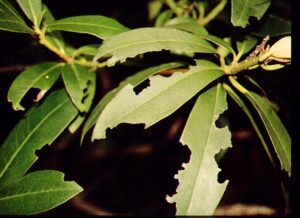
- Adults cause leaf notching damage on lower leaves in late July
- Notches deeper & closer to the leaf mid-rib, & feeds during the day
- Larvae feeding on roots causes stunted growth and decline in plant health
- Host plants: Shrubs – privet, azalea, rhododendron, mountain laurel,
euonymus, etc.
Management:
Cultural Practices:
- Natural predators: spiders, birds, parasitic fungi, nematodes
- Handpick and dispose of visible weevils
- Trap or monitor for adults by laying a white sheet under the shrub and shaking the branches
- Destroy trapped weevils by dropping them into soapy water or freezing them
Materials:
- Contact insecticides:
- Pyrethroids [3]: -thrins
- Systemic insecticides:
- Organophosphates [1B]: Acephate
- Neonicotinoids [4A]: Imidacloprid, acetamiprid
- Considerations:
- Resistant to carbaryl [1A]
- Will harm non-target species
Biorationals:
- Horticultural oil
- Neem oil
- Azadirachtin [UN]
- Acetamiprid [4A]
- Beauvaria bassiana
- Entomopathogenic nematodes
Resources:
Landscape Pest Notes for July 2023 – PPA
Disclaimer – Materials do not cover all possible control scenarios and are intended for licensed professionals. Tradenames do not imply endorsement and are used as examples. You must strictly follow the label for each compound prior to use. Rutgers is not responsible form is used materials or damages thereof. The label is the law. Labels will provide detailed information on use and restrictions. Additionally, application intervals, compatibility, surfactant use, PHI, PPE, important and other key information is described in detail. Always discuss treatments with your local agents. Note: Neonicotinoids can only be legally applied in commercial agriculture settings by licensed applicators. Guidelines and recommendations made in this presentation are specific to the state of New Jersey.