
Turning Policy into Progress: How New Jersey is Advancing Maternal and Infant Health
Nurture NJ is a statewide initiative to improve maternal and infant health, with a focus on reducing racial and ethnic disparities in health outcomes. This comprehensive initiative leverages policy, funding, and workforce investments to build a safe, high-quality system of care and facilitate supportive community services.
Under the leadership of Dr. Leslie M. Kantor, Professor and Chair of the Department of Urban-Global Public Health, a team of community and academic researchers partnered with the State of New Jersey to evaluate the initiative’s progress towards making New Jersey the safest and most equitable place to have and raise a baby.
Original Story in Rutgers Today Rutgers School of Public Health and the New Jersey Health Care Quality Institute examine the progress in implementing New Jersey’s ambitious maternal health policies A … Read More
Original Story in Rutgers Today Rutgers Health researchers evaluate the reach of Connecting NJ to the state’s most vulnerable from pregnancy through early childhood Targeted enhancements to Connecting NJ, … Read More
Original Story in Rutgers Today Rutgers Health researchers evaluate the early-stage implementation of Family Connects NJ and its role in advancing maternal and child health throughout the state Family … Read More
Dr. Slawa Rokicki, a member of the evaluation team, was interviewed by NJ Spotlight News on June 24, 2025 about the progress in reducing the low-risk Cesarean birth rate in New Jersey. The findings are part of the evaluation of Nurture NJ.
Explore and download each of the Nuture NJ Evaluation publications below.
Connecting NJ is New Jersey’s statewide maternal and child health referral system that simplifies the process of linking families to essential supports from pregnancy through early childhood. The Rutgers evaluation team assessed the state’s strategic efforts to expand the system’s reach and increase family participation. The analysis examines patterns in system usage and identifies opportunities to improve equity and strengthen linkages to local and state services. Click the “Download Report” button to learn more about the progress and performance of Connecting NJ.
Studies show that universal nurse home visiting improves maternal and infant health outcomes, including breastfeeding initiation and postpartum visit attendance. In 2021, New Jersey passed landmark legislation, becoming the second state to guarantee universal nurse home visits for families welcoming a new baby. Since then, Family Connects NJ—the state’s universal nurse home visiting program—has been rolled out county by county. The Rutgers Evaluation Team analyzed state data to assess the program’s reach and impact. Learn more by clicking the “Download Policy Brief” button below.
Access to perinatal health care providers is critical for supporting maternal health across pregnancy, labor and delivery, and postpartum. The Rutgers Evaluation team, in collaboration with the New Jersey Health Care Quality Institute, assessed the availability of maternity care services using data from the Leapfrog Group, a national nonprofit that collects and reports on hospital care metrics, and the New Jersey Department of Health’s hospital demographic data. Click on the “Download Report” button below to learn about what the analysis revealed.
Interviews with maternal and infant health leaders and stakeholders across the state suggested that Nurture NJ triggered broader, indirect ripple effects that shifted mindsets, encouraged professional collaboration and engagement, and built momentum for change. Understanding these indirect effects is essential for assessing the full scope of the initiative’s influence and for informing future policy proposals and investments. Read more about the effects of Nurture NJ on the New Jersey perinatal health landscape by clicking the “Download Brief Report” button below.
While Cesarean deliveries can be a necessary intervention, the procedure has significant health risks. New Jersey historically has had one of the highest rates of low-risk Cesarean births in the United States, however the state has implemented several policies aimed at reducing this rate and improving perinatal health outcomes. Read more about New Jersey’s progress in reducing the low-risk Cesarean birth rate by clicking on the “Download Policy Brief” button below.
Even before the formal launch of the Nurture NJ initiative, the state passed several legislative policies to improve maternal and infant health outcomes while reducing health disparities. The Rutgers evaluation team carefully reviewed the science underpinning these policies and found the majority are backed by strong or emerging scientific evidence. Click on the “Download Report” button below to learn more about New Jersey’s scientific approach to maternal and infant health policy making.
Access to paid family leave has been shown to positively impact perinatal health outcomes and ease economic stress on families particularly in marginalized groups. In 2019, New Jersey expanded Family Leave Insurance and Temporary Disability Insurance, giving families more paid leave benefits. Learn more about the effects of New Jersey’s paid leave expansion by clicking on the “Download Policy Brief” button below.
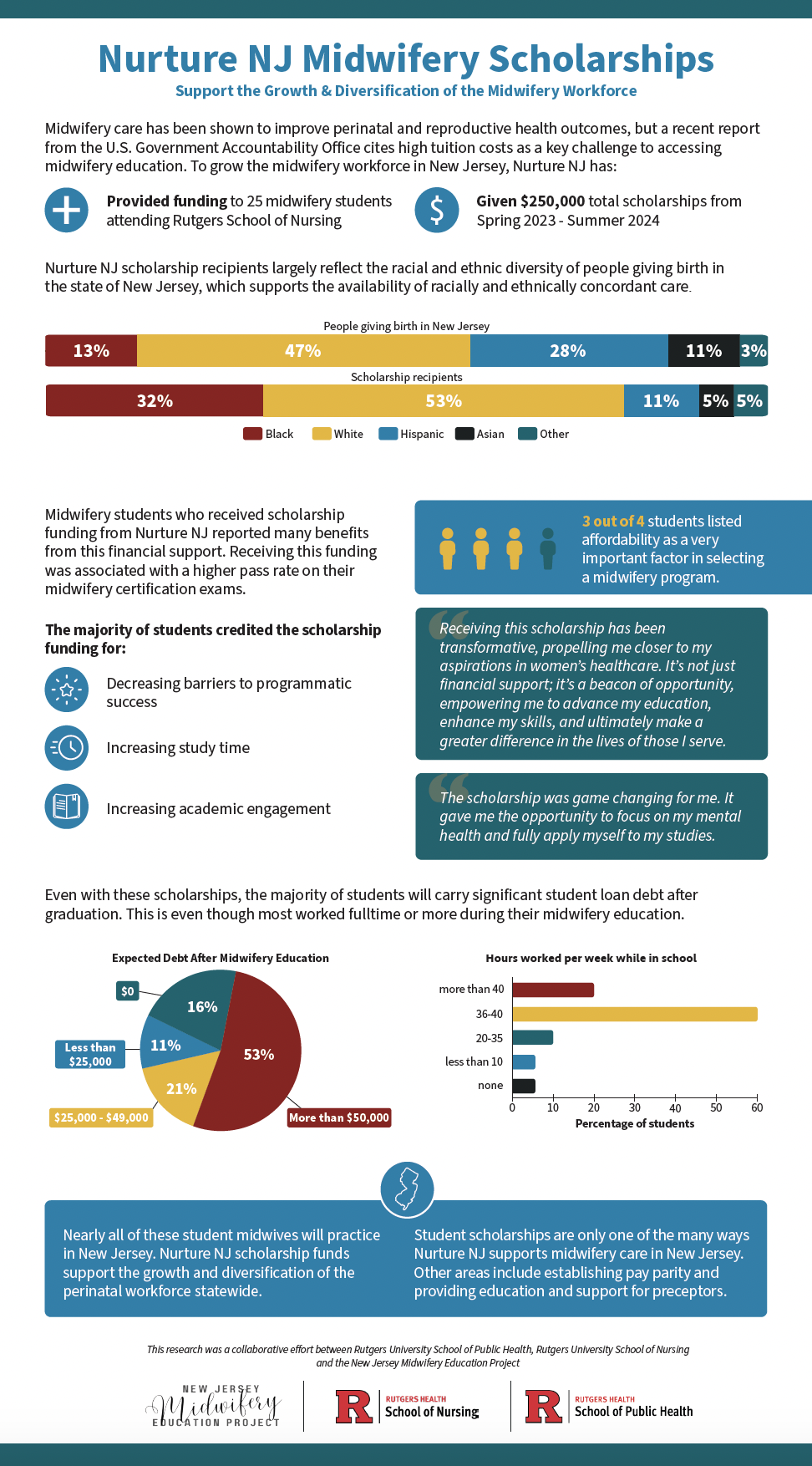
Midwifery care can improve perinatal and reproductive health outcomes, but high tuition costs are a key challenge to accessing midwifery education. To grow the midwifery workforce in New Jersey, Nurture NJ provided $250,000 in scholarships to midwifery students from spring 2023 to summer 2024. Learn about the impact of these scholarships on midwifery students in New Jersey by clicking on the “Download Infographic” button below.