Social Power
Social power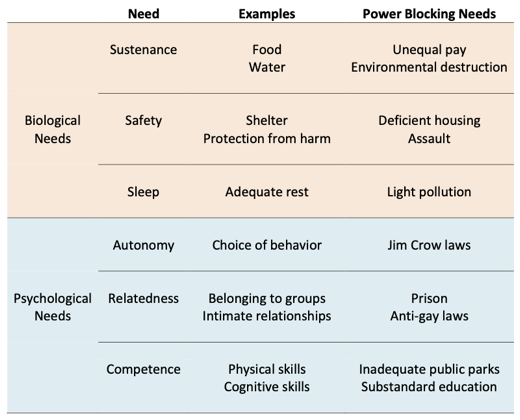 is the ability to influence another person’s outcome.
This influence could be harmful or beneficial to that person. Harmful social power is based in blocking a person from meeting a need (Pratto, 2016).
Human needs are requirements for surviving or thriving.
Survival (biological) needs include food, water, sleep, and shelter.
Thrival (psychological) needs include autonomy of behavior, social bonds, and competent skills (Deci & Ryan, 2000).
Group inequalities are an outcome of the abuse of social power.
To understand how different groups have different levels of social power it is useful to understand Ideologies.
An ideology is a socially shared belief of how things should be. Ideologies can create or can maintain social power differences between groups (Foels & Pratto, 2015).
Social power differences are maintained through ideologies that encourage tautological reasoning. This reasoning is circular. It starts with a mistaken belief, then uses the belief to reinforce itself. Rather than looking at evidence, tautology is looking at the outcome as if it was the cause of itself. If instead we looked at the cause that led to the outcome, we would see that racism is the cause of different outcomes for different racial groups. Ideologies that are not even about social groups, such as meritocracy, can still be used to hide or excuse racism (Foels & Pratto, 2015).
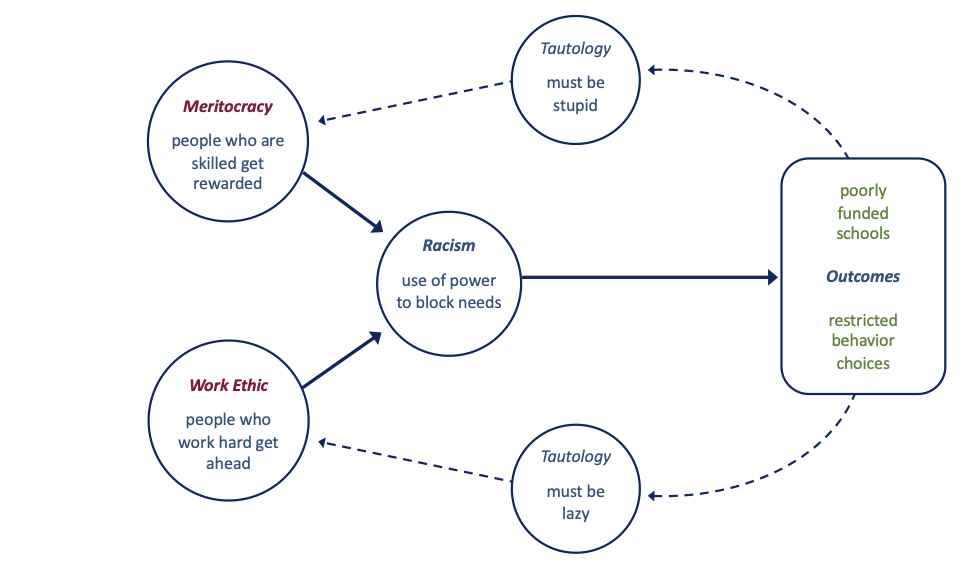
If a person has their freedom of autonomy blocked to a severe enough extent, they are then socially paralyzed from moving about the world. Tautologically other people can blame the group for their negative outcome, rather than the actual cause: laws and norms restrict certain groups from engaging in many behaviors. It is easier for a racist to judge a lack of movement as coming from laziness rather than restricted social movement.
If a person attends a poorly funded school then they are less likely to fully develop their cognitive skills. Tautologically other people can blame the group for their negative outcome, rather than focusing on the actual cause: a society that refuses to adequately fund education means that different groups have different levels of educational achievement. It is easier for a racist to judge a lack of education as coming from low intelligence rather than restricted educational opportunities.
Deci, E. L., & Ryan, R. M. (2000). The” what” and” why” of goal pursuits: Human needs and the self-determination of behavior. Psychological inquiry, 11(4), 227-268.
Foels, R., & Pratto, F. (2015). The hidden dynamics of discrimination: How ideologies organize power and influence intergroup relations. In M. Mikulincer, P. R. Shaver, J. F. Dovidio, & J. A. Simpson (Eds.), APA Handbook of Personality and Social Psychology: Volume 2. Group Processes (pp. 341-369). Washington, DC: American Psychological Association.
Pratto, F. (2016). On power and empowerment. British Journal of Social Psychology, 55(1), 1-20.