About Us
Welcome To The Schuster Lab!
The Schuster Lab has two main goals: to do great science, and to train great people.
We are a group of researchers from interdisciplinary backgrounds, including chemical engineering, bioengineering, biochemistry, and the biopharmaceutical industry. Our lab studies and engineers protein materials. We are particularly interested in biomolecular condensates, intrinsically disordered proteins, and the self-organization of proteins into mesoscale assemblies. We employ approaches from protein engineering, soft matter, biophysics, nanotechnology, synthetic biology, and quantitative microscopy.
Our interests span from fundamental biophysics, to disease processes and therapeutics, to biotechnology applications. These basic and applied research interests are intertwined: New fundamental insights into biomolecular condensates and protein assemblies inform their roles in health and disease. And by engineering these proteins, we can invent new technologies for biocatalysis, biomanufacturing, and biopharmaceuticals.
What We Do:
General Background

We study proteins that self-organize into nano- and micrometer sized assemblies. A major area of focus is intrinsically disordered proteins (IDPs), which are dynamic proteins that lack a stable three-dimensional structure. IDPs have many important functions in biology, including contributing to the formation of non-membrane-bound cellular compartments called biomolecular condensates. Furthermore, IDPs and biomolecular condensates hold promise as novel biomaterials for bioengineering applications.
Molecular Grammar of Protein Phase Separation, Aging, and Aggregation
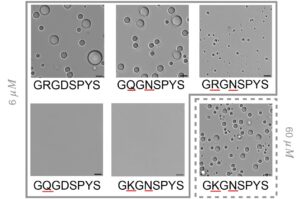
The traditional paradigm in protein science is that protein sequence determines structure, which in turn determines function. Intrinsically disordered proteins (IDPs) defy this paradigm because IDPs lack a stable three-dimensional structure. However, sequence still determines IDP biophysical properties and function. We seek to understand how the sequence of IDPs, and the associated molecular interactions, encode phase behavior, condensate material properties, and the propensity of condensates to undergo physical aging or aggregation.
Surfactant Proteins that Stabilize Biomolecular Condensates

Hierarchical biomolecular condensate structures are found in nature – how do they form, and how can we take inspiration from these complex assemblies to design new biomolecular materials? Towards that goal, we have sought to generate surfactant proteins that adsorb to the surface of biomolecular condensates. We have found that amphiphilic proteins can act as surfactants on condensates if the amphiphilic protein is comprised of two domains, where one domain strongly interacts with the condensate, while the second domain does not. These surfactant proteins reduce condensate interfacial tension and impact condensate size.
Linking Condensate Material Properties to Biological Function and Disease
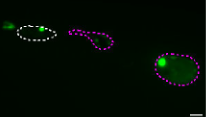
The rheological properties of biomolecular condensates are closely connected with their biological functions. Rheology is the science of how materials deform and flow. Rheological measurements reveal that different biomolecular condensates exhibit varied material properties, ranging from liquid to gel to a combination thereof. Importantly, condensate viscoelasticity may be altered and contribute to pathology in disease states. We are working to understand how sequence-encoded material properties relate to biological function. We have explored this question in several important and varied biological contexts, including viral infection and neuronal proteostasis mechanisms relevant to neurodegenerative disease.
Partitioning and Targeting Drugs to Biomolecular Condensates
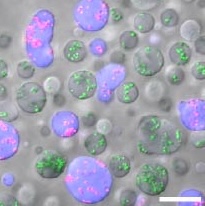
The emerging science of biomolecular condensates has fueled a new strategy for drug discovery: targeting biomolecular condensates involved in pathologies to cure diseases or halt their progression. Condensates may provide a therapeutic target for disease-related processes that have so far been considered undruggable. We seek to understand the biophysical determinants of drug partitioning into condensates and to engineer efficient targeting drugs to condensates.
Protein Technologies For Biomanufacturing
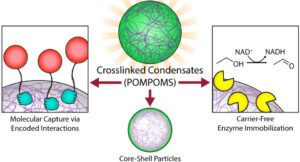
In the modern pharmaceutical industry, there is keen interest in replacing traditional catalytic reactions with in vitro enzyme-catalyzed reactions to synthesize medicinal compounds more sustainably, safely, and affordably. However, enzyme purification and stability are critical challenges that have hindered the implementation of pharmaceutical biocatalysis. Inspired by cells’ use of organelles to compartmentalize and regulate enzymatic reactions, we are working to develop enabling technologies for pharmaceutical biosynthesis by leveraging biomolecular condensates. The rationale is that these protein materials will allow facile enzyme purification and highly active immobilized enzyme systems.