National Fish and Wildlife Foundation ~ Implementing Green Stormwater Management Initiatives in the New Jersey Highlands
- Background
- Project Location
- Project Description
- Resources
- Project Deliverables
- Project Funding Source
Background:
The Highlands Water Protection and Planning Act is a law signed in August 2004 to preserve open space and protect the state’s greatest diversity of natural resources including the precious water resources that supply drinking water to more than half of New Jersey’s families. The Highlands Act documents the geographical boundary of the Highlands Region and establishes the Highlands Preservation Area and the Highlands Planning Area. The Highlands Act requires the New Jersey Department of Environmental Protection (NJDEP) to establish regulations in the Highlands Preservation Area to create a Highlands Water Protection and Planning Council and to develop a regional master plan for the entire Highlands Region.
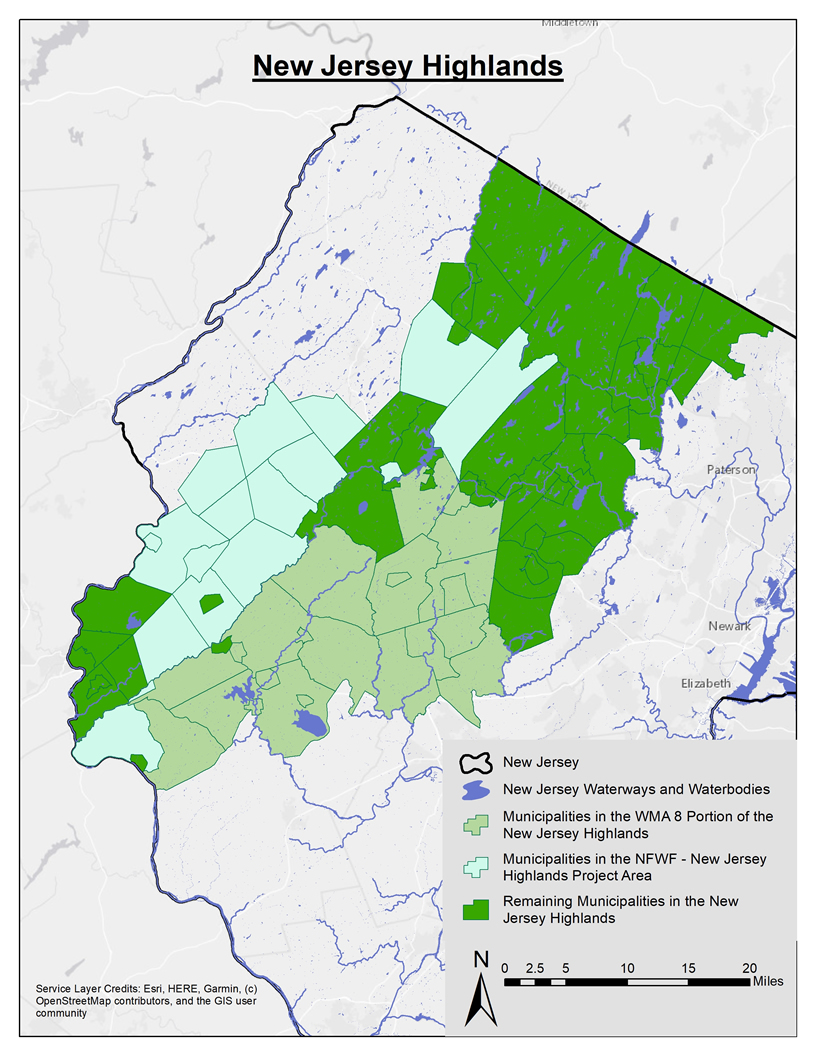
There are 37 municipalities in the New Jersey Highlands Preservation Area or Planning Area in the Delaware River Watershed. For Phase I of the Delaware River Watershed Initiative, the RCE Water Resources Program prepared impervious cover assessments (ICAs) and impervious cover reduction action plans (RAPs) for 14 of these 37 municipalities to provide communities with a blue print of green stormwater infrastructure projects that could be implemented to reduce stormwater runoff, improve water quality, and enhance wildlife habitat. These plans have led to strong community engagement and the implementation of several green stormwater infrastructure projects. The RCE Water Resources Program is currently partnering with the New Jersey Highlands Council to develop ICAs, RAPs, and green infrastructure feasibility studies for municipalities that are completely or partially in the Raritan River Watershed. Since these studies are conducted at the municipal level, six municipalities in the Raritan River Watershed also have portions of their territory in the Delaware River Watershed. This leaves 17 municipalities in the New Jersey Highlands that are also in the Delaware River Watershed that still need ICAs, RAPs, and green infrastructure studies.
An ICA will be completed for each of the 17 municipalities. Five of these 17 municipalities will be selected for the development of RAPs and green infrastructure feasibility studies. Engineering designs will be prepared for five projects within the municipalities that have plans or will have plans, and these projects will be implemented. All projects will be designed to create and improve wildlife habitat as well as provide stormwater management to reduce flooding and improve water quality.
Project Location:
Project Description:
Task 1 – Prepare impervious cover assessments (ICAs)
The RCE Water Resources Program will prepare ICAs for the remaining 17 municipalities in the New Jersey Highlands portion of the Delaware River Watershed.
Task 2 – Prepare impervious cover reduction action plans (RAPs)
Using the data gained from the ICA, the RCE Water Resources Program will develop a RAP for five of the 17 remaining municipalities. The sites from the RAP will be incorporated into a web-based interface (i.e., RAP web map) so the general public can easily access the recommendations.
Task 3 – Create green infrastructure feasibility studies
The RCE Water Resources Program will prepare a green infrastructure feasibility study for the five municipalities that have been identified for RAP development in Task 2.
Task 4 – Wildlife habitat enhancement green infrastructure design and implementation
Upon the conclusion of Tasks 1, 2 and 3, all 37 municipalities will have ICAs and 25 municipalities will have RAPs and green infrastructure feasibility studies. Engineering designs will be completed for five wildlife habitat enhancement green infrastructure projects taken from these plans. Each of the five projects will be constructed, and maintenance plans will be developed for each project.
Resources:
Highlands Region Map and Quick Facts (11×17 pdf; New Jersey Highlands Council)
Access the Green Infrastructure Guidance Manual for New Jersey.
Project Deliverables:
Task 1, Task 2, Task 3: Links are provided below to the impervious cover assessments (ICA), impervious cover reduction action plans (RAP), and feasibility studies completed as part of this project.
Hunterdon County
Bloomsbury Borough
Holland Township
Morris County
Jefferson Township
Sussex County
Stanhope Borough
Warren County
Task 4:
Five wildlife habitat enhancement green infrastructure projects were designed and installed as part of Task 4.
Photo Presentation:
Wildlife Habitat Enhancement Green Infrastructure Project Design and Installations (pdf)
As-Built Designs & Maintenance Plans:
1. Pope John High School Naturalized Detention Basin Implementation Project 28 Andover Road, Sparta Township, Sussex County, NJ
2. Belvidere Elementary School Rain Garden Implementation Project 807 Oxford Street, Belvidere, Warren County, NJ
3. Hackettstown High School Bioretention System Implementation Project 599 Warren Street, Hackettstown, Warren County, NJ
4. Hackettstown Middle School Rain Garden Implementation Project 500 Washington Street, Hackettstown, Warren County, NJ
5. Hope Elementary School Rain Garden Implementation Project 320 Johansonburg Road, Hope Township, Warren County, NJ
Newsletter Articles about the Five Projects:
Project Funding Source:

NFWF Grant ID 0403.19.065576