Community Based Projects & Research
South Asian Youth Mental Health Project (2022–Ongoing)
A Culture-Centered Approach to Assessing the Mental Health Needs of Adolescents and Young Adults of South Asian Descent
This community-engaged project aims to develop and implement a community-driven intervention that addresses the mental health concerns of adolescents and young adults (AYAs) of South Asian (SA) descent who face unique mental health challenges including the stress of acculturation, mental health stigmatization, expectations to be model students, and underutilization of mental health services. We adopt a Culture-Centered Approach and utilize concept mapping to represent SA AYA voices and cultural experiences, to identify distinctive challenges, and implement community-generated solutions. Investigating mental health challenges and community driven solutions is crucial for understanding their challengesthat are often overlooked when only commonly-accepted measures are employed.
Project Team: Lisa Mikesell, Usha Ramachandran, Nandini Moorthy, Varsha Singh, Sunanda Gaur
Cultural Competence Trainings (2013–Ongoing)
Cultural competence in healthcare is the method by which healthcare systems can show cultural sensitivity toward patients with different cultural faith, values, beliefs, and behaviors. SATHI offers workshops for healthcare professionals emphasizing awareness of South Asian cultural and health related beliefs. The sessions are conducted using interactive case studies.
SATHI-SEHAT Project (2017-2018)
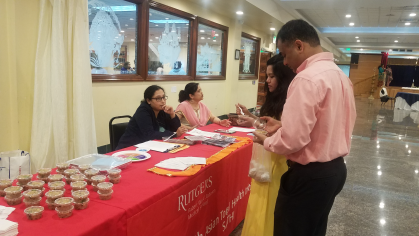
The SATHI-SEHAT initiative was an evidence-based nutrition and lifestyle education program focused on making transformational changes in the health status of those who attend temple based devotional and community health events. Under the umbrella of SATHI-SEHAT, we engaged with local Hindu temples that are the home of spiritual health and fitness to become active centers for information on improving healthy food choices and physical activity.
Project Team: Sunanda Gaur, Shailja Mathur, Bishakha Ghoshal, Varsha Singh, Manisha Bajpai, Vanessa Rios
Latent Tuberculosis Project (2017-2019)
SATHI collaborated with the Children’s Hospital at Saint Peter’s University Hospital (SPUH), the Middlesex Department of Health (DOH) and the Rutgers Global Tuberculosis Institute (RGTI) on a Latent Tuberculosis project. This project had two main objectives. Firstly, to educate the lay South Asian community living in Middlesex, Mercer and Somerset counties on the importance of screening and treating Latent Tuberculosis infection (LTBI). Secondly to educate primary care physicians regarding risks of TB in the South Asian community and the need for TB testing to diagnose and treat LTBI. The first phase of this project which was a community survey regarding TB knowledge and attitudes regarding testing and treatment of LTBI, completed in 2018. Second phase was the development and implementation an educational intervention to improve TB testing rates in this community.
Project Team: Sabah Kalyoussef, Sunanda Gaur, Kristina Feja, Amisha Malhotra, Navaneeth Narayanan, Bishakha Ghoshal, Nupur Gulati, Rajita Bhavaraju, Arpita Jindani, Marybeth Caruso
Publications:
- J Community Health. 2018 Dec 17. PMID: 30560311
- Open Forum Infect Dis. 2019 Oct; 6 (Suppl 2): S499–S500
IDO Project (2013-2016)
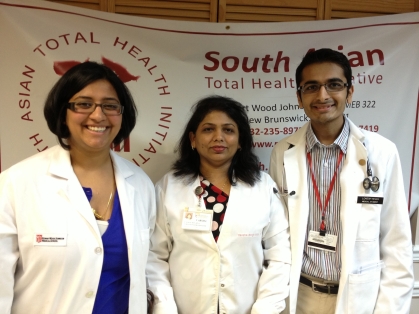
In the Infectious Disease Outreach (IDO) Project, SATHI conducted a brief survey on the knowledge and attitudes of South Asians towards HIV/AIDS. HIV testing rates among South Asians, both nationally and in NJ, remain much lower than expected based on demographic figures. Early diagnosis of HIV through routine testing is the best strategy to achieve optimal outcomes for HIV infected individuals.
Sneha Jacob, a faculty member at Rutgers and director of the HIV program at the Eric B. Chandler Health Clinic in New Brunswick, led the study. The study consisted of two surveys: one for South Asian community members and the other for health care providers of South Asian origin. The surveys were conducted at various South Asian health fairs in NJ and South Asian cultural events as well.
Project Team: Sunanda Gaur, Sunpreet Singh, Shreedevi Shukla, Devangi Shukla, medical students from the American Association of Physicians of India chapter
CHALO Project (2016-2022)
SATHI worked with the Albert Einstein College of Medicine on the CHALO project, which has been funded by the NIH-NIMHHD. CHALO (Child Health Action to Lower Obesity and Oral Health risk) was a multi-level strategy aimed at reducing pediatric obesity and dental caries risk in South Asian (SA) children. Although SA children are at high risk for both obesity and dental caries, there has been very little research in this population. CHALO aims to address that need. It involved three steps: a mixed methods descriptive study of SA child health risks, a randomized controlled trial (RCT) of an educational program aimed at reducing risk behavior, and a knowledge translation project which will share data from the descriptive and RCT arms of the project with the SA community, health professionals and other stakeholders in order to raise awareness regarding risks for obesity and caries in SA children.
Project Team: Usha Ramachandran, Allison Karasz,Sunanda Gaur, Bishakha Ghoshal
Publication: Clin Pediatr (Phila). 2022;99228221143306. doi:10.1177/00099228221143306 PMID: 36482667
Project SAHAS (2013-2018)
A culturally tailored stroke prevention program for South Asian communities funded by the New Jersey Office of Minority and Multicultural Health. SATHI developed and implemented Project SAHAS (South Asian Health Awareness about Stroke) for the South Asian community residing in Central New Jersey. Stroke prevention education was conducted in settings that were easily accessible to the South Asian community. The curriculum was delivered in the two most commonly spoken languages, Hindi and Gujarati. Based on the results of the project, a revised curriculum was developed and named SAHAS (South Asian Health Awareness about Stroke). In this five-year long project, which was completed in June 2018, we enrolled over 500 participants. In addition, we developed a “Stroke Talker” program in which Rutgers University students were trained to become “stroke talkers” to continue to spread the message of stroke prevention and early action within the South Asian community.
Project Team: Varsha Singh, Shailja Mathur, Bishakha Ghoshal, Sunanda Gaur
Publication: Journal of Immigrant and Minority Health. August 2020. PMID: 32813225 DOI: 10.1007/s10903-020-01071-w
Global Crossroads (2013-2017)
Seminars on South Asian Culture, Ecology and Health
The Global Crossroads Seminar Series was established in 2013. These yearly seminars organized by SATHI serve as a medium to bring together researchers, public health professional, medical professional, and the community to discuss the most pressing health issues facing South Asian community living in the US.
Seminars:
- Identity, Culture and Cardiovascular Disease Prevention in the South Asian Diaspora, November 4, 2013. Speaker: Namratha Kandula
- What is Health, What is Illness? Global and Local Forms of World-Making, April 14, 2014. Speaker: Veena Das
- Stroke in Minority Communities: Partnership for Prevention, April 23, 2014. Speakers: James McKinney, Gaurav Gupta, and Varsha Singh
- Improving Mental Health in South Asian Communities: Interfacing Global and Local Approaches, April 1, 2015. Speaker: Alison Karasz
- H.E.A.L.: Holistic Care and Empowerment of Youth & Adults with Lupus, April 19, 2016. Speaker: L. Nandini Moorthy
- Breaking Barriers: Raising HIV Awareness in South Asian Community, April 11, 2017. Speaker: Sneha Jacob