Publications
Guide to my Publications
My Books
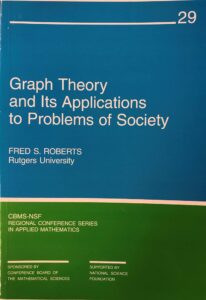
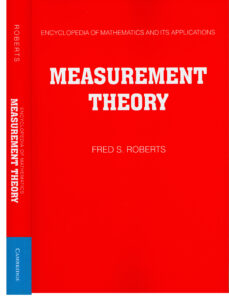
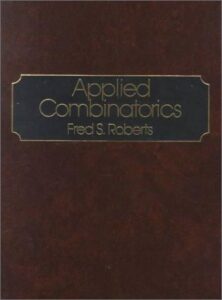
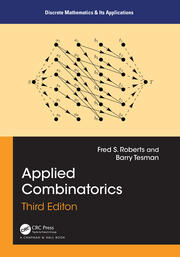
My first book, Discrete Mathematical Models, with Applications to Social, Biological, and Environmental Problems (1976), has been called a classic in the field, and was translated into Russian in 1986. It reflected my early interests in applications of mathematics to the social sciences, to environmental problems, and to biology – all interests that have continued throughout my career. My second book, Graph Theory and its Applications to Problems of Society (1978), continued the emphasis on the uses of mathematics to address critical problems facing our planet. Measurement Theory, with Applications to Decisionmaking, Utility, and the Social Sciences (1979) was solicited by Gian-Carlo Rota for the series Encyclopedia of Mathematics and its Applications. It arose from my interests in mathematical psychology, and in particular the foundations of measurement in areas such as preference, utility, and noise. This book, widely considered the most readable introduction to the theory of measurement, was republished in 2009. Applied Combinatorics, originally published in 1984, explores graph theory, counting, combinatorial designs, combinatorial optimization, and other topics. It has been updated, rewritten, and expanded several times, in 2004, 2009, and 2024, with my former PhD student Barry Tesman as co-author. It is unique among combinatorics books in its emphasis on modern applications and its extensive connection to the research literature. Applied Combinatorics has also been translated into Chinese.
My Edited Books
I am also the editor of 26 books covering such topics as energy modeling, reliability of networks, psychophysics, mathematical support for molecular biology, bioconsensus, intelligence and security informatics, preference and choice, algorithmic decision theory, mathematical challenges for sustainability, discrete mathematics in the schools, and biomathematics in the schools. My recent edited (co-edited) books include the first book on maritime cyber security, Issues in Maritime Cyber Security (2017), that helped jump-start an entire subdiscipline; a book on Mathematics of Planet Earth (2019) resulting from a major worldwide initiative on this topic; a book on Resilience in the Digital Age (2021) arising from my service on the Scientific Advisory Committee of IIASA (the International Institute for Applied Systems Analysis) and resulting from a collaboration with Igor Sheremet, a Russian representative to that Advisory Committee; and a book Mathematics for Action: Supporting Science-based Decision-making (2022) published by UNESCO and subsequently translated into both French and Vietnamese.
Books Authored
| 1. | F.S. Roberts, Discrete Mathematical Models, with Applications to Social, Biological and Environmental Problems, Prentice-Hall, Englewood Cliffs, NJ, 1976.
|
| 1a. | Russian translation of #1, Nauka, Moscow, 1986.
|
| 2. | F.S. Roberts, Graph Theory and its Applications to the Problems of Society, NSF-CBMS Monograph #29, SIAM Publications, Philadelphia, 1978.
|
| 3. | F.S. Roberts, Measurement Theory, with Applications to Decisionmaking, Utility, and the Social Sciences, Addison Wesley, Reading, MA, 1979. (Book in the Encyclopedia of Mathematics and its Applications series.)
|
| 3a. | Digital printing, Cambridge University Press, 2009.
|
| 4. | F.S. Roberts, Applied Combinatorics, Prentice Hall, Englewood Cliffs, NJ, 1984.
|
| 5. | F.S. Roberts and B. Tesman, Applied Combinatorics, Second Edition, Pearson Prentice Hall, Upper Saddle River, NJ, 2004.
Click here for book website, including table of contents and ANSWERS TO SELECTED EXERCISES.
|
| 5a. | New edition, 2009: Chapman&Hall/CRC, an imprint of Taylor&Francis, including added section with answers to selected exercises, 860 pages.
|
| 5b. | Chinese paperback edition (in English), Pearson Education Asia, 2005.
|
| 5c. | Simplified Chinese edition (in Chinese), Pearson Education Asia and China Machine Press, 2007. |
| 6. | F.S. Roberts and B. Tesman, Applied Combinatorics, Third Edition, Chapman & Hall/CRC, an imprint of Taylor & Francis, 2024.
|






Books Edited
For the DIMACS Volumes, click on the URL below the listing for the Preface and Table of Contents.
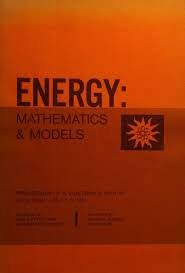
| 1. | F.S. Roberts (ed.), Energy: Mathematics and Models, SIAM Publications, Philadelphia, 1976.
|
| 2. | F.S. Roberts (ed.), Energy Modeling and Net Energy Analysis, Inst. of Gas Technology, Chicago, 1979. |
| 3. | F.S. Roberts (ed.), Energy Modelling II: The Interface Between Model Builder and Decision Maker, Inst. of Gas Technology, Chicago, 1980. |
| 4. | F.S. Roberts (ed.), Energy Modelling III: Dealing with Energy Uncertainty, Inst. of Gas Technology, Chicago, 1981. |
| 5. | F.S. Roberts (ed.), Energy Modelling IV: Planning for Energy Disruptions, Inst. of Gas Technology, Chicago, 1982. |
| 6. | W.F. Lucas, F.S. Roberts, and R.M. Thrall (eds.), Discrete and System Models, Springer-Verlag, NY, 1983.
|
| 6a. | Chinese translation of #6, National University of Defense Technology, University Press, Changsha, Hunan, People’s Republic of China, 1997. |
| 7. | R.D. Ringeisen and F.S. Roberts (eds.), Applications of Discrete Mathematics, SIAM, Philadelphia, 1988. |
| 8. | F.S. Roberts (ed.), Applications of Combinatorics and Graph Theory in the Biological and Social Sciences, Vol. 17 of IMA Volumes in Mathematics and its Applications, Springer-Verlag, New York, 1989.
|
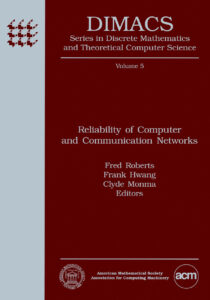
| 9. | F. Hwang, C. Monma, and F.S. Roberts (eds.), Reliability of Computer and Communication Networks, DIMACS Series, Volume 5, American Mathematical Society and Association of Computing Machinery, Providence, RI, 1991.
|
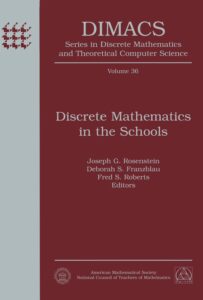
| 10. | J. Rosenstein, D. Franzblau, and F.S. Roberts (eds.), Discrete Mathematics in the Schools, DIMACS Series, Volume 36, American Mathematical Society, Providence, RI, 1997. (Co-published by National Council of Teachers of Mathematics.)
|
| 11. | B. Mirkin, F.R. McMorris, A. Rzhetsky, and F.S. Roberts (eds.), Mathematical Hierarchies and Biology, DIMACS Series, Volume 37, American Mathematical Society, Providence, RI, 1997.
|
| 12. | C.E. Dowling, F.S. Roberts, and P. Theuns (eds.), Recent Trends in Mathematical Psychology: Psychophysics, Knowledge Representation, Cognition, and Measurement, Lawrence Erlbaum Associates, Mahwah, NJ, 1998. |
| 13. | M. Farach, F.S. Roberts, M. Vingron, and M. Waterman (eds.), Mathematical Support for Molecular Biology, DIMACS Series, Volume 47, American Mathematical Society, Providence, RI, 1999.
|
| 14. | R.L. Graham, J. Kratochvil, J. Nesetril, and F.S. Roberts (eds.), Contemporary Trends in Discrete Mathematics, DIMACS Series, Volume 49, American Mathematical Society, Providence, RI, 1999.
|
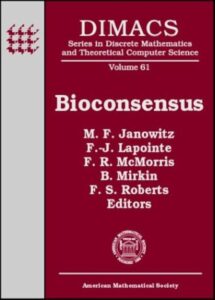
| 15. | M. F. Janowitz, F.-J. Lapointe, F. R. McMorris, and F.S. Roberts (eds.), Bioconsensus, DIMACS Series, Volume 61, American Mathematical Society, Providence, RI, 2003.
|
| 16. | P. Kantor, G. Muresan, F. Roberts, D.D. Zeng, F-Y. Wang, H. Chen, and R.C. Merkle (eds.), Intelligence and Security Informatics (Proceedings of the IEEE International Conference ISI 2005), Lecture Notes in Computer Science LNCS 3495, Springer Verlag, Berlin and Heidelberg, 2005.
|
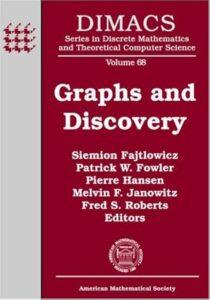
| 17. | S. Fajtlowicz, P.W. Fowler, P. Hansen, M.F. Janowitz, and F.S. Roberts (eds.), Graphs and Discovery, DIMACS Volume Series, Volume 69, American Mathematical Society, Providence, RI, 2005.
|
| 18. | S. Brams, W.V. Gehrlein, and F.S. Roberts (eds.), The Mathematics of Preference, Choice and Order: Essays in Honor of Peter C. Fishburn, Springer-Verlag, 2009.
|
| 19. | M. Cozzens and F.S. Roberts (eds.), Bio-Math in the Schools, DIMACS Volume Series, American Mathematical Society, Providence, RI, Vol. 76, 2011.
|
| 20. | Mathematical and Statistical Challenges for Sustainability, M. Cozzens and F.S. Roberts (eds.), American Mathematical Society, Providence, RI, 2011. |
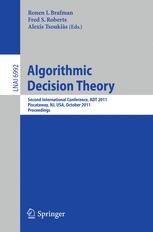
| 21. | R.I. Brafman, F.S. Roberts, and A. Tsoukias (eds.), Algorithmic Decision Theory, Lectures Notes in Artificial Intelligence, Springer-Verlag, Berlin/Heidelberg, 2011, Volume LNAI 6992.
|
| 22. | C. Biddle, M. Cozzens, and F.S. Roberts (eds.), Homeland Security Achievements at CCICADA, in preparation. |
| 23. | J. DiRenzo, N. Drumhiller, and F.S. Roberts (eds.), Issues in Maritime Cyber Security, PSO/Westphalia Press, 2017.
|
| 24. | H. Kaper and F.S. Roberts (eds.), Mathematics of Planet Earth: Protecting Our Planet, Learning from the Past, Safeguarding for the Future, Springer, 2019.
|
| 25. | F.S. Roberts and I. Sheremet (eds.), Resilience in the Digital Age, Springer, 2021.
|
| 26. | J-S. Dhersin, H. Kaper, W. Ndifon, F. Roberts, C. Rousseau, and G.M. Ziegler (eds.), Mathematics for Action: Supporting Science-based Decision-making, UNESCO, 2022. (French translation 2023) (Vietnamese translation 2023)
|













Book Reviews
| 1. | F.S. Roberts, Review of Anatol Rapoport: Mathematical Models in the Social and Behavioral Sciences, Contemporary Psychology, 29 (1984), 990. |
Obituaries
Where indicated in blue, these articles are available for reading or download.
| 1. | H. Brezis, R.D. Nussbaum, A. Cohen, J. Mawhin, R. Temam, R. Beals, L. Nirenberg, H. , B. Mastrian, J. Lebowitz, S. Chanillo, F. Roberts, J. Bona, Felix Browder (1927-2016), Notices of the American Mathematical Society, 65 (2018), 1398-1411. |
| http://dx.doi.org/10.1090/noti1757 | |
| 2. | S.J. Brams, W.V., Gehrlein, and F.S. Roberts, Peter C. Fishburn (1936-2021), Soc Choice Welf, 57 (2021), 1-3. |
| https://doi.org/10.1007/s00355-021-01354-7 (reviews Fishburn’s papers published in Social Choice and Welfare) | |
| 3. | S.J. Brams, W.V., Gehrlein, and F.S. Roberts, Obituary: Peter C. Fishburn (1936-2021), Discrete Applied Mathematics, 310 (2022), 109-110. |
| https://doi.org/10.1016/j.dam.2021.10.002 (reviews Fishburn’s papers published in Discrete Applied Math) | |
| 4. | S.J. Brams, W.V., Gehrlein, and F.S. Roberts, Peter C. Fishburn (1936-2021), Mathematical Social Sciences, 113 (2021), 230-231. |
| https://doi.org/10.1016/j.mathsocsci.2021.08.001 (reviews Fishburn’s papers published in Mathematical Social Sciences) |
Articles
Where indicated in blue, these articles are available for reading or download, either in manuscript form or as preprints in the DIMACS Technical Report Series. CAVEAT: In most cases, the final journal version has been updated from the technical report version.
| 1. | F.S. Roberts and P. Suppes, Some problems in the geometry of visual perception, Synthese, 17 (1967), 173-201. https://doi.org/10.1007/BF00485026 |
| 2. | F.S. Roberts and R.D. Luce, Axiomatic thermodynamics and extensive measurement, Synthese, 18 (1968), 311-326. https://doi.org/10.1007/BF00484975 |
| 3. | F.S. Roberts, Indifference graphs, in F. Harary (ed.), Proof Techniques in Graph Theory, Academic Press, NY, 1969, 139-146. |
| 4. | F.S. Roberts, On the boxicity and cubicity of a graph, in W.T. Tutte (ed.), Recent Progress in Combinatorics, Academic Press, NY, 1969, 301-310. |
| 5. | F.S. Roberts and J.H. Spencer, A characterization of clique graphs, in R. Guy, H. Hanani, N. Sauer, and J. Schonheim (eds.), Combinatorial Structures and Their Applications, Gordon and Breach, NY, 1970, 367-368. |
| 6. | K.A. Baker, P.C. Fishburn, and F.S. Roberts, A new characterization of partial orders of dimension two, Annals of NY Acad. of Sci., 175 (1970), 23-24. |
| 7. | W.F. Ogden and F.S. Roberts, Intersection graphs of families of convex sets with distinguished points, in R. Guy, H. Hanani, N. Sauer, and J. Schonheim (eds.), Combinatorial Structures and Their Applications, Gordon and Breach, NY, 1970, 311-313. |
| 8. | F.S. Roberts, On nontransitive indifference, Jour. of Math. Psychology, 7 (1970), 243-258. https://doi.org/10.1016/0022-2496(70)90047-7 |
| 9. | F.S. Roberts and J.H. Spencer, A characterization of clique graphs, Jour. of Comb. Theory, 10B (1971), 102-108 (an expanded version of #5). https://doi.org/10.1016/0095-8956(71)90070-0 |
| 10. | F.S. Roberts, Homogeneous families of semiorders and the theory of probabilistic consistency, Jour. of Math. Psychology, 8 (1971), 248-263. https://doi.org/10.1016/0022-2496(71)90016-2 |
| 11. | F.S. Roberts, On the compatibility between a graph and a simple order, Jour. of Combinatorial Theory, 11 (1971), 28-38. https://doi.org/10.1016/0095-8956(71)90010-4 |
| 12. | F.S. Roberts, Signed digraphs and the growing demand for energy, Environment and Planning, 3 (1971), 395-410. https://doi.org/10.1068/a030395 |
| 13. | F.S. Roberts, Noise pollution: The unseen problem, Coast Environment, 1 (1971), 13-15. |
| 14. | R.Z. Norman and F.S. Roberts, A derivation of a measure of relative balance for signed digraphs and a characterization of extensive ratio systems, Jour. of Math. Psychology, 9 (1972), 66-91. https://doi.org/10.1016/0022-2496(72)90006-5 |
| 15. | R.Z. Norman and F.S. Roberts, A measure of relative balance for social structures, in J. Berger, M. Zelditch, and B. Anderson (eds.), Structural Theories in Progress, II, Houghton-Mifflin, NY, 1972, 358-391. https://doi.org/10.1016/0022-2496(72)90006-5 |
| 16. | K.A. Baker, P.C. Fishburn, and F.S. Roberts, Partial orders of dimension 2, Networks, 2 (1972), 11-28. https://doi.org/10.1002/net.3230020103 |
| 17. | F.S. Roberts, What if utility functions do not exist?, Theory and Decision, 3 (1972), 126-139. https://doi.org/10.1007/BF00141052 |
| 18. | F.S. Roberts, A note on Fine’s axioms for qualitative probability, Annals of Probability, 1 (1973), 484-487. https://doi.org/10.1214/aop/1176996942 |
| 19. | F.S. Roberts, Building and analyzing an energy demand signed digraph, Environment and Planning, 5 (1973), 199-221. https://doi.org/10.1068/a050199 |
| 20. | F.S. Roberts, Tolerance geometry, Notre Dame Jour. of Formal Logic, 14 (1973), 68-76. https://doi.org/10.1305/ndjfl/1093890809 |
| 21. | F.S. Roberts, Laws of exchange and their applications, SIAM Jour. of Applied Math.,, 26 (1974), 260-284. https://doi.org/10.1137/0126023 |
| 22. | F.S. Roberts, Structural characterizations of stability of signed digraphs under pulse processes, in R. Bari and F. Harary (eds.), Graphs and Combinatorics, Springer Verlag Lecture Notes #406, 1974, 330-338. https://doi.org/10.1007/BFb0066455 |
| 23. | F.S. Roberts and T.A. Brown, Signed digraphs and the energy crisis, Amer. Math. Monthly, 82 (1975), 577-594. https://doi.org/10.1080/00029890.1975.11993884 |
| 24. | F.S. Roberts, Weighted digraph models for the assessment of energy use and air pollution in transportation systems, Environment and Planning, 7 (1975), 703-724. https://doi.org/10.1068/a070703 |
| 25. | F.S. Roberts, Structural analysis of energy systems, in F.S. Roberts (ed.), Energy: Mathematics and Models, SIAM Publications (1976), 84-101. |
| 26. | F.S. Roberts, Commuter transportation and the energy crisis, in R. Axelrod (ed.), The Structure of Decision, Princeton Univ. Press, 1976, 142-179. |
| 27. | F.S. Roberts, Graphs, garbage, and a pollution solution, in D.P. Maki and M. Thompson (eds.), Mathematical Models in the Undergraduate Curriculum, Proc of Conf. held at Indiana Univ., 1976, 58-94. |
| 28. | F.S. Roberts and C.H. Franke, On the theory of uniqueness in measurement, Jour. of Math. Psychology, 14 (1976), 211-218. https://doi.org/10.1016/0022-2496(76)90002-X |
| 29. | F.S. Roberts, The questionnaire method, in R. Axelrod (ed.), The Structure of Decision, Princeton Univ. Press, 1976, 333-342. https://doi.org/10.1515/9781400871957-016 |
| 30. | F.S. Roberts, DNA counts, pesticide projections, and vehicular vectors, in D. Tarwater (ed.), The Bicentennial Tribute to American Mathematics, Math. Asso. of America, 1977, 209-218. |
| 31. | F.S. Roberts, Food webs, competition graphs, and the boxicity of ecological phase space, in Y. Alavi and D. Lick (eds.), Theory and Applications of Graphs, Springer-Verlag Lecture Notes #642, 1978, 477-490. https://doi.org/10.1007/BFb0070404 |
| 32. | P.C. Fishburn and F.S. Roberts, Mixture axioms in linear and multilinear utility theories, Theory and Decision, 9 (1978), 161-171. https://doi.org/10.1007/BF00131771 |
| 33. | F.S. Roberts, Energy modeling and net energy analysis: an overview, in Energy Modeling and Net Energy Analysis, Inst. of Gas Technology, Chicago, 1979, 1-25. (Reprinted in Current Engr. Practice, 1979.) |
| 34. | F.S. Roberts, Graph theory and the social sciences, in R. Wilson and L. Beineke (eds.), Applications of Graph Theory, Academic Press, 1979, 255-291. |
| 35. | F.S. Roberts, Indifference and seriation, in F. Harary (ed.), Advances in Graph Theory, NY Academy of Sciences, 1979, 171-180. https://doi.org/10.1111/j.1749-6632.1979.tb17778.x |
| 36. | F.S. Roberts, On the mobile radio frequency assignment problem and the traffic light phasing problem, Annals, NY Acad. of Sci., 319 (1979), 466-483. https://doi.org/10.1111/j.1749-6632.1979.tb32824.x |
| 37. | F.S. Roberts, Structure and stability in weighted digraph models, Annals, NY Acad. of Sciences, 321 (1979), 64-77. https://doi.org/10.1111/j.1749-6632.1979.tb14109.x |
| 38. | F.S. Roberts, Structural modeling and measurement theory, Tech. Forecasting and Social Change, 14 (1979), 353-365. https://doi.org/10.1016/0040-1625(79)90034-9 |
| 39. | F.S. Roberts, Energy modeling: The interface between model builder and decision maker, in Energy Modeling II: The Interface Between Model Builder and Decision-Maker, Inst. of Gas Technology, Chicago, 1980, 1-10. |
| 40. | F.S. Roberts, On Luce’s theory of meaningfulness, Philos. of Sci., 47 (1980), 424-433. https://doi.org/10.1086/288945 |
| 41. | F.S. Roberts, Energy modeling: Dealing with energy uncertainty, in Energy Modeling III: Dealing with Energy Uncertainty, Inst. of Gas Technology, Chicago, 1981, 1-13. |
| 42. | R.J. Opsut and F.S. Roberts, On the fleet maintenance, mobile radio frequency, task assignment, and traffic phasing problems, in G. Chartrand, et al (eds.), The Theory and Applications of Graphs, Wiley, New York, 1981, 479-492. |
| 43. | F.S. Roberts, Structural models and graph theory, in H. Greenberg and J. Maybee (eds.), Computer Assisted Analysis and Model Simplification, Academic Press, New York, 1981, 59-67. https://doi.org/10.1016/B978-0-12-299680-1.50010-0 |
| 44. | P. Hell and F.S. Roberts, Analogues of the Shannon capacity of a graph, Annals of Discrete Math., 12 (1982), 155-168. https://doi.org/10.1016/S0304-0208(08)73501-1 |
| 45. | M.B. Cozzens and F.S. Roberts, T-colorings of graphs and the channel assignment problem, Congressus Numerantium, 35 (1982), 191-208. |
| 46. | M.B. Cozzens and F.S. Roberts, Double semiorders and double indifference graphs, SIAM Jour. on Algebraic & Discrete Methods, 3 (1982), 566-583. https://doi.org/10.1137/0603058 |
| 47. | F.S. Roberts, Planning for energy disruptions, in Energy Modeling IV: Planning for Energy Disruptions, Inst. of Gas Tech., Chicago, 1982, 1-13. |
| 48. | F.S. Roberts and J.E. Steif, A characterization of competition graphs of arbitrary digraphs, Discrete Applied Math., 6 (1983), 323-326. https://doi.org/10.1016/0166-218X(83)90087-2 |
| 49. | M.B. Cozzens and F.S. Roberts, Computing the boxicity of a graph by covering its complement by cointerval graphs, Discrete Applied Math., 6 (1983), 217-228. https://doi.org/10.1016/0166-218X(83)90077-X |
| 50. | F.S. Roberts, Efficiency of energy use in obtaining food I: Humans, in H. Marcus-Roberts and M. Thompson (eds.), Life Science Models, Springer-Verlag, NY, 1983, 250-285. |
| 51. | H. Marcus-Roberts and F.S. Roberts, Efficiency of energy use in obtaining food II: Animals, in H. Marcus-Roberts and M. Thompson (eds.), Life Science Models, Springer-Verlag, NY, 1983, 286-348. |
| 52. | F.S. Roberts, How to cure the plague of calculus (or revisions in the introductory mathematics curriculum), in A. Ralston and G.S. Young (eds.), The Future of College Mathematics, Springer-Verlag, NY, 1983, 121-133. https://doi.org/10.1007/978-1-4612-5510-9_12 |
| 53. | H. Marcus-Roberts and F.S. Roberts, Malaria (models of the population dynamics of the malaria parasite), in H. Marcus-Roberts and M. Thompson (eds.), Life Science Models, Springer-Verlag, NY, 1983, 161-177. |
| 54. | R.J. Opsut and F.S. Roberts, I-colorings, I-phasings, and I-intersection assignments for graphs and their applications, Networks, 13 (1983), 327-345. https://doi.org/10.1002/net.3230130302 |
| 55. | F.S. Roberts, Is calculus necessary, in M. Zweng, et al (eds.), Proc. of the Fourth Internat’l Congress on Math. Education, Birkhauser-Boston, Boston, Mass., 1983, 52-53. |
| 56. | R.J. Opsut and F.S. Roberts, Optimal I-intersection assignments for graphs: A linear programming approach, Networks, 13 (1983), 317-326. https://doi.org/10.1002/net.3230130301 |
| 57. | F.S. Roberts, Applications of the theory of meaningfulness to order and matching experiments, in E. DeGreef and J. Van Buggenhaut (eds.), Trends in Mathematical Psychology, North-Holland, Amsterdam, 1984, 283-292. https://doi.org/10.1016/S0166-4115(08)62093-2 |
| 58. | F.S. Roberts, Applications of Ramsey theory, Discrete Applied Math., 9 (1984), 251-261. https://doi.org/10.1016/0166-218X(84)90025-8 |
| 59. | M.B. Cozzens and F.S. Roberts, On k-suitable sets of arrangements and the boxicity of a graph, J. Comb., Info. & Syst. Sci., 9 (1984), 14-24. |
| 60. | F.S. Roberts, On the theory of meaningfulness of ordinal comparisons in measurement, Measurement, 2 (1984), 35-38. https://doi.org/10.1016/0263-2241(84)90021-6 |
| 61. | F.S. Roberts, The introductory mathematics curriculum: Misleading, outdated, and unfair, College Math. Journal, 15 (1984), 383-385 & 397-399. https://doi.org/10.1080/00494925.1984.11972811 |
| 62. | F.S. Roberts, Applications of edge coverings by cliques, Discrete Applied Math., 10 (1985), 93-109. https://doi.org/10.1016/0166-218X(85)90061-7 |
| 63. | F.S. Roberts, Applications of the theory of meaningfulness to psychology, Jour. of Math. Psych., 29 (1985), 311-332. https://doi.org/10.1016/0022-2496(85)90011-2 |
| 64. | A. Raychaudhuri and F.S. Roberts, Generalized competition graphs and their applications, in P. Brucker and R. Pauly (eds.), Methods of Operations Research, 49, Anton Hain, Konigstein, West Germany, 1985, 295-311. |
| 65. | F.S. Roberts and Z. Rosenbaum, Some results on automorphisms of ordered relational systems and the theory of scale type in measurement, in Y. Alavi, et al (eds.), Graph Theory and its Applications to Algorithms and Computer Science, Wiley, NY, 1985, 659-669. |
| 66. | F.S. Roberts, Issues in the theory of uniqueness in measurement, in I. Rival (ed.), Graphs and Orders, D. Reidel, 1985, 415-444. https://doi.org/10.1007/978-94-009-5315-4_11 |
| 67. | J. Aczel, F.S. Roberts, and Z. Rosenbaum, On scientific laws without dimensional constants, J. Math. Anal. & Appl., 119 (1986), 389-416. https://doi.org/10.1016/0022-247X(86)90162-9 |
| 68. | F.S. Roberts and Z. Rosenbaum, Scale type, meaningfulness, and the possible psychophysical laws, Math. Soc. Sci., 12 (1986), 77-95. https://doi.org/10.1016/0165-4896(86)90048-X |
| 69. | H. Marcus-Roberts and F.S. Roberts, Meaningless statistics, J. Educ. Stat., 12 (1987), 383-394. https://doi.org/10.3102/10769986012004383 |
| 70. | K.F. Jones, J.R. Lundgren, F.S. Roberts, and S. Seager, Some remarks on the double competition number of a graph, Congr. Numerantium, 60 (1987), 17-24. |
| 71. | F.S. Roberts and Y. Xu, On the optimal orientations of city street graphs I: Large grids, SIAM J. Discr. Math., 1 (1988), 199-222. https://doi.org/10.1137/0401022 |
| 72. | F.S. Roberts and Z. Rosenbaum, Tight and loose value automorphisms, Discrete Applied Math., 22 (1988), 69-79. https://doi.org/10.1016/0166-218X(88)90123-0 |
| 73. | P.C. Fishburn and F.S. Roberts, Unique finite conjoint measurement, Math. Soc. Sci., 16 (1988), 107-143. https://doi.org/10.1016/0165-4896(88)90046-7 |
| 74. | P.C. Fishburn, H. Marcus-Roberts, and F.S. Roberts, Unique finite difference measurement, SIAM J. Discrete Math., 1 (1988), 334-354. https://doi.org/10.1137/0401034 |
| 75. | M.B. Cozzens and F.S. Roberts, On dimensional properties of graphs, Graphs and Combinatorics, 5 (1989), 29-46. https://doi.org/10.1007/BF01788656 |
| 76. | L.H. Harvey and F.S. Roberts, On the theory of meaningfulness of ordinal comparisons in measurement II, Annals NY Acad. Sci., 555 (1989), 220-229. https://doi.org/10.1111/j.1749-6632.1989.tb22456.x |
| 77. | F.S. Roberts and Y. Xu, On the optimal orientations of city street graphs II: Two east-west avenues or north-south streets, Networks,, 19 (1989), 221-233. https://onlinelibrary.wiley.com/doi/pdf/10.1002/net.3230190204 |
| 78. | P.C. Fishburn and F.S. Roberts, Uniqueness in finite measurement, in Applications of Combinatorics and Graph Theory in the Biological and Social Sciences, Vol. 17 of IMA Volumes in Mathematics and its Applications, Springer-Verlag, New York, 1989, 103-137. https://doi.org/10.1007/978-1-4684-6381-1_5 |
| 79. | F.S. Roberts, Meaningless statements, matching experiments, and colored digraphs (applications of graph theory and combinatorics to the theory of measurement), in Applications of Combinatorics and Graph Theory in the Biological and Social Sciences, Vol. 17 of IMA Volumes in Mathematics and its Applications, Springer-Verlag, New York, 1989, 275-294. https://doi.org/10.1007/978-1-4684-6381-1_12 |
| 80. | P.C. Fishburn and F.S. Roberts, Axioms for unique subjective probability on finite sets, Jour. of Math. Psych., 33 (1989), 117-130. https://doi.org/10.1016/0022-2496(89)90026-6 |
| 81. | J. Aczel and F.S. Roberts, On the possible merging functions, Math. Soc. Sci., 17 (1989), 205-243. https://doi.org/10.1016/0165-4896(89)90054-1 |
| 82. | F.S. Roberts, Seven fundamental ideas in the application of combinatorics and graph theory in the biological and social sciences, in Applications of Combinatorics and Graph Theory in the Biological and Social Sciences, Volume 17 of IMA Volumes in Mathematics and its Applications, Springer-Verlag, New York, 1989, 1-37. |
| 83. | P.C. Fishburn, A.M. Odlyzko, and F.S. Roberts, Two-sided generalized Fibonacci sequences, Fibonacci Quart., 27 (1989), 352-361. |
| 84. | F. Harary, S.-R. Kim, and F.S. Roberts, Extremal competition numbers as a generalization of Turan’s theorem, J. Ramanujan Math. Society, 5 (1990), 33-43. |
| 85. | S. Kim and F.S. Roberts, On Opsut’s conjecture for the competition number, Congr. Num., 71 (1990), 173-176. |
| 86. | F.S. Roberts, Meaningfulness of conclusions from combinatorial optimization, Discrete Applied Math., 29 (1990), 221-241. https://doi.org/10.1016/0166-218X(90)90146-4 |
| 87. | F.S. Roberts, Merging relative scores, J. Math. Anal. & Appl., 147 (1990), 30-52. https://doi.org/10.1016/0022-247X(90)90382-P |
| 88. | P.C. Fishburn, F.S. Roberts, and H. Marcus-Roberts, Van Lier sequences, Discrete Applied Math., 27 (1990), 209-220. https://doi.org/10.1016/0166-218X(90)90066-L |
| 89. | F.S. Roberts, Characterizations of the plurality function, Math. Soc. Sci.,, 21 (1991), 101-127. https://doi.org/10.1016/0165-4896(91)90074-2 |
| 90. | F.S. Roberts, From garbage to rainbows: Generalizations of graph coloring and their applications, in Y. Alavi, G. Chartrand, O.R. Oellermann, and A.J. Schwenk (eds.), Graph Theory, Combinatorics, and Applications, Vol. 2, Wiley, New York, 1991, 1031-1052. |
| 91. | K.A.F. Hefner, K.F. Jones, S. Kim, J.R. Lundgren, and F.S. Roberts, i,j Competition graphs, Discrete Applied Math., 32 (1991), 241-262. https://doi.org/10.1016/0166-218X(91)90002-E |
| 92. | D. de Werra and F.S. Roberts, On the use of augmenting chains in chain packings, Discrete Applied Math., 30 (1991), 137-149. https://doi.org/10.1016/0166-218X(91)90039-Y |
| 93. | F.S. Roberts, T-colorings of graphs: Recent results and open problems, Discrete Math., 93 (1991), 229-245. https://doi.org/10.1016/0012-365X(91)90258-4 |
| 94. | F.S. Roberts, On the indicator function of the plurality function, Math. Soc. Sci., 22 (1991), 163-174. https://doi.org/10.1016/0165-4896(91)90005-C |
| 95. | M.B. Cozzens and F.S. Roberts, Greedy algorithms for T-colorings of complete graphs and the meaningfulness of conclusions about them, J. Comb., Info., & Syst. Sci., 16 (1991), 286-299. |
| 96. | F.S. Roberts and Y. Xu, On the optimal orientations of city street graphs III: Three east-west avenues or north-south streets, Networks, 22 (1992), 109-143. https://onlinelibrary.wiley.com/doi/pdf/10.1002/net.3230220202 |
| 97. | S.-R. Kim, F.S. Roberts, and S. Seager, On 1 0 1-clear (0,1) matrices and the double competition number of bipartite graphs, J. Comb., Info., & Syst. Sci., 17 (1992), 302-315. https://www.researchgate.net/publication/268028409_On_101-clear_01_matrices_and_the_double_competition_number_of_bipartite_graphs |
| 98. | G. Isaak, S.-R. Kim, T.A. McKee, F.R. McMorris, and F.S. Roberts, 2-Competition graphs, SIAM J. on Discrete Math., 5 (1992), 524-538. https://doi.org/10.1137/0405042 |
| 99. | F.S. Roberts, No-Hole 2-distant colorings, Math. & Computer Modelling, 17 (1993), 139-144. https://doi.org/10.1016/0895-7177(93)90265-Z |
| 100. | F.S. Roberts, New directions in graph theory, with an emphasis on applications, Annals of Discrete Math., 55 (1993), 13-44. https://doi.org/10.1016/S0167-5060(08)70373-X |
| 101. | F.S. Roberts, On the median procedure, in B. Bouchon-Meunier, L. Valverde, and R.R. Yager (eds.), Uncertainty in Intelligent Systems, Elsevier, Amsterdam, 1993, 451-462. |
| 102. | S.-R. Kim, T.A. McKee, F.R. McMorris, and F.S. Roberts, p-competition numbers, Discrete Applied Math., 46 (1993), 87-92. https://doi.org/10.1016/0166-218X(93)90160-P |
| 103. | B. Mirkin and F.S. Roberts, Consensus functions and patterns in molecular sequences, Bull. Math. Biology, 55 (1993), 695-713. https://www.sciencedirect.com/science/article/pii/S0092824005801855 |
| 104. | P.C. Fishburn and F.S. Roberts, Elementary sequences, sub-Fibonacci sequences, Discrete Applied Math., 44 (1993), 261-281. https://doi.org/10.1016/0166-218X(93)90236-H |
| 105. | F.S. Roberts and Y. Xu, On the optimal orientations of city street graphs IV: Four east-west avenues or north-south streets, Discrete Applied Math., 49 (1994), 331-356. https://doi.org/10.1016/0166-218X(94)90217-8 |
| 106. | F.S. Roberts, Limitations on conclusions using scales of measurement, in A. Barnett, S.M. Pollock, and M.H. Rothkopf (eds.), Operations Research and the Public Sector, Elsevier, Amsterdam, 1994, 621-671. https://doi.org/10.1016/S0927-0507(05)80099-4 |
| 107. | F.S. Roberts and Z. Rosenbaum, The meaningfulness of ordinal comparisons for general order relational systems, in P. Humphreys (ed.), Patrick Suppes: Scientific Philosopher, Kluwer Academic Publishers, Dordrecht, 1994, 251-274. |
| 108. | J.P. Barthelemy, O. Hudry, G. Isaak, F.S. Roberts, and B. Tesman, The reversing number of a digraph, Discrete Applied Math., 60 (1995), 39-76. https://doi.org/10.1016/0166-218X(94)00042-C |
| 109. | S.-R. Kim, T.A. McKee, F.R. McMorris, and F.S. Roberts, p-Competition graphs, Linear Algebra and Applications, 217 (1995), 167-178. https://doi.org/10.1016/0024-3795(94)00060-Q |
| 110. | F.S. Roberts, On the problem of consistent marking of a graph, Linear Algebra and Applications, 217 (1995), 255-263. https://doi.org/10.1016/0024-3795(94)00193-H |
| 111. | B.L, Piazza, F.S. Roberts, and S.K. Stueckle, Edge-tenacious networks, Networks, 25 (1995), 7-17. https://doi.org/10.1002/net.3230250103 |
| 112. | F.S. Roberts, A functional equation that arises in problems of scheduling with priorities and lateness/earliness penalties, Mathematical and Computer Modelling, 21 (1995), 77-83. https://doi.org/10.1016/0895-7177(95)00009-Q |
| 113. | P. Hansen and F.S. Roberts, An impossibility result in axiomatic location theory, Math. of Operations Research, 21 (1996), 195-208. https://doi.org/10.1287/moor.21.1.195 |
| 114. | F.S. Roberts, Calculus and mathematical modeling, in Calculus of a Single and Multivariable, D. Zill and S. Wright (eds), Student Resource Manual, Jones and Bartlett Publishers, 2009. |
| 115. | F.S. Roberts, The one-way street problem (how to teach discrete mathematics), submitted. |
| 116. | N.V.R. Mahadev, F.S. Roberts, and P. Santhanakrishnan, 3-choosable complete bipartite graphs, submitted. |
| 117. | F.S. Roberts and L. Sheng, Role primitive indifference graphs and role assignments on w-fan graphs, Congr. Numer., 121 (1996), 65-75. |
| 118. | N.V.R. Mahadev and F.S. Roberts, Amenable colorings, Discrete Appl. Math., 76 (1997), 225-238. https://doi.org/10.1016/S0166-218X(96)00127-8 |
| 119. | F.S. Roberts, The role of applications in teaching discrete mathematics, in Discrete Mathematics in the Schools, DIMACS Series, Vol. 36, American Mathematical Society, Providence, RI, 1997, 105-117. https://doi.org/10.1090/dimacs/036/12 |
| 120. | N.V.R. Mahadev, A. Pekec, and F.S. Roberts, Effect of change of scale on optimality in a scheduling model with priorities and earliness/tardiness penalties, Mathematical and Computer Modelling, 25 (1997), 9-22. https://doi.org/10.1016/S0895-7177(97)00080-0 |
| 121. | S.-R. Kim and F.S. Roberts, Competition numbers of graphs with a small number of triangles, Discrete Applied Math., 78 (1997), 153-162. https://doi.org/10.1016/S0166-218X(97)00026-7 |
| 122. | F.S. Roberts and L. Sheng, Phylogeny graphs of arbitrary digraphs, in Mathematical Hierarchies and Biology, DIMACS Series, Vol. 37, American Mathematical Society, Providence, RI, 1997, 233-237. |
| 123. | F.S. Roberts and L. Sheng, Threshold role assignments, Congr. Numer., 123 (1997), 135-148. |
| 124. | N.V.R. Mahadev, A. Pekec, and F.S. Roberts, On the meaningfulness of optimal solutions to scheduling problems: Can an optimal solution be non-optimal?, Operations Research, 46 supp. (1998), S120-S134. https://doi.org/10.1287/opre.46.3.S120 |
| 125. | F.S. Roberts, Role assignments and indifference graphs, in Recent Trends in Mathematical Psychology, Lawrence Erlbaum Associates, Mahwah, NJ, 1998, 33-46. |
| 126. | F.R. McMorris, H.M. Mulder, and F.S. Roberts, The median procedure on median graphs, Discrete Applied Math., 84 (1998), 165-181. https://doi.org/10.1016/S0166-218X(98)00003-1 |
| 127. | S.-R. Kim and F.S. Roberts, The elimination procedure for the competition number, Ars Combinatoria, 50 (1998), 97-113. |
| 128. | F.S. Roberts and L. Sheng, Phylogeny numbers, Discrete Applied Math., 87 (1998), 213-228. https://doi.org/10.1016/S0166-218X(98)00058-4 |
| 129. | F.S. Roberts and L. Sheng, Role assignments, in Y. Alavi, D. Lick, and A. Schwenk (eds.), Combinatorics, Graph Theory, and Algorithms, Vol. II, New Issues Press, Kalamazoo, MI, 1999, 729-745. |
| 130. | F.S. Roberts, Meaningless statements, in Contemporary Trends in Discrete Mathematics, DIMACS Series, Vol. 49, American Mathematical Society, Providence, RI, 1999, 257-274. https://doi.org/10.1090/dimacs/049/19 |
| 131. | F.S. Roberts, Competition graphs and phylogeny graphs, in L. Lovasz (ed.), Graph Theory and Combinatorial Biology, Bolyai Society Mathematical Studies, J. Bolyai Mathematical Society, Budapest, Hungary, 7 (1999), 333-362. |
| 132. | F.S. Roberts, Balanced signed graphs and consistent marked graphs, Electronic Notes in Discrete Mathematics (ENDM), 2 (1999). https://doi.org/10.1016/S1571-0653(04)00017-4 |
| 133. | J-C. Bermond, J. Bond, C. Martin, A. Pekec, and F.S. Roberts, Orientations of annular cities, J. of Interconnection Networks, 1 (2000), 21-46. |
| ftp://dimacs.rutgers.edu/pub/dimacs/TechnicalReports/TechReports/1999/99-13.ps.gz | |
| 134. | F.S. Roberts and L. Sheng, Phylogeny numbers for graphs with two triangles, Discrete Applied Math., 103 (2000), 191-207. https://doi.org/10.1016/S0166-218X(99)00209-7 |
| 135. | F.S. Roberts and L. Sheng, How hard is it to determine if a graph has a 2-role assignment?, Networks, 37 (2001), 67-73. https://doi.org/10.1002/1097-0037(200103)37:2%3C67::AID-NET1%3E3.0.CO;2-9 |
| 136. | A. Pekec and F.S. Roberts, The role assignment model nearly fits most social networks, Math. Social Sci., 41 (2001), 275-293. https://doi.org/10.1016/S0165-4896(00)00064-0 |
| 137. | F.S. Roberts and S. Xu, Characterizations of consistent marked graphs, Discrete Applied Math., 127 (2003), 357-371. https://doi.org/10.1016/S0166-218X(02)00254-8 |
| 138. | F.S. Roberts and L. Sheng, Extremal phylogeny numbers, J. Comb. Info., Syst. Sci., 24 (1999), 143-149. |
| ftp://dimacs.rutgers.edu/pub/dimacs/TechnicalReports/TechReports/1998/98-50.ps.gz | |
| 139. | S.-R. Kim and F.S. Roberts, Competition graphs of semiorders and the condition C(p), Ars Combinatoria, 63 (2002), 161-173. |
| ftp://dimacs.rutgers.edu/pub/dimacs/TechnicalReports/TechReports/2000/2000-09.ps.gz | |
| 140. | F.S. Roberts, Applications of graph theory, in S. Hong, J.H. Kwak, J.H. Kim, and F.W. Roush (eds.), Combinatorial and Computational Mathematics, World Scientific Press, Singapore, 2001, 210-242. |
| 141. | W. Fang, F.S. Roberts, and Z. Ma, A measure of discrepancy of multiple sequences, J. Information Sciences, 137 (2001), 75-102. https://doi.org/10.1016/S0020-0255(01)00108-6 |
| 142. | P.C. Fishburn and F.S. Roberts, Minimal forbidden graphs for L(2,1)-colorings, submitted. |
| ftp://dimacs.rutgers.edu/pub/dimacs/TechnicalReports/TechReports/2000/2000-32.ps.gz | |
| 143. | F.R. McMorris, F.S. Roberts, and C. Wang, The center function on trees, Networks, 38 (2001), 84-87. https://doi.org/10.1002/net.1027 |
| 144. | F.S. Roberts, Discrete mathematics, International Encyclopedia of the Social and Behavioral Sciences, Elsevier, 2001, 3743-3746. |
| 145. | N.V.R. Mahadev and F.S. Roberts, Consensus list colorings of graphs and physical mapping of DNA, in M. Janowitz, F-J. Lapointe, F.R. McMorris, B. Mirkin, and F.S. Roberts (eds.), Bioconsensus, DIMACS Volume 61, American Mathematical Society, Providence, RI, 2003, 83-95. https://doi.org/10.1090/DIMACS/061/06 |
| 146. | P.C. Fishburn and F.S. Roberts, No-hole L(2,1)-colorings, Discrete Applied Mathematics, 130 (2003), 513-519. https://doi.org/10.1016/S0166-218X(03)00329-9 |
| 147. | F.S. Roberts, Challenges for discrete mathematics and theoretical computer science in the defense against bioterrorism, in C. Castillo-Chavez and H.T. Banks (eds.), Mathematical and Modeling Approaches in Homeland Security, SIAM Frontiers in Applied Mathematics Series, 2003, 1-34. https://doi.org/10.1137/1.9780898717518.ch1 |
| 148. | P.B. Kantor and F.S. Roberts, Monitoring message streams: Algorithmic methods for automatic processing of messages, Journal of the Intelligence Community Research and Development, February 2, 2007. |
| 149. | F.S. Roberts, Computational and mathematical epidemiology, Science: Next Wave, 2004. (Also Science, 303 (2004), 717.) https://www.science.org/content/article/computational-and-mathematical-epidemiology |
| 150. | R.W. Morris, C.A. Bean, G.K. Farber, D. Gallahan, A. R. Hight-Walker, Y. Liu, P.M. Lyster, G.C.Y. Peng, F.S. Roberts, M. Twery, and J. Whitmarsh, Digital biology: An emerging and promising discipline, Trends in Biotechnology, 23 (2005), 113-117. http://dx.doi.org/10.1016/j.tibtech.2005.01.005 |
| 151. | F.S. Roberts, Decision support algorithms for port-of-entry inspection, in Working Together: Research & Development Partnerships in Homeland Security, Proceedings of DHS/IEEE Conference, Boston, 2005. |
| 152. | D.L. Roberts and F.S. Roberts, Locating sensors in paths and cycles: The case of 2-identifying codes, European Journal of Combinatorics, 29 (2008), 72-82. https://doi.org/10.1016/j.ejc.2006.12.006 |
| 153. | S. Anand, D. Madigan, R. Mammone, S. Pathak, and F. Roberts, Experimental analysis of sequential decision making algorithms for port of entry inspection procedures, in S. Mehrotra, D. Zeng, H. Chen, B. Thuraisingham, and F-X Wang (eds.), Intelligence and Security Informatics, Proceedings of ISI-2006, Lecture Notes in Computer Science #3975, Springer-Verlag, New York, 2006, 319-330. https://doi.org/10.1007/11760146_28 |
| 154. | P.J. Lioy, F.S. Roberts, B. McCluskey, M.J. Lioy, A. Cross, L. Clarke, L.L. Stanton, W. Tepfenhart, and M.E. Ferrara, TOPOFF 3 comments and recommendations by members of New Jersey Universities Consortium for Homeland Security Research, Journal of Emergency Management, 4 (2006), 41-51. https://doi.org/10.5055/jem.2006.0052 |
| 155. | P.C. Fishbrn and F.S. Roberts, Full color theorems for L(2,1)-colorings, SIAM Journal on Discrete Mathematics, 20 (2006), 428-443. https://doi.org/10.1137/S0895480100378562 |
| 156. | F.S. Roberts, Computer science and decision theory, Annals of Operations Research, 163 (2008), 209-253. https://doi.org/10.1007/s10479-008-0328-z |
| 157. | D. Madigan, S. Mittal, and F.S. Roberts, Sequential decision making algorithms for port of entry inspection: Overcoming computational challenges, in G. Muresan, T. Altiok, B. Melamed, and D. Zeng (eds.), Proceedings of IEEE International Conference on Intelligence and Security Informatics (ISI-2007), IEEE Press, Piscataway, NJ, May 2007, 1-7. https://doi.org/10.1109/ISI.2007.379521 |
| 158. | E. Boros, E. Elsayed, P. Kantor, F. Roberts, and M. Xie, Optimization problems for port-of-entry detection systems, in Intelligence and Security Informatics: Techniques and Applications, H. Chen and C. C. Yang (eds), Springer, 2008, 319-335. https://doi.org/10.1007/978-3-540-69209-6_17 |
| 159. | F.S. Roberts, Decision making using multi-attributed alternatives: Raiffa’s contributions in the context of 21st century decision problems, J. of Multi-Criteria Decision Analysis, 14 (2008), 161-168. https://doi.org/10.1002/mcda.416 |
| 160. | S. Poljak and F.S. Roberts, An application of Stahl’s conjecture about the k-tuple chromatic numbers of Kneser graphs, in The Mathematics of Preference, Choice, and Order: Essays in Honor of Peter C. Fishburn, 2009, 345-352. https://doi.org/10.1007/978-3-540-79128-7_20 |
| 161. | B.J. Latka and F.S. Roberts, The REU Program at DIMACS/Rutgers University, J. A. Gallian (ed.), Proceedings of the Conference on Promoting Undergraduate Research in Mathematics, American Mathematical Society, Providence, RI, 2007, 131-136. |
| 162. | P.A. Dreyer, Jr. and F.S. Roberts, Irreversible k-threshold processes: Graph-theoretical threshold models of the spread of disease and of opinion, Discrete Applied Mathematics, 157 (2009), 1615-1627. https://doi.org/10.1016/j.dam.2008.09.012 |
| 163. | D. Madigan, S. Mittal, and F. Roberts, Efficient sequential decision-making algorithms for container inspection operations, Naval Research Logistics, 58 (2011), 637-654. https://doi.org/10.1002/nav.20472 |
| 164. | F.S. Roberts, Why BioMath? Why now?, M.B. Cozzens, and F.S. Roberts (eds.), BioMathematics in the Schools, DIMACS Volume Series, American Mathematical Society, Providence, RI, Vol. 76 (2011), 3-34. |
| 165. | F.S. Roberts, Meaningful and meaningless statements in epidemiology and public health, in B. Berglund, G. B. Rossi, J. Townsend and L. Pendrill (eds.), Measurements with Persons, Taylor and Francis, 2012, 75-95. |
| 166. | J. Cheng, M. Xie, and F. Roberts, Design and deployment of a mobile sensor network for the surveillance of nuclear materials in metropolitan areas, in Proceedings of 15th International Conference on Reliability and Quality of Design (ISSAT09), 2009. https://www.researchgate.net/publication/268360415_Design_and_deployment_of_a_mobile_sensor_network_for_the_surveillance_of_nuclear_materials_in_metropolitan_areas |
| 167. | F.S. Roberts, Greedy algorithms in economic epidemiology, A. Gumel and S. Lenhart (eds.), Modeling Paradigms and Analysis of Disease Transmission Models, American Mathematical Society, Providence, RI, Vol. 75 (2010), 249-268. https://doi.org/10.1090/dimacs%2F075%2F10 |
| 168. | T. Carpenter, J. Cheng, F. Roberts, and M. Xie, Sensor management problems of nuclear detection, H. Pham (ed.), Safety and Risk Modeling and Their Applications, Springer, Springer, London, 2011, 299-322. https://doi.org/10.1007/978-0-85729-470-8_11 |
| 169. | F.S. Roberts, The port reopening scheduling problem, in H. Kaul and H.M. Mulder (eds.), Advances in Interdisciplinary Applied Discrete Mathematics. Interconnections between Consensus and Voting Theory, Clustering, Location Theory, Mathematical Biology, and Optimization, World Scientific, Vol. 11 (2011), 199-210. https://doi.org/10.1142/9789814299152_0010 |
| 170. | G.F. Estabrook, T.A. McKee, H.M. Mulder, R.C. Powers, and F.S. Roberts, The contributions of F.R. McMorris to discrete mathematics and its applications, in H. Kaul and H.M. Mulder (eds.), Advances in Interdisciplinary Applied Discrete Mathematics Interconnections between Consensus and Voting Theory, Clustering, Location Theory, Mathematical Biology, and Optimization, World Scientific, 11 (2011), 225-241. https://doi.org/10.1142/9789814299152_0012 |
| 171. | F.S. Roberts, Urban commerce and security study, Journal of Homeland Security, 2011. |
| 172. | M. Greenberg, T. Altiok, N. Fefferman, P. Georgopoulos, C. Lacy, M. Lahr, P. Lioy, K. Lowrie, H. Mayer, B. Ozbas, and F. Roberts, A set of blended risk-based decision support tools for protecting passenger rail-centered transit corridors against cascading impacts of terrorist attacks, Journal of Homeland Security, 2011. |
| 173. | F.S. Roberts, The challenges of multidisciplinary education in computer science, Journal of Computer Science and Technology, 26 (2011), 636-642. https://doi.org/10.1007/s11390-011-1164-1 |
| 174. | D.L. Roberts and F.S. Roberts, A method for transferring probabilistic user models between environments, Proceedings of the Fourth International Conference on Interactive Digital Storytelling (ICIDS 2011), Vancouver, Canada, Lecture Notes in Computer Science, Springer, Vol 7065, (2011), 43-54. https://doi.org/10.1007/978-3-642-25289-1_6 |
| 175. | J.Q. Cheng, M. Xie, R. Chen, and F. Roberts, A latent model to detect multiple spatial clusters with application in a mobile sensor network for surveillance of nuclear materials, Journal of the American Statistical Association, Journal of the American Statistical Association, 108 (2013), 902-913. https://doi.org/10.1080/01621459.2013.808945 |
| 176. | F.S. Roberts, Meaningful and meaningless statements in landscape ecology and environmental sustainability, (2013), in P. Pardalos, B. Goldengorin, and F. Aleskerov (eds.), Clusters, Orders, Trees: Methods and Applications, Springer, 2014. 297-312. https://doi.org/10.1007/978-1-4939-0742-7_18 |
| 177. | F.R. McMorris, H.M. Mulder, and F.S. Roberts, Strategy-proof location functions on finite graphs, (2013), in P. Pardalos, B. Goldengorin, and F. Aleskerov (eds.), Clusters, Orders, Trees: Methods and Applications, Springer, 2014, 63-75. https://doi.org/10.1007/978-1-4939-0742-7_4 |
| 178. | H. Chalupsky, R. DeMarco, E.H. Hovy, P. Kantor, A. Matlin, P. Mitra, B. Ozbas, F.S. Roberts, J. Wojtowicz, and M. Xie, Estimating violation risk for fisheries regulations, in P. Perny, M. Pirlot, and A. Tsoukias (eds), Proceedings of International Conference on Algorithmic Decision Theory III, Lecture Notes in Computer Science, LNAI 8176, Springer, 2013, 297-308. https://doi.org/10.1007/978-3-642-41575-3_23 |
| 179. | B.C. Ricks, B. Nakamura, A. Almaz, R. DeMarco, C. Hui, P. Kantor, A. Matlin, C. Nelson, H. Powell, F. Roberts, and B. Thompson, Modeling the impact of patron screening at an NFL stadium, in Y. Guan and H. Liao (eds), Proceedings of 2014 IIE Industrial and Systems Engineering Research Conference (ISERC2014), 2014, to appear. https://www.researchgate.net/publication/287032462_Modeling_the_impact_of_patron_screening_at_an_NFL_stadium |
| 180. | C. Nelson, E. Boros, F. Roberts, P. Ball, C. Conrad, K. Hanson, J. Rubio-Herrero, P. Kantor, C. McGinity, B. Nakamura, T. Rader, and B. Ricks, ACCAM global optimization model for the USCG aviation air stations, in Y. Guan and H. Liao (eds), Proceedings of 2014 IIE Industrial and Systems Engineering Research Conference (ISERC2014), 2014, to appear. https://www.researchgate.net/publication/280113238_ACCAM_global_optimization_model_for_the_USCG_aviation_air_stations |
| 181. | G. Guo, P. Kantor, F. Roberts, D. Robinson, C.A. Correa, and B. Cignarella, Risk analysis for flood mitigation on the Raritan, Proceeding of the 6th International Conference on Flood Management – ICFM6: Floods in a changing Environment, Associocao Brasilera de Recursos Hidricos, (Brazilian Water Resource Association), 2014. http://www.abrh.org.br/icfm6/proceedings/ |
| 182. | C. Nelson, P. Kantor, D. Egan, A. Matlin, B. Nakamura, B. Ricks, F. Roberts, M. Tobia, R. Whytlaw, and M. Young, Experimental designs for testing metal detectors at a large sports stadium,Proceedings 2015 IEEE Technologies for Homeland Security Symposium, IEEE, 2015. https://doi.org/10.1109/THS.2015.7225280 |
| 183. | C. McGinity, E. Boros, P. Kantor, F. Roberts, B. Nakamura, C. Nelson, B. Ricks, T. Rader, K. Hanson, P. Ball, and C. Conrad, The ACCAM model: Simulating aviation mission readiness for United States Coast Guard stations,Proceedings 2015 IEEE Technologies for Homeland Security Symposium, IEEE, 2015, 1-7. https://doi.org/10.1109/THS.2015.7446230 |
| 184. | B. Nakamura, E. Boros, P. Kantor, C. McGinity, C. Nelson, M. Oster, B. Ricks, F. Roberts, W. Yao, P. Ball, C. Conrad, T. Rader, and K. Hanson, Optimal US Coast Guard boat allocations with sharing, in S. Cetinkaya and J. K. Ryan, (eds.), Proceedings of the 2015 Industrial and Systems Engineering Research Conference, 2015, (winner of Best Paper award). |
| 185. | D.A. Goward, J. DiRenzo III, and F.S. Roberts, The Little-known Challenge of maritime cyber security,Proceedings of the 6th International Conference on Information, Intelligence, Systems and Applications (IISA), IEEE, 2015, 1-5. https://doi.org/10.1109/IISA.2015.7388071 |
| 186. | F.S. Roberts, Meaningful and meaningless statements using metrics for the border condition, Proceedings of 2016 IEEE International Symposium on Technologies for Homeland Security, IEEE, (winner of Best Paper award). |
| 187. | P. Kantor, C. Nelson, F. Roberts, and W.M. Pottenger, Highly efficient evaluation design (HEED) for comparing algorithms used to detect nuclear materials, in S. Cetinkaya and J.K. Ryan (eds.), Proc. 2015 Industrial and Systems Engineering Research Conference, Norcross, 1842-1851. |
| 188. | D. Egan, D. Hering, P. Kantor, C. Nelson, and F. Roberts, Information sharing for maritime cyber risk management, in J. DiRenzo, III, N. Drumhiller, and F.S. Roberts (eds.) Maritime Cyber Security, PSO/Westphalia Press, 2017, 271-302. |
| 189. | D. Egan, P.B. Kantor, J. Lee, C. Nelson, F.S. Roberts, and H.M. Roberts, Trend flagging to aid resource allocation decisions, Proc. Western Decision Sciences Inst., 2018 |
| 190. | F.S. Roberts, D. Egan, C. Nelson, and R. Whytlaw, Combined cyber and physical attacks on the maritime transportation system, NMIOTC Journal, 18 (2019), 27-37. |
| 191. | F.S. Roberts, Data science and resilience, in F.S. Roberts and I. Sheremet (eds.), Resilience in the Digital Age, Springer, (2021), 118-138. https://doi.org/10.1007/978-3-030-70370-7_7 |
| 192. | C. Cai, R. Chen, A.D. Liu, F.S. Roberts, and M. Xie, iGroup learning and iDetect for dynamic anomaly detection with applications in maritime threat detection, in Proceedings 2018 IEEE International Symposium on Technologies for Homeland Security (HST), 2018. https://doi.org/10.1109/THS.2018.8574162 |
| 193. | A.D. Gvishiani, F.S. Roberts, and I.A. Sheremet, On the assessment of sustainability of distributed sociotechnical systems to natural disasters, Russian Journal of Earth Sciences, 18 (2018), 1-17. https://doi.org/10.2205/2018ES000627 |
| 194. | F.S. Roberts, From football to oil rigs: Risk assessment for combined cyber and physical attacks, Journal of Benefit Cost Analysis, 10 (2019), 251-273. https://doi.org/10.1017/bca.2019.15 |
| 195. | F.S. Roberts, Measurement of biodiversity: Richness and evenness, in H. Kaper, F.S. Roberts (eds.), Mathematics of Planet Earth: Protecting Our Planet, Learning from the Past, Safeguarding for the Future, Springer, (2019), 203-224. https://link.springer.com/chapter/10.1007/978-3-030-22044-0_8 |
| 196. | Z. Jewell, F. Roberts, S. Alibhai, I. Khokhlov, S. Lee, L. Reznik, D. Roberts, H. Roberts, M. Stanberry, and I. Valdez, Automated biometrics for biodiversity calculation, submitted. |
| 197. | B. Ricks, A. Dobson, A. Krontiris, K. Bekris, M. Kapadia, and F. Roberts, Generation of crowd arrival and destination locations/times in complex transit facilities, The Visual Computer Journal, (2019), 1-11. https://link.springer.com/article/10.1007/s00371-019-01761-z |
| 198. | M.B. Cozzens and F.S. Roberts, Introductory College Mathematics for the Life Sciences – Has anything changed?, Bulletin of Mathematical Biology, 82(87), (2020). https://doi.org/10.1007/s11538-020-00761-8 |
| 199. | F.S. Roberts, Resilience algorithms in complex networks, in F.S. Roberts, I. Sheremet (eds.), Resilience in the Digital Age. Springer, (2021), 3-15. https://link.springer.com/chapter/10.1007/978-3-030-70370-7_1 |
| 200. | R. Wang, D. Nakhimovitch, F.S. Roberts, and K.E. Bekris, Robotics as an Enabler of Resiliency to Disasters: Promises and Pitfalls, in F.S. Roberts, I. Sheremet (eds.), Resilience in the Digital Age. Springer, (2021), 75-101. https://doi.org/10.1007/978-3-030-70370-7_5/a> |
| 201. | S.J. Brams, W.V. Gehrlein, F.S. Roberts, and M. Salles, Peter Fishburn, in M. Fleurbaey and M. Salles (eds.), Conversations on Social Choice and Welfare Theory, Springer-Verlag, 1 (2021), 165-170. |
| 202. | W. Guo, P.B. Kantor, E.A. Elsayed, E. Rosenberg, R. Lei, S. Patel, B. Ruskey, and F. Roberts, Supply Chain Threats and Countermeasures: From Elicitation through Optimization, Proceedings of HICSS 2022, 2022. https://scholarspace.manoa.hawaii.edu/handle/10125/79621, http://hdl.handle.net/10125/79621 |
| 203. | B. Cozzens, H. Roberts, and F.S. Roberts, Tracking gender parity: Mathematical foundations of gender equality indicators, in J-S Dhersin, H. Kaper, W. Ndifon, F. Roberts, C. Rousseau, and G.M. Ziegler (eds.), Mathematics for Action: Supporting Science-based Decision-making, UNESCO, 2022, 17-18. |
| 204. | H. Roberts and F.S. Roberts, Managing water resources: Probabilistic tools for water resources vulnerability, in J-S Dhersin, H. Kaper, W. Ndifon, F. Roberts, C. Rousseau, and G.M. Ziegler (eds.), Mathematics for Action: Supporting Science-based Decision-making, UNESCO, 2022, 19-20. |
| 205. | H. Kaper, F.S. Roberts, and I. Sheremet, Preparing for a crisis: Improving the resilience of digitized complex systems, in J-S Dhersin, H. Kaper, W. Ndifon, F. Roberts, C. Rousseau, and G.M. Ziegler (eds.), Mathematics for Action: Supporting Science-based Decision-making, UNESCO, 2022, 25-26. |
| 206. | F.S. Roberts, Measuring biodiversity: A data-driven approach to global nature conservation, in J-S Dhersin, H. Kaper, W. Ndifon, F. Roberts, C. Rousseau, and G.M. Ziegler (eds.), Mathematics for Action: Supporting Science-based Decision-making, UNESCO, 2022, 43-44. |
| 207. | L. Vijayagopal, F. Roberts, A. Tucci, R. Whytlaw, and C. Nelson, Understanding complexity, Ports & Harbors, July/August 2022 edition, 10-11. |
| 208. | F. Roberts, A. Tucci, and L. Vijayagopal, Complex disruptions to marine transportation systems, Port Technology, 123 (2022), 39-41. |
| 209. | T. Asamov, E. Yamangil, E. Boros, P.B. Kantor, and F. Roberts, Optimal layered defense for site protection, in B. Goldengorin and S. Kuznetsov (eds.) Data Mining is More than Comprehensive Analysis, Springer, (2023), 1-21. https://arxiv.org/abs/2204.08961 |
| 210. | D. Egan, C. Nelson, F. Roberts, A. Rose, and A. Tucci, Complex economic consequence analysis to protect the maritime infrastructure, Proceedings of 2022 IEEE International Symposium on Technologies for Homeland Security, IEEE, (2022), 8-13. (Winner of Best Paper Award.) https://ieeexplore.ieee.org/document/10024979 |
| 211. | S.J. Brams, W.V., Gehrlein, and F.S. Roberts, Peter C. Fishburn (1936-2021), Theory Decis, 2021. https://doi.org/10.1007/s11238-021-09851-y (reviews Fishburn’s papers published in Theory & Decision) |
| 212. | A. Tucci, D. Egan, C. Nelson, F. Roberts, L. Vijayagopal, and R. Whytlaw, Complex risk factors and cascading consequences in the maritime supply chain, Coast Guard Proceedings, Summer 2023, 88-95. |
| 213. | R. Lei, S. Saleh, W. Guo, F. Roberts, and E. Elsayed, Simulation modeling of the counterfeit threat and countermeasures in ICT manufacturing supply chains, Manufacturing Letters, 35 (2023), 105-116. https://www.sciencedirect.com/science/article/pii/S2213846323001621 |
| 214. | R. Lei, S. Saleh, W. Guo, E. Elsayed, P. Kantor, and F. Roberts, Evaluating effectiveness of countermeasures in ICT supply chains through elicitation-informed simulation, in C.G. Corlu, S.R. Hunter, H. Lam, B.S. Onggo, J. Shortle, and B. Biller (eds.), Proceedings of the 2023 Winter Simulation Conference, IEEE Press, February 2024, 1292-1303. https://dl.acm.org/doi/10.5555/3643142.3643249 |
| 215. | F.S. Roberts, Socially responsible facial recognition of animals, AI and Ethics, 2023. https://doi.org/10.1007/s43681-023-00344-y |
| 216. | A. Baveja, D. Egan, P. March, C. Nelson, W. Chen, A. Goswami, B. Melamed, and F. Roberts, Detecting criminal disruptions of supply chains, Proc. Western Decision Sciences Inst., 2024. |
| 217. | A. Baveja, J. Betak, D. Egan, P. March, C. Nelson, F. Roberts, A. Tucci, and R. Whytlaw, Risk assessment for integrated cyber and physical attacks on critical infrastructure, Proc. Western Decision Sciences Inst.,, 2024. |
| 218. | A. Goswami, A. Baveja, B. Melamed, and F. Roberts, Policy position: Prevention and mitigation of disruptions in medical device supply chains: A policy perspective, J. Science Policy & Governance, 24 (2024). DOI: https://doi.org/10.38126/JSPG240108 |
| 219. | F.S. Roberts, C. Davis-Stober, and M. Regenwetter, The mathematical psychology of Peter Fishburn, J. Mathematical Psychology, Vols. 120-121 (2024), 102845. https://doi.org/10.1016/j.jmp.2024.102845 |
| 220. | A. Goswami, A. Baveja, X. Ding, B. Melamed, and F. Roberts, An integrated framework for modeling pharmaceutical supply chains with disruptions and risk mitigation, Annals of Operations Research, 2024 https://doi.org/10.1007/s10479-024-06381-y |
| 221. | A. Tucci, F. Roberts, A. Rose, N. Miller, Z. Chen, and L. Vijayagopal, ‘Complex disruption’ scenarios at the Los Angeles and Long Beach seaports, Pacific Maritime Magaize, January 2025. |
| 222. | F. Roberts, H. Roberts, and A. Tsoukias, Meaningful, useful and legitimate information in the use of index numbers for decision making, Quality & Quantity, 2025. https://doi.org/10.1007/s11135-025-02113-x |
| 223. | D. Egan, K. Mc Inerney, P. Kantor, C. Nelson, and F. Roberts, Simulation experiments to assess the effectiveness of randomization in security screening at sports and entertainment venues, in B. Goldengorin (ed.), Theory, Algorithms and Experiments in Applied Optimization, Springer, 2025. https://link.springer.com/chapter/10.1007/978-3-031-91357-0_4. |
| 224. | Z. Chen, A. Rose, F. Roberts, and A. Tucci, Regional supply-chain impacts of Mississippi River fertilizer shipments disrupted by climate change, Risk Analysis, 45 (2025), 3090-3109, https://doi.org/10.1111/risa.70064. |
| 225. | Z. Zhu, J. Gong, C. Di, E. Samoylov, B. Vasquez, H. Liu, S. Feng, and F. Roberts, Real-time computer vision and deep learning for 3D environment modeling, camera network calibration, and human-robot interaction using a robot dog, Proc. SPIE 13458, Real-Time Image Processing and Deep Learning 2025s, 134580E (28 May 2025), https://doi.org/10.1117/12.3052817. |
| 226. | A. Rana, R. Patel, A.Goswami, S. Luke, A. Baveja, C. Domeniconi, B. Melamed, F. Roberts, W. Chen, A. Crooks, V. Menkov, V. Narayan, J. Jones, and H. Kavak, , A Hybrid simulation methodology for identifying and mitigating supply chain disruptions, J. of Simulation, February 2026, 1-22, https://doi.org/10.1080/17477778.2026.2628944. |