Research
Insects remain among the most urgent threats to agriculture and public health, transmitting deadly vector-borne diseases and inflicting billions of dollars in crop losses each year. Traditional control strategies, including chemical insecticides, face declining efficacy due to widespread resistance, ecological disruption, and non-target effects. Addressing this challenge requires innovative approaches rooted in fundamental biology. Increasing evidence suggests that insect-associated microbes profoundly shape sensory systems that underlie feeding, mating, oviposition, and host-seeking behaviors. Yet the molecular, ecological, and translational dimensions of these interactions remain largely undefined. The Sun Lab seeks to establish a comprehensive framework for understanding how microbes and microbial products regulate insect sensory plasticity, and how these interactions are influenced by environmental context and microbial metabolites.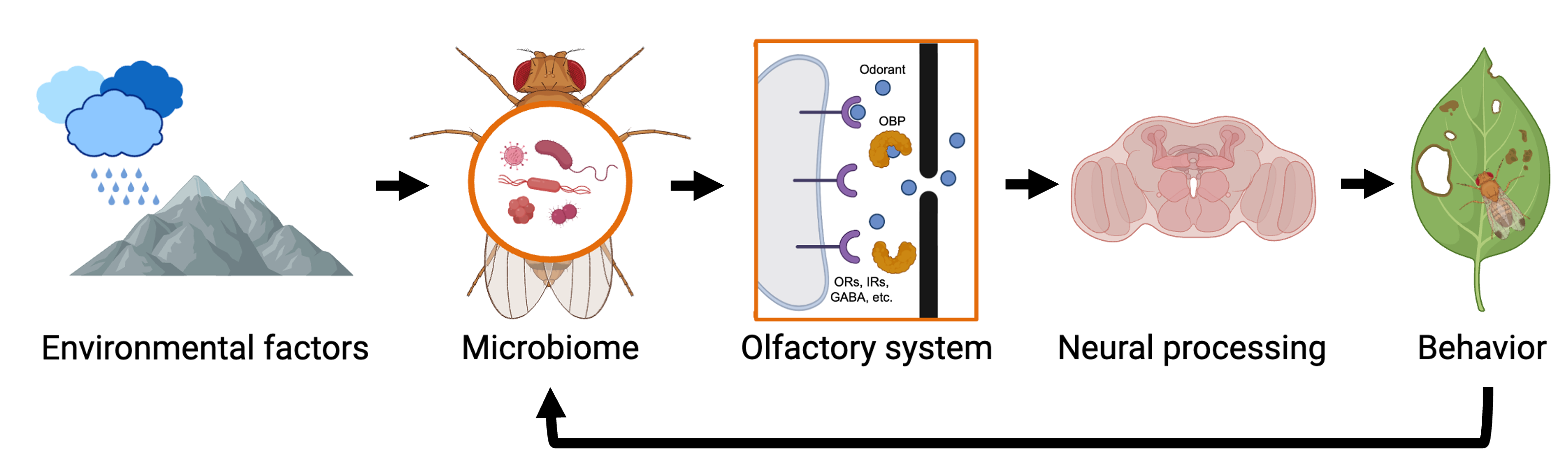
-
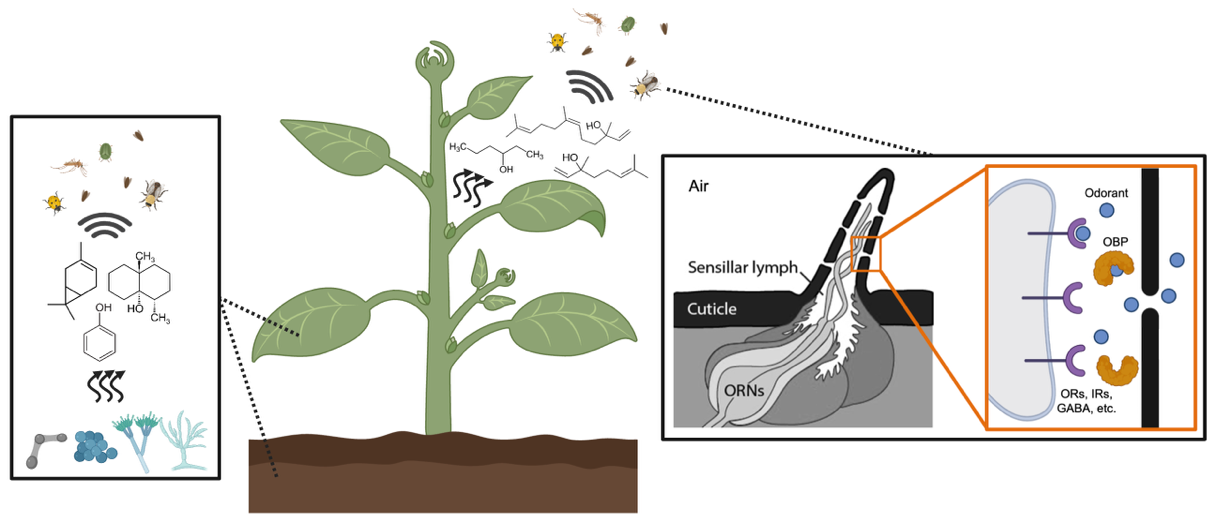
A growing body of research suggests that insect-associated microbes profoundly influence chemosensory systems, yet the mechanisms underlying this influence remain poorly defined. Studies in tsetse flies, Drosophila, and mosquitoes reveal that symbionts such as Wolbachia and Escherichia coli can regulate the expression of olfactory co-receptors (Orco, IR25a) and odorant binding proteins (OBPs), which in turn alter host behaviors ranging from food seeking to mate recognition. Our own published work demonstrates that E. coli colonization of Drosophila melanogaster reprograms sensory responses across multiple modalities — including olfaction, gustation, thermosensation, and mechanosensation — primarily through ionotropic receptor pathways. Symbionts can also influence mosquito digestion and host-seeking, as shown in Aedes aegypti. These findings point to microbes as central regulators of insect behavior, but major questions remain unresolved. Which microbial species directly shape chemosensory circuits, and what molecular pathways do they target? Do transient microbes exert the same regulatory influence as stable endosymbionts? Can single microbial signals alter host sensory gene expression in ways that persist across development? Defining the mechanisms by which microbes control insect chemosensory systems is essential to identifying novel microbe-derived targets to disrupt vectorial capacity.
-
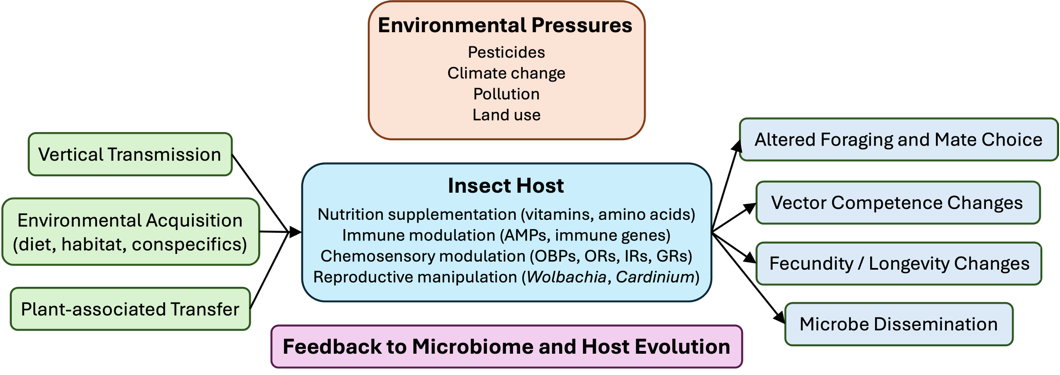
While microbes clearly influence insect sensory biology, the ecological context that shapes these interactions is largely unknown. Insects do not acquire their microbiomes in isolation — they are embedded within complex environments that provide microbial reservoirs through water, soil, plants, and human activity. Geographic and environmental factors such as rainfall, elevation, pesticide exposure, urbanization, and climate variability alter the composition of these reservoirs and, in turn, the microbiomes of local insect populations. For example, the microbial diversity of honeybees is tightly coupled to available floral resources, while mosquito microbiota vary across larval habitats and are influenced by pollutants and temperature. Our preliminary data show that even non-gut tissues of Aedes albopictus harbor diverse microbial communities that shift dynamically following blood feeding. These findings highlight the plasticity of insect microbiomes and suggest that environmental factors may indirectly regulate host-seeking by dictating microbial composition. Yet critical gaps remain. Which environmental drivers exert the strongest influence on mosquito microbiomes? Do microbial shifts caused by climate or anthropogenic activity translate into measurable changes in chemosensory gene expression? And can these ecological factors be mapped to vectorial capacity in ways that allow prediction and intervention? Addressing these questions will reveal the environmental determinants of insect-microbe dynamics, providing a systems-level understanding of how ecological factors shape disease transmission.
-
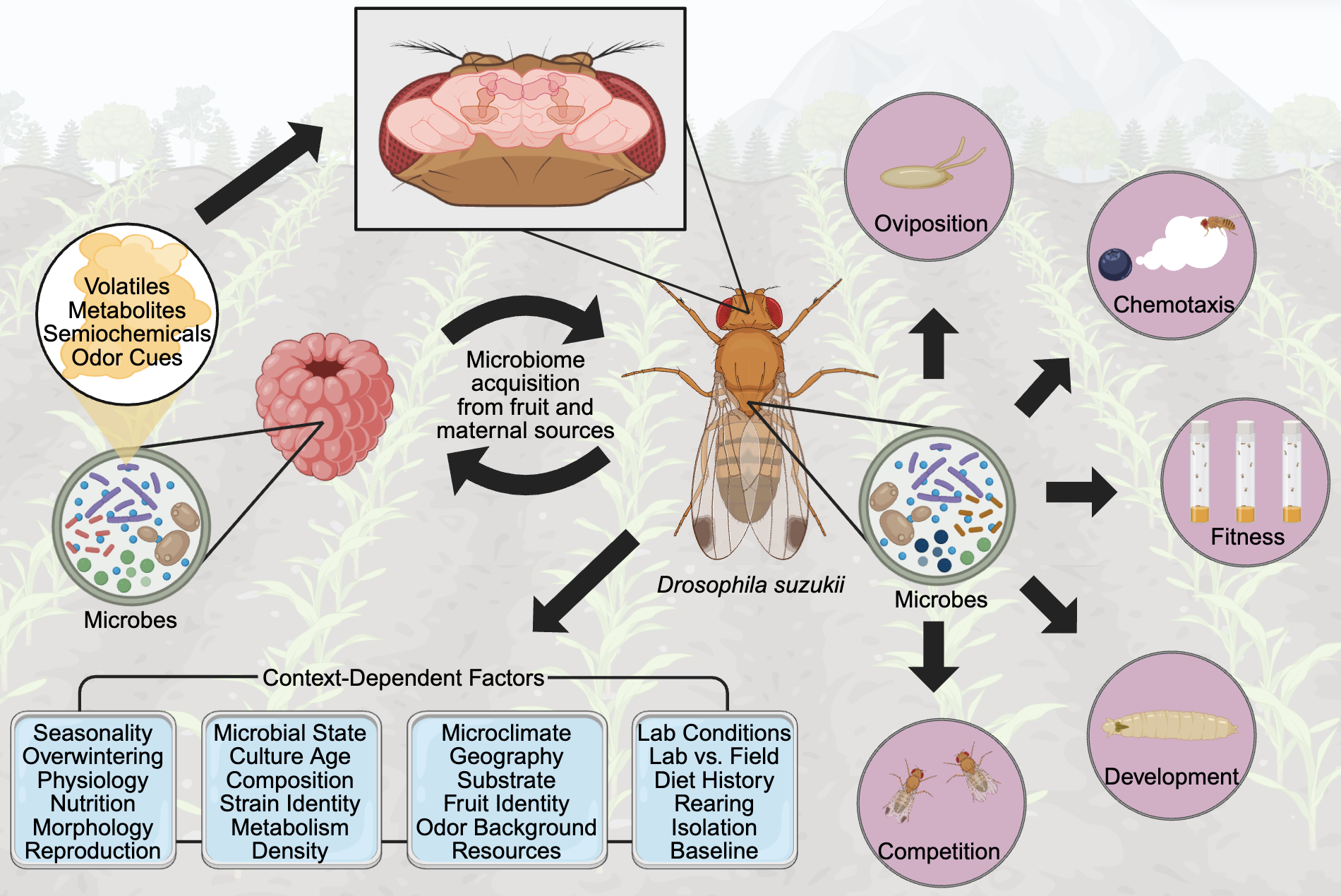
In parallel to bacterial and environmental regulation, entomopathogenic fungi (EPFs) represent a distinct microbial pathway for controlling insect populations. Species such as Beauveria bassiana, Metarhizium anisopliae, and Lecanicillium lecanii infect a broad range of insect hosts and produce secondary metabolites with potent effects on physiology and behavior. Laboratory studies confirm that EPFs can kill insects directly, but their persistence in natural environments is limited by UV radiation, desiccation, and temperature stressors. Emerging evidence suggests that fungal metabolites themselves — independent of fungal survival — may modulate insect behavior, disrupting olfaction, gustation, or locomotion. Secondary metabolite studies in Hypocrealean fungi support their potential as modulators of insect physiology. Our preliminary work demonstrates the feasibility of isolating and characterizing these metabolites, as well as assessing their stability under ecologically relevant conditions. However, the precise metabolite classes responsible for behavioral changes remain unidentified, and the mechanisms by which they act on chemosensory circuits are entirely unexplored. This represents a major gap: fungal metabolites may provide a stable, sustainable, and highly specific means of redirecting insect behavior, yet their potential as next-generation bioinsecticides remains unrealized.