Aiden M Stanley, Ph.D.
Postdoctoral Research Associate, Aronson Lab, Department of Ecology, Evolution, and
Natural Resources, Rutgers University
 Ph.D. Biology (Ecology and Evolution), University of Pittsburgh
M.S. Biology, East Tennessee State University
B.S. Biology, East Tennessee State University
As someone who was raised with constant exposure to the outdoors, I quickly came to
understand that people and nature are inextricably connected. Therefore, I believe it is
our duty to understand the influence we can exert over natural processes, both to
prevent and repair damage as well as promote healthy environments. With this goal in
mind, I continue to pursue research with a commitment to mentorship of fledgling
scientists and engagement with the general public to promote understanding of our role
in nature.
Research focus: Uncovering the influence of anthropogenic stressors, such as climate
change and urbanization, on the evolution and plasticity of plant functional traits and
plant-animal interactions.
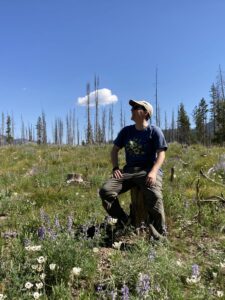
Current project: Assessing the influence of urbanization and climate change on
functional traits and herbivory in Trifolium repens
Human actions are exerting changes in ecological interactions such as pollination and
herbivory. Such human-mediated stressors as climate change and urbanization have
been, are, and will continue—with increasing intensity—to alter habitats on a global
scale. As such changes occur, plants are often exposed to novel and/or altered
interactions with animal partners. White Clover (Trifolium repens) is a globally
distributed plant of both agricultural and management interest, as a crop plant and lawn
“weed”. Interestingly, there is trade-off between herbivory defense and frost tolerance
that differs latitudinally and between urban and non-urban habitats. Because herbivory
defense is also a costly trait, we predict that there is an additional trade-off with fitness.
As such, we are investigating the relationship between herbivory defense, functional
traits, climate, and landuse through the lens of historically preserved plant specimens.
Select publications
– AM Stanley, and TL Ashman. 2025. Urbanization Alters Phenology, Mating
System Allocation, and Life History of Impatiens capensis (Balsaminaceae) via
Trait-Specific Plasticity and Genetic Differentiation. Ecology and Evolution 15 (6),
e71583.
– D Rakosy, TL Ashman, L Zoller, AM Stanley, TM Knight. 2023. Integration of
historic collections can shed light on patterns of change in plant–pollinator
interactions and pollination service. Functional Ecology 37 (2), 218-233.
– C Albor, TL Ashman, AM Stanley, C Martel, G Arceo‐Gómez. 2022. Flower
colour and flowering phenology mediate plant–pollinator interaction assembly in
a diverse co‐flowering community. Functional Ecology 36 (10), 2456-2468.
– Urbanization increases seed dispersal interaction diversity but decreases
dispersal success in Toxicodendron radicans. AM Stanley, G Arceo-Gómez.
2020. Global Ecology and Conservation 22, e01019.