Aronson Lab (Dr. Myla Aronson, Samantha E. Fuentes-Gigliotti(PhD candidate), Hogyeum Evan Joo(PhD candidate), and Lucien Fitzpatrick (PhD candidate)) attended the 110th Ecological Society of America 2025 Annual Meeting in Baltimore.
Dr. Aronson led several special sessions, a field trip, and other talks on urban ecology and other related topics. See the abstracts below.
SS 42 – Celebrating 110 Years of Excellence in Ecology and What’s to Come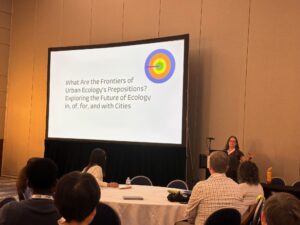
Organizer: Myla Aronson (Rutgers) + Co-Organizers : Jonathan Miller (ESA), Catherine O’Rlordan
Description:
A decade ago, ESA commemorated its centennial in Baltimore. Now, as we celebrate our 110th anniversary, back in Baltimore, we are again presented with an opportunity to reflect on the transformations that have shaped our community and the field of ecology.
This special session, hosted by ESA’s History Committee, will highlight the progress made since 2015, including a growing emphasis on equity and inclusion, broadening participation and opportunities for all ecologists, new chapters and sections reflecting modern ecology, and an incredible increase in student engagement. We will also introduce Humans of ESA, where we present real-life stories of ecologists from various backgrounds, career stages, and career trajectories, illuminating the diversity of our members. Participants will also have the opportunity to document their own story and have it highlighted on the History Committee’s website.
The session will end with a visioning workshop including all participants focused on how ESA’s members envision the future and direction of both the science and the association that supports us.
FT 11 – A Crosstown Walk in West Baltimore
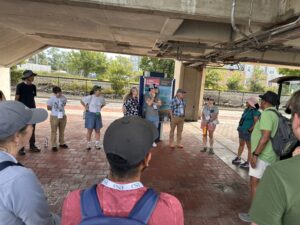
Organizer: Charles Nilon (University of Missouri) + Co-Organizer: Myla Aronson, Olyssa Starry, Ela-sita Carpenter, George Middendorf.
Accessibility: This field trip is an easy 2.1 mile walk along through residential neighborhoods. Most of the walk will be on sidewalks, however the condition of the sidewalks and the presence of curb cutouts are unknown. Bathrooms are available at the West Cold Spring metro station and in Hanlon Park.
Equipment and Attire: Participants should plan on bringing good walking shoes, sunscreen, hat, bug repellent, water, and other personal items for outdoor walking in the summer sun. Binoculars, and field guides or phone apps for identify plants and animals may be useful.Join the Urban Ecosystem Ecology, Environmental Justice, and Human Ecology Sections on an exploration of environmental changes along a socioeconomic gradient in West Baltimore and learn how the Crosstown Walk can be applied to teaching, outreach, and community engagement efforts. The Crosstown Walk is a course module that can be used in undergraduate and graduate courses in ecology, design, urban planning, and the social sciences to help students understand how ecological and social factors can be drivers of environmental change in cities, and to illustrate key concepts about urban ecology and environmental justice. On this field trip, we will introduce the course module and describe how it can be used in different types of courses and how it can be used in collaborative studies of biodiversity in the world’s cities. Along the walk will discuss how findings from the walk might be relevant to management for biodiversity and ecosystem service in Baltimore neighborhoods. The field trip leaders are active in community-based conservation programs in Baltimore City. Our 2.1 mile walk will go through several West Baltimore neighborhoods. The northern end of the walk is middle class neighborhood with row house and yards typical of many in neighborhoods in the northern and western portions of Baltimore City and Baltimore County. The portion of the walk between Sequoia Avenue and Powhatan Avenue is an upper middle class neighborhood with large single family homes, including many that border Hanlon Park and Lake Ashburton. South of Powhatan Ave. is a neighborhood of older row houses where residents face a number of social and environmental challenges. We will collect data on temperature, tree canopy cover, birds, insects, and vegetation during the walk. At the conclusion of the walk we will review our findings from the walk and discuss how the module can be used in different courses and settings, and opportunities to participate in a comparison of route data for multiple cities. We will also discuss ongoing debates about redevelopment, gentrification, and environmental justice in West Baltimore.
WK 25 – Design and Implementation of Leaf Decomposition and Biodiversity Experiments in Urban and Suburban Environments: Opportunities for Collaboration
Organizer: Olyssa Starry (Bucknell University) + Co-Organizer: Katalin Szlavecz (Johns Hopkins University), Richard Pouyat (U.S. Forest Service), Myla Aronson (Rutgers), Max Ferlauto (Maryland DNR)
Description:
Decades of research support the importance of leaf breakdown to recycle nutrients and thus to maintain ecological function. Leaf litter also provides habitat for diverse groups of soil invertebrates and their predators. However, in urban and suburban landscapes, tree species are different, leaves are often managed, and the local environment is altered. The ecological consequences of all these scenarios are less understood.
In this workshop, we will briefly review key findings from historical and recent studies of leaf breakdown in urban environments. 1) The bulk of the workshop will explore different techniques for assaying leaf breakdown, with emphasis on how design choices can affect results. For example, litter bags can have different mesh sizes, be filled with substrates, at varying depth, etc. 2) We will discuss ways of collecting complimentary information, including soil physical and chemical properties, and soil biodiversity. 3) We will also review ways to connect with participatory science projects on this topic and connections to the classroom. Our hope is to establish a network of campuses and other locations where interested parties can conduct experiments and share data at a common platform.
Workshop participants will receive a kit to start a leaf study at their respective locations.
Yard Ecology: The Future of Socioecological Science and Urban Biodiversity Conservation
Presenting Author: Myla Aronson (Rutgers) + Co-Author: Christopher Lepczyk
As urbanized areas steadily grow worldwide, ecologists are increasingly interested in studying how cities can function to provide for both people and wildlife. In particular, residential yards and gardens-privately-owned spaces that are planted and managed by homeowners-have emerged as a compelling place to study the interplay between human decision-making and ecological patterns and processes. Past work has established that yards can contain surprisingly high levels of biodiversity, and also serve as crucibles for positive human-nature interactions. For these reasons, yards might also facilitate community-driven conservation action (e.g. pollinator gardening), with possible benefits for biodiversity, ecosystem function, urban sustainability, and human well-being. However, much remains unknown about how urban residential lands function, particularly how ecological and social processes interact to influence both conservation efforts and human well-being. This Organized Oral Session will bring together research on the socioecology of residential yards, in order to highlight the opportunities and challenges of studying both people and nature in residential contexts, and for doing conservation in human-occupied landscapes. Specifically, this OOS will explore: patterns of biodiversity in residential spaces, factors influencing yard management decisions, a framework for grounding community-driven conservation action in science, and drivers of human-nature connection.
Where does urban ecology go from here? Advancing the sustainable future of urban social-ecological systems using the field’s prepositional framework
Presenting Author: Myla Aronson (Rutgers)
Co-Author: Loren Byrne (Roger Williams University)
Several influential frameworks guide the science and education of urban ecology, particularly ecology in, of, for, and with cities (where “cities” is shorthand for diverse types of urbanized environments). When considered together, these four prepositions provide for an integrated, interdisciplinary study of urban social-ecological patterns and processes. Here we discuss the frontiers of urban ecology with examples of how these four approaches can be applied to topics such as biodiversity conservation, greenspace design and management, and education. Such examples reveal how urban ecology’s prepositional framework provides a useful guide for advancing more sustainable, resilient, healthy and biodiverse urban social-ecological systems.
———————————————–
Restoration Ecology>Harnessing southern oak genotypes for improving canopy restoration of northeastern forests

Presenting Author: Samantha Fuentes-Gigliotti, Rutgers, The State University of New Jersey
Co-Author: Myla Aronson, Rutgers, The State University of New Jersey
Regeneration failure of canopy trees is a critical issue defining the present and future of forest ecosystems. Consequently, land managers are motivated to identify strategies that can mitigate the impacts of climate change. An emerging technique for building climate resilience is the use of southern genotypes in northern landscape restorations. The objective of our study was to compare survival and height growth of local (southern New Jersey and eastern Pennsylvania) and southern genotypes (Northcentral Kentucky) of native canopy trees (Quercus alba and Quercus rubra) in canopy gap restoration. We hypothesize that southern genotypes will have greater success in northern sites because they are adapted to warmer and drier conditions. We conducted our study at Hutcheson Memorial Forest, a suburban old-growth forest located in Somerset, NJ. We planted 1-2 yr old saplings in 10 small, naturally occurring canopy gaps (20-m diameter): 5 gaps planted with local genotypes and 5 gaps planted with southern genotypes. Prior to planting, we mechanically removed invasive plants to establish suitable site conditions for restoration. We measured success by using survival and height growth and found that southern genotypes had greater success from 2021 to 2024. Southern Q. alba had a higher probability of surviving to the next year compared to local oak genotypes (year 1=3.3x, p<0.01; year 2=4.4x, p<0.0001; and year 3=3.0x, p<0.01). Southern Q. rubra also had higher probability of surviving to the next year (year 1=50.7x higher, p<0.0001; year 2=15.3x higher, p<0.0001). Growth data suggests similar results, with highest growth occurring in southern oak genotypes particularly in years 1 and 2. Southern Q. alba had higher growth compared to local genotypes (year 1=11.2±10.4cm and 6.77±16.9cm, Z=-2.555, p<0.05; year 2=6.47±15.9cm and -1.04±17.0cm, Z=-3.812; p<0.01). Southern Q. rubra also showed higher growth than local genotypes (year 1=20.0±14.6cm and 3.78±10.8cm, Z=-8.186, p<0.001; year 2=8.10±21.cm and 0.502±5.76cm, Z=-4.149, p<0.001). Our data suggests that regeneration of northeastern forests may be enhanced by introducing southern genotypes. Future measurements will inform how long-term success varies by genotype, supporting land managers looking for adaptive approaches to climate resiliency in restoration work.
———————————————–
Urban Ecosystems>Habitat heterogeneity, not park size, drives plant biodiversity in urban green spaces

Presenting Author: Hogyeum Joo, Rutgers, the State University of New Jersey
Co-Author: Myla Aronson, Rutgers, the State University of New Jersey
Habitat heterogeneity plays a crucial role in maintaining biodiversity. In urban green spaces (UGS), habitat heterogeneity is shaped by management, design, and human use. However, we lack an understanding of the variety of habitat types and biodiversity UGS is capable of supporting. In this study, we hypothesized that size and habitat heterogeneity of UGS are important predictors of species richness, and these relationships are mediated by park type. To test this hypothesis, we we sampled the vegetation of four park types: a) Neighborhood Parks (n=11), b) Community Parks (n=5), c) Playgrounds (n=7), and d) Nature Areas (n=4), in New York City, USA.
We categorized habitat types within each park using canopy density, shrub density, and mowing/weeding intensity of the herbaceous layer. We conducted 10 x 2m transect surveys of plant species composition within each habitat type.
The surveyed parks supported 26 habitat types. Community Parks (avg size=34.54ha) supported the highest number of habitat types (avg=8.2) and species richness (avg=159.8), Neighborhood Parks (avg size=2.23ha) had the next highest number of habitat types(avg=6.45) and species richness (avg =112.36). Nature Areas (avg size=23.58ha) and Playgrounds (avg size=0.35ha) had the lowest habitat heterogeneity and species richness (avg=4.75 and 3.14; 83.75 and 46.57, respectively).
Park size showed significant, but weak, positive relationships with habitat heterogeneity (p=0.023, R2 = 0.191) and species richness(p=0.012, R2= 0.226). Notably, habitat heterogeneity reported a strong positive relationship to species richness (p<0.0001, R2=0.721).
Post-hoc comparisons (Tukey’s HSD test) indicated that mean habitat heterogeneity significantly differed among park types (ANOVA p<0.0001). Community Parks had a significantly higher number of habitat types compared to Nature Areas (p<0.05) and Playgrounds (p<0.005). However, Playgrounds had significantly lower habitat heterogeneity than Neighborhood Parks (p<0.05). When comparing species richness across park types, we found a significant difference only between Community Parks and Playgrounds (p<0.005). Our study highlights that habitat heterogeneity is a stronger driver of species richness than park area in urban green spaces. These results suggest that increasing habitat heterogeneity within existing parks may be a key strategy for enhancing urban biodiversity.
———————————————–
Ecosystem Function: Biodiversity>Increased Structural Diversity Improves Ecosystem Function: Evidence from Current literature

Presenting Author: Lucien Fitzpatrick, Rutgers, The State University of New Jersey
Co-Author: Myla Aronson, Rutgers, The State University of New Jersey
In this era of unprecedented global biodiversity loss, understanding how biodiversity influences ecosystem function is critical for managing healthy ecosystems. However, vegetation structural diversity and its relationship to ecosystem functions has been historically understudied compared to traditional metrics of diversity. Vegetation structure impacts critical resources such as light, water, and habitat availability which directly impacts ecosystem processes such as water use efficiency, carbon sequestration, and forest food webs. Structural diversity based recommendations for management are also easier to act on than taxonomic or functional recommendations as forestry practices explicitly target structural goals. We hypothesize that structural diversity is an important factor mediating the relationship between biodiversity and ecosystem function. We conducted a comprehensive literature review of studies investigating the relationship between the structural diversity of terrestrial vegetation and metrics of ecosystem functioning. Papers with either the search terms “structur* diversity”, “structur* complexity” or “foliage height diversity” combined with “ecosystem” were found using the Web of Science database. 122 papers were retained after 2153 papers were screened for quality and relevance to investigating the relationship between an accepted metric of terrestrial vegetation structural diversity and a dimension of ecosystem function such as forest productivity and faunal biodiversity. We counted instances of positive, negative, or non-significant results for each study, each metric of diversity, each ecosystem function, and each habitat. Results were used to design a framework outlining how structural and taxonomic diversity mediate each other and influence different mechanism controlling ecosystem functions. Structural diversity had a majority positive relationship with 18 of the 24 ecosystem functions examined. Structural diversity was a stronger predictor than taxonomic diversity for six of the seven functions examined. However 79.5% of all evaluations of structural diversity compromised three functions associated with common silvicultural goals: forest productivity, carbon storage, and faunal biodiversity. The other 15 functions that were positively associated with structural diversity related either to ecosystem services (temperature regulation) or forest health (soil nutrients). Our findings demonstrate that vegetation structural diversity plays an important role in key ecosystem functions, but the relationship is underexplored beyond a few functions. For land managers interested in maximizing ecosystem functions like habitat availability and carbon sequestration, structure is a readily modifiable attribute of forests that can quickly improve ecosystem function. To better manage ecosystem function, vegetation structural diversity must be considered alongside more traditional metrics.