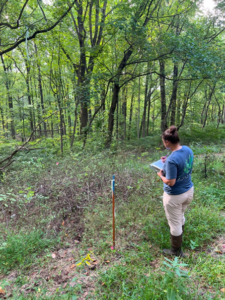
Samantha Gigliotti (PhD Program) just published a paper with Dr. Aronson on pre-planting treatment strategies in urban forest patches.
Urban forest patches face many pressures, from storms that open tree canopies, to heavy browsing by wildlife, to the spread of invasive plants. Restoring these forests often depends on successfully re-establishing trees, and that success begins with how a site is prepared before planting. Many common site preparation methods rely on synthetic herbicides, which can raise environmental concerns and are increasingly restricted or banned in parks and urban green spaces. In this study, we compared three pre-planting approaches: mechanical removal, synthetic herbicide application, and organic herbicide application. We wanted to see how well each approach reduced invasive plants and supported native vegetation. Research was conducted over two years in a 16-hectare mixed hardwood forest in Philadelphia, Pennsylvania. Synthetic herbicides were found to be the most effective at reducing invasive plant cover, while organic herbicides and mechanical removal were less effective but still showed reduction. Importantly, plant species responded differently to each treatment, and results suggest that when organic herbicides are applied at the right time and frequency, their effectiveness may improve. Overall, this work highlights practical, species-focused strategies for preparing urban forest sites and offers guidance for land managers seeking effective approaches that support long-term forest restoration success. To learn more about this study, please click this link to access the recently published article in Urban Forestry & Urban Greening, December 2025.
(picture above:
Lead researcher on this project, Samantha Gigliotti, recording data on an organic herbicide application plot.)
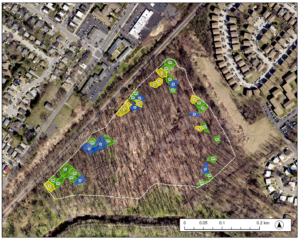
Map of the study site at Pennypack Park in Philadelphia, PA. Green (m) represents plots with mechanical removal, blue (o) is organic, and yellow (s) synthetic 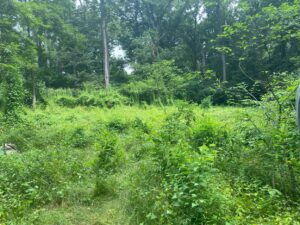
Canopy gaps within our research site were heavily invaded with non-native plants such as mile-a-minute, Japanese stiltgrass, and multiflora rose.
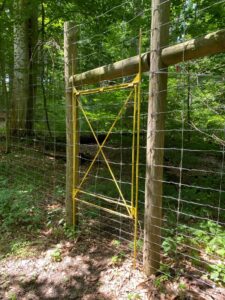
Our research site was located within a deer fence exclosure. This aids in reducing browsing on developing trees or seedlings.