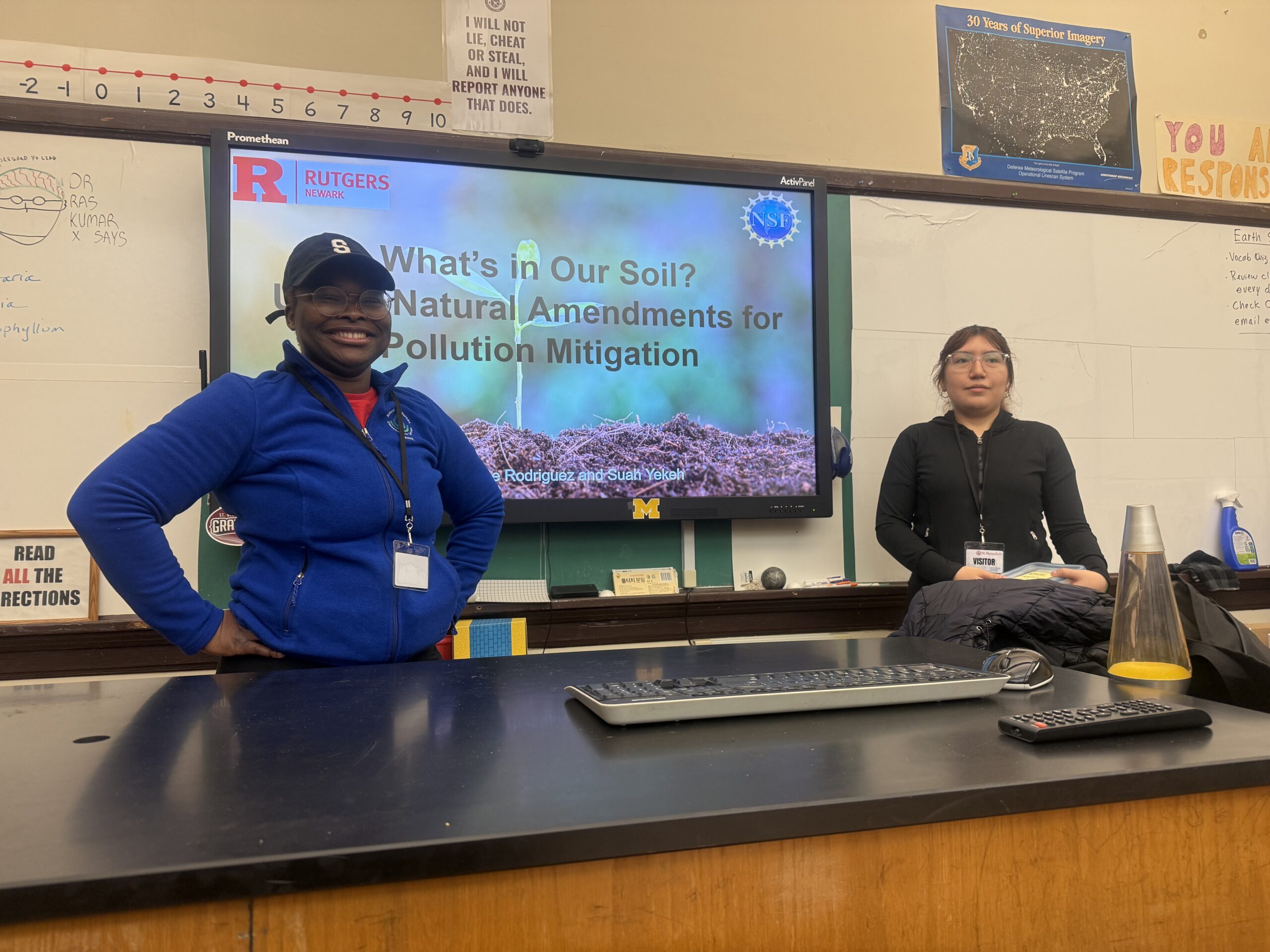
The Newark Geoscience Ecosystem (NewGeo) recently visited St. Benedict’s for a classroom session focused on pollution mitigation, heavy metals in soils, and the use of X-ray fluorescence (XRF) in environmental research.
During the visit, students were introduced to key concepts in environmental contamination and learned how heavy metals can enter and persist in soils, why these pollutants matter for environmental and public health, and how scientists use field and laboratory tools to assess contamination. The session also highlighted pXRF as an important screening tool for identifying metals in soil and discussed broader approaches to pollution mitigation and environmental problem-solving.
The visit provided students with an opportunity to engage directly with applied environmental science and to see how geoscience tools can be used to better understand and address real-world challenges. By connecting classroom learning with hands-on scientific methods, the session helped illustrate the role of research in advancing community and environmental health.
NewGeo is grateful to St. Benedict’s for welcoming us and for creating space for meaningful dialogue around science, pollution, and community-centered solutions.
