 

Our research in theoretical condensed matter physics focuses on: strongly correlated electron systems, quantum phase transitions in and out of equilibrium, superconductivity (unconventional and or topological), quantum magnetism, quantum impurities, low dimensional physics, three dimensional Dirac and Weyl semi metals, graphene and van der Waals heterostructures, Anderson localization, many body localization, effects of quasiperiodicity, thermalization in quantum statistical mechanics, open and monitored many-body quantum systems, and ultracold atomic systems. Experimental platforms include quantum materials (solid state compounds, thin films, 2D materials), ultracold gases, and quantum processors.


Current Focus

Disordered topological semimetals and insulators.

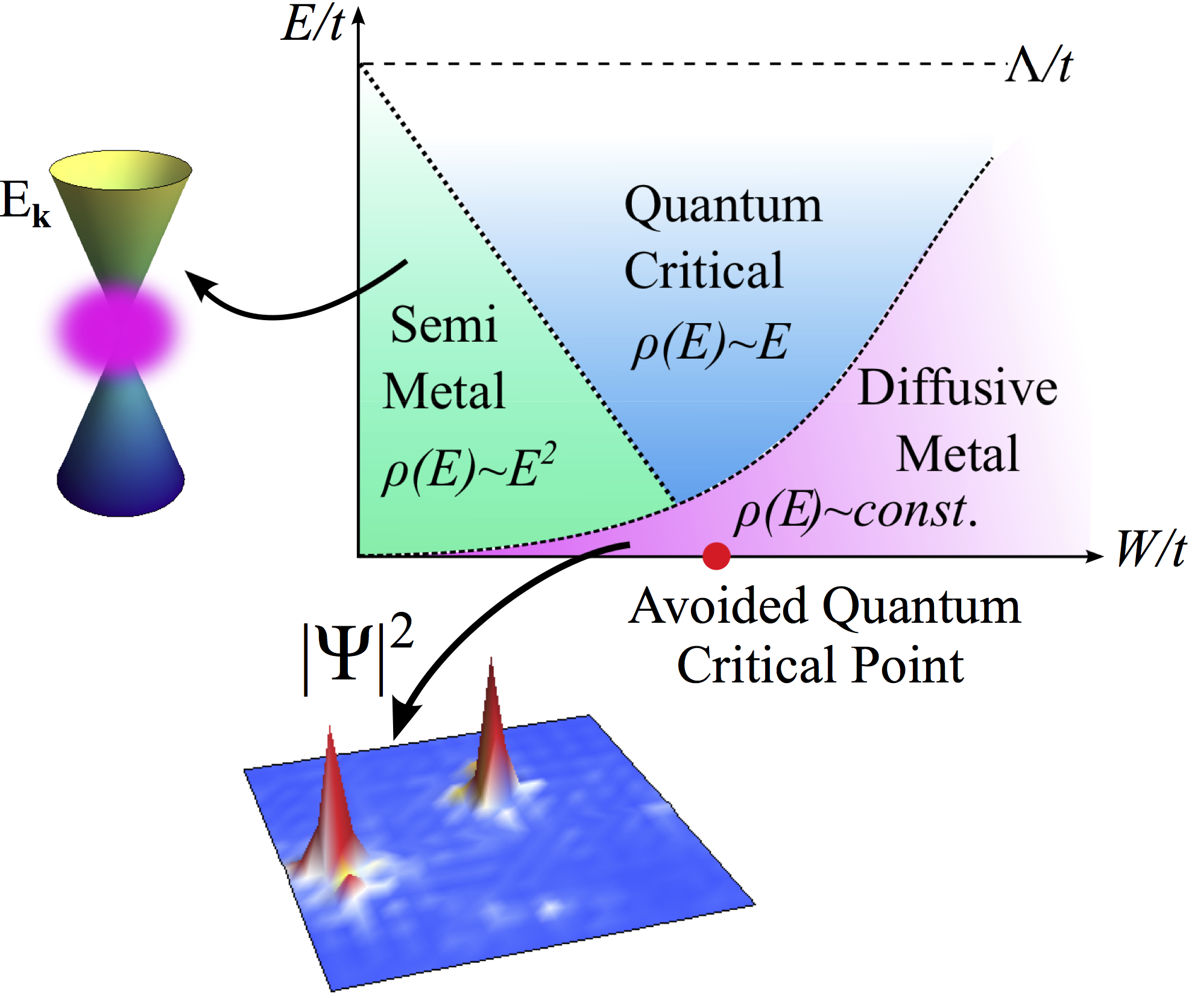
Our research in disordered topological materials focuses on quantum phase transitions that can arise by destroying topological properties. In particular, we are focusing on the effects of rare regions on the properties of Weyl and Dirac semimetals as well as topological phase transitions in general. More recent investigations have included higher order topological insulators, their stability, and creating new phases with disorder and topology. Image © American Physical Society. Representative papers: 1, 2, 3, 4, 5, 6, 7
multifractal wf

Twisted van der Waals heterostructure (“Twistronics”) and its emulation beyond solid state physics.

We have been interested in various aspects of twistronics. One focus has included how to emulate this phenomena in different physical settings. To achieve this we have been studying the effects of quasiperiodicity on two-dimensional Dirac semimetals, in models that can be realized in ultra-cold atomic gases and metamaterials. Our group was involved in developing the theory of twisted superconductors and collaborated on its experimental realization and observation; the state of the field is summarized in our recent review. We have also been investigating the strongly correlated properties of stacked and twisted transition metal dichalcogenides. In addition, we have an active pursuit of twisted bilayer and trilayer graphene including the role of twist disorder, quasicrystal formation, quantum criticality, and superconductivity.  Image © Nature Research. Representative papers: 12, 3, 4, 5, 6, 7, 8

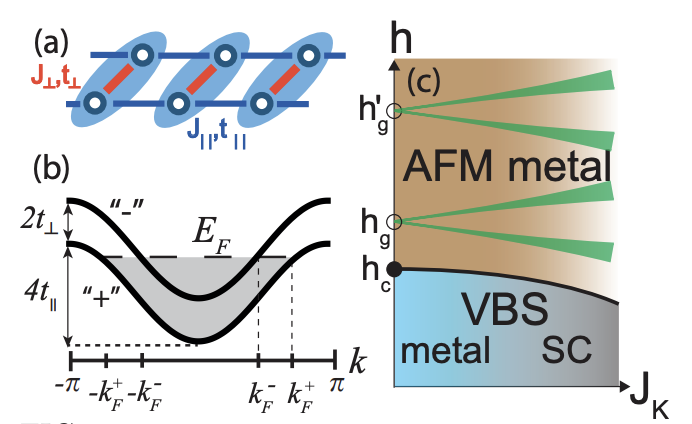
Frustrated quantum magnetism in metals.

We are generally interested in how magnetic frustration can persist (or not) in a metallic environment. This is motivated by the recent discoveries of heavy fermion materials that have local magnetic moments that reside on geometrically frustrated lattices. The past focus my group has taken is to understand the fate of a valence bond solid in the presence of a metallic band and are studying how quantum phase transitions out of a valence bond solid ground state are affected by a metallic Fermi sea. More recently, our work has shifted to understanding interfaces that realize frustrated magnets in metals, in particular by stacking spin-ice on a Weyl semimetal.  Image © PNAS. Representative Papers: 1, 2, 3, 4

Non-equilibrium quantum dynamics: thermalization, localization, and phase transitions.

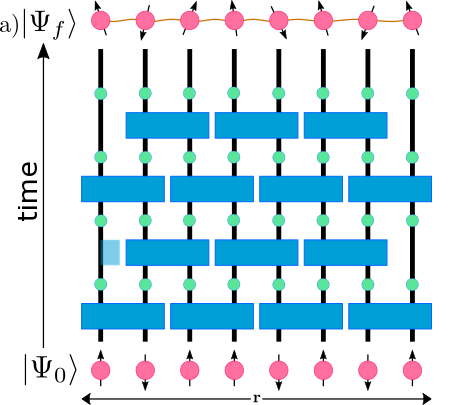
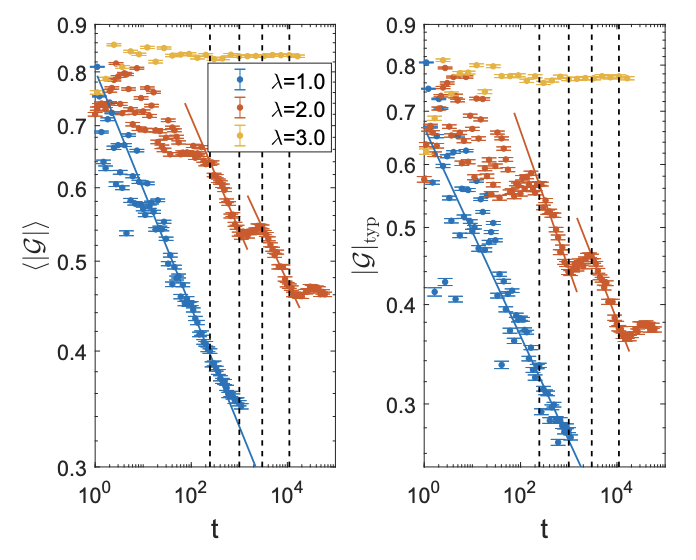
I am generally interested aspects of localization, thermalization, and dynamical transitions between them. One key aspect of my work in this direction has been exploring the effects of deterministic quasiperiodicity (e.g. and how this can lead to mobility edges) and its effect on many body localization. My group has been exploring quantum dynamics in monitored random quantum circuits and the nature of the measurement induced quantum phase transition. We have extended this to include feedback from the measurement outcomes that create a seperate phase transition that we are actively investigating in a range of models and experimental realizations. Recently, one of our models has been realized on IBM’s superconducting quantum processor. Image © American Physical Society. Representative papers: 1, 2, 3, 4, 5, 6, 7, 8

Strong correlations in quasicrystals.

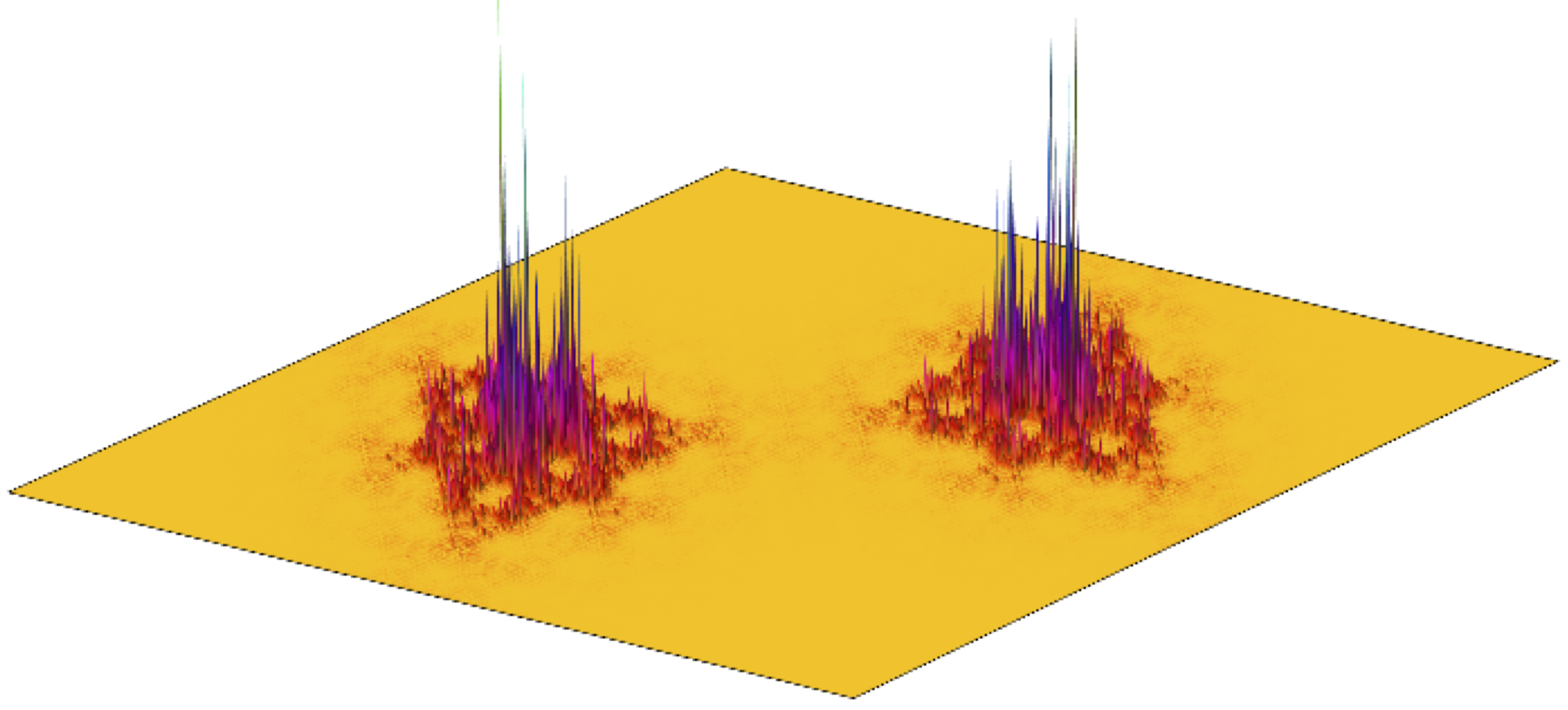
The fractal electronic gap structure of tight binding models in quasicrystals can produce exotic single particle phenomena. I am currently interested in understanding how this affects strongly correlated effects that normally emerge out of a band picture. The group has been working to understand how the Kondo effect can develop in such a setting, which led to us developing the KPM+NRG algorithm (see the Software page). This includes the Kondo effect in twisted bilayer graphene that forms at an atomic vacancy as well as strongly correlated quasicrystals in twisted bilayer graphene aligned with hBN. Image © American Physical Society. Representative Papers: 1, 2, 3, 4, 5, 6