Past Research
The results below, from the group’s early years and from Vatsan’s postdoctoral work in the group of David Schuster (then at the University of Chicago), laid the foundations for our current program in multimode circuit QED. For the group’s current research directions, see the Research page; for the full list of papers, see Publications.
The quantum flute: seamless high-Q multimode cavities
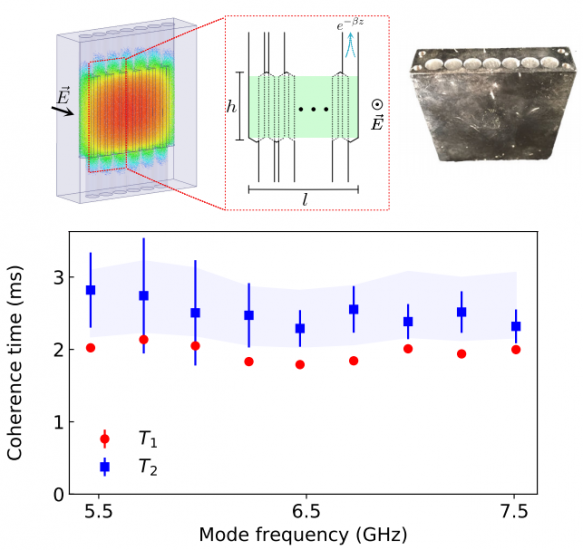 Our microwave cavities are typically multimodal, possessing tens of modes with photon lifetimes of a few milliseconds, forming state-of-the-art multimode cavity QED systems when combined with superconducting circuits. We build our cavities by the flute method, drilling overlapping holes into a monolithic block of superconductor. This naturally eliminates loss from joints and seams, achieving coherences determined only by intrinsic material properties. We use the location and depth of the holes to adjust the cavity mode frequencies and their interactions with a superconducting circuit. With this approach we demonstrated a multimode cavity with 9 operable modes with photon lifetimes of ~2 ms, an order of magnitude longer than state-of-the-art transmons, controlled through a single line [PRL 127, 107701 (2021)].
Multimode photon blockade
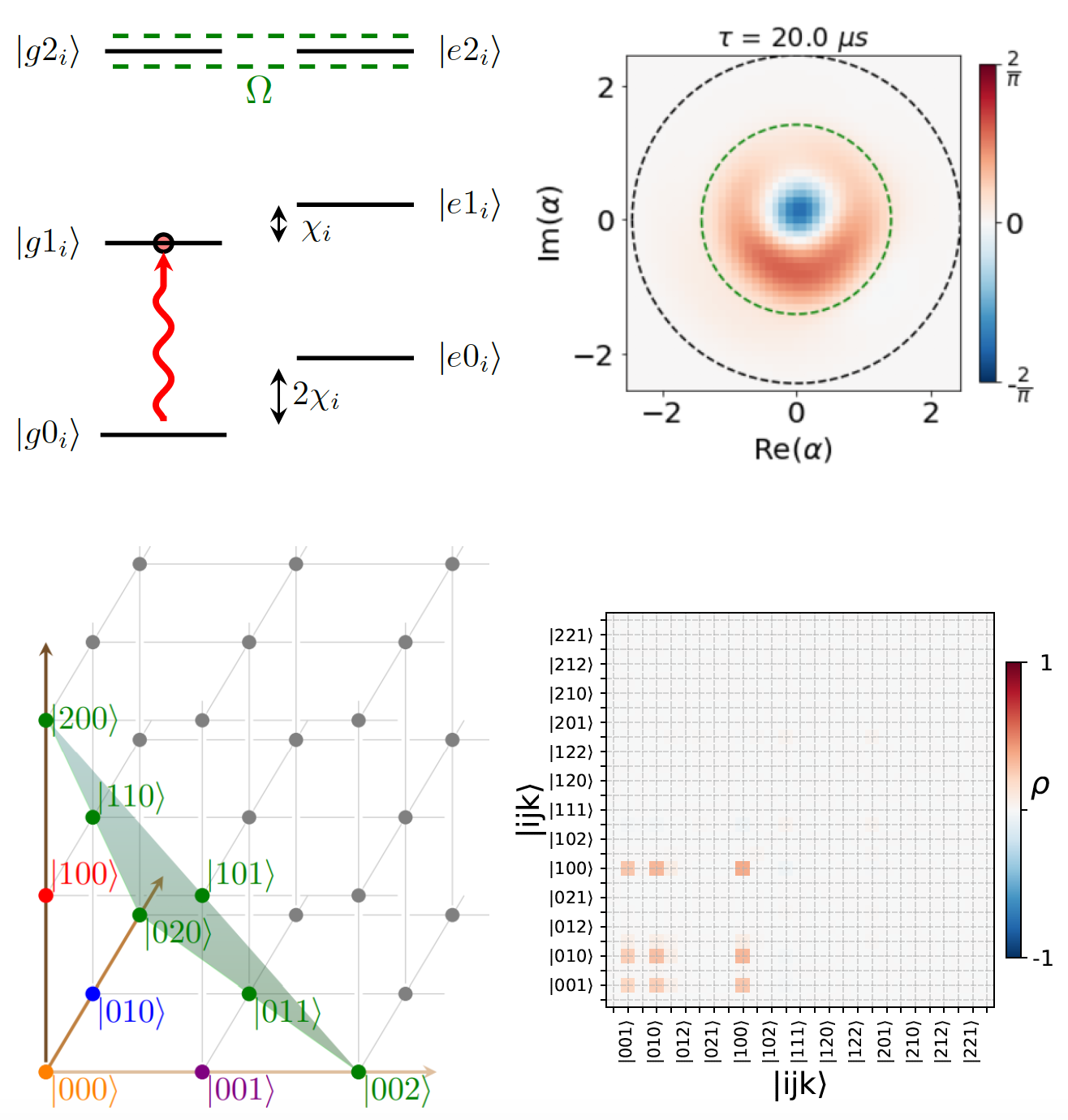 We developed techniques for controlling the quantum states of microwave cavity modes using photon-number-selective drives on a coupled transmon, disallowing states with a target photon number to implement photon blockade. A sufficiently weak cavity drive then Rabi-oscillates the blockaded cavity, preparing arbitrary qubit states, and with higher blockades qudit states, in any mode. Generalizing this to multimode photon blockade, we disallowed a manifold of states with the same total photon number, implementing a non-local N-body interaction between photons with no condensed-matter analog. In its presence, simple simultaneous drives on each mode generate entangled states, including a 3-mode W-state prepared by blockading two photons [Nature Physics 18, 879 (2022)].
Random-access quantum information processing
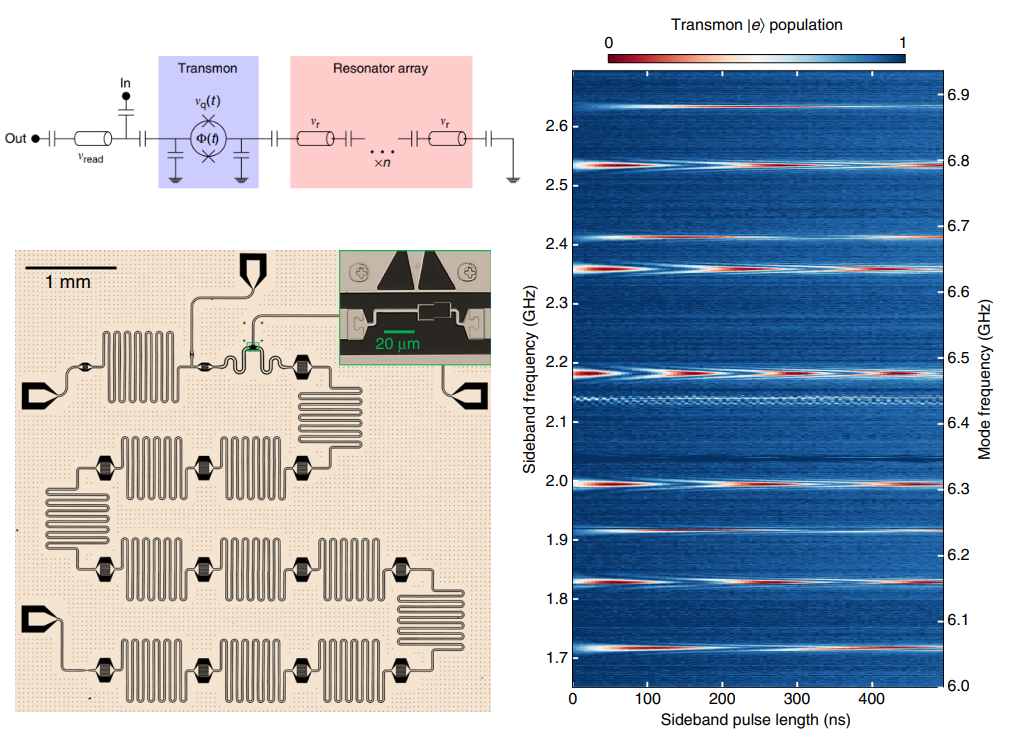 We implemented a random-access quantum information processor in a 2D circuit comprising a chain of strongly coupled coplanar waveguide resonators. Memory bits were stored as photons in the normal modes of the chain, all addressed by a single flux-tunable transmon coupled to one end. Like an FM radio, the transmon was flux-modulated at the appropriate frequency to exchange quantum information between the processor (transmon) and memory (normal modes of the chain). Using higher transmon levels, we implemented two-qubit gates between arbitrary pairs of modes with equal ease, demonstrating random access [Nature Communications 8, 1904 (2017)]. This is the architecture that our current 3D random-access quantum memories generalize.
The heavy fluxonium
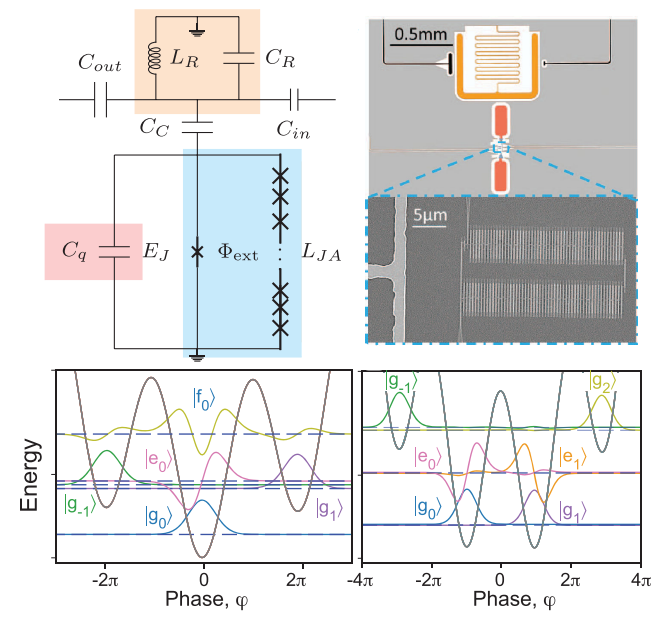 Unlike transmons, which are weakly anharmonic oscillators, the fluxonium has an additional parallel inductor that realizes a double-well potential, with the qubit formed from the ground states of the two wells. We added a shunt capacitance to the original fluxonium design to exponentially suppress the tunneling matrix elements responsible for spontaneous energy relaxation. The resulting heavy fluxonium has metastable states with energy relaxation times up to 8 ms, among the highest reported for superconducting circuits. We overcame the suppression of direct transitions by realizing a Λ system through a higher fluxonium level, with fast single-qubit gates via Raman transitions [PRL 120, 150504 (2018)]. We later developed fast-flux control operating the circuit near its degeneracy point, where T1 and T2 exceeded those of standard transmons at comparable gate speeds [PRX 11, 011010 (2021)]. This work underpins our current use of fluxonium as a high-coherence ancilla.
Searching for dark matter with superconducting qubits
We developed a quantum non-demolition microwave photon counting technique using superconducting qubits, and used it to set an exclusion limit on hidden-photon dark matter three orders of magnitude beyond previous bounds [PRL 126, 141302 (2021)], later extended to stimulated emission of signal photons from dark matter waves [PRL 132, 140801 (2024)]. The same photon-counting methodology now drives our thermalization measurements at Rutgers.
Engineered dissipation and remote entanglement
In planar circuit QED, we demonstrated universal stabilization of a parametrically coupled qubit [PRL 119, 150502 (2017)] and deterministic bidirectional communication and remote entanglement between superconducting qubits [npj Quantum Information 5, 18 (2019)], primitives for the autonomous error correction and modular networking directions we pursue today.