Highlights
A closer look at some of our recent results. Click a title to expand it. The full list of papers is on the publications page.
Universal Jaynes-Cummings control
 The Jaynes-Cummings interaction is fundamental in quantum optics and native to platforms including trapped ions, mechanical resonators and magnonics, but experimental demonstrations had remained limited to state preparation and restricted gates. Our protocol compiles arbitrary unitaries within a chosen d dimensional Fock subspace from alternating sequences of ancilla rotations and JC interactions. Each JC rotation executes a 2π rotation on the cutoff transition, closing the dynamics within the computational subspace and suppressing leakage by construction, while ancilla relaxation events are detectable by design at the end of any sequence and can be mitigated by post-selection. We demonstrated a complete universal qutrit gate set with a mean post-selected process fidelity of 96%, along with ququart and ququint shift gates at 95% and 94%.
Monitored bosonic dynamics
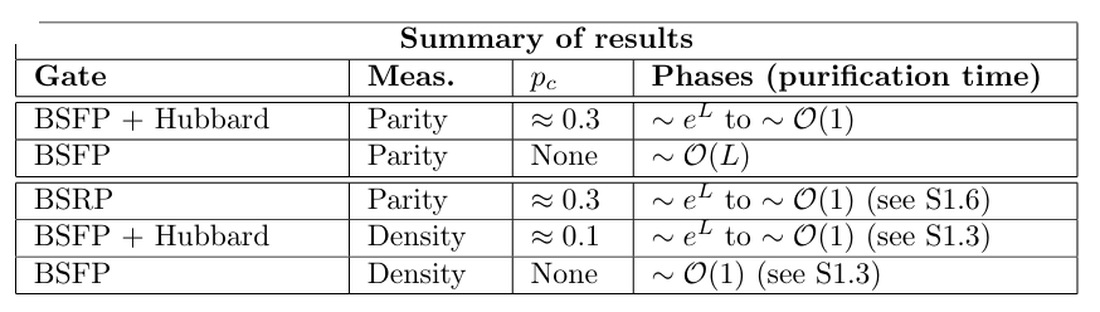
 In collaboration with J. H. Pixley (Rutgers) and Romain Vasseur (University of Geneva), we proposed and analyzed a route to measurement-induced phase transitions in multimode bosonic systems. Such transitions arise from the competition between entangling unitary evolution and local measurements, and had so far been probed only in qubit platforms. Prior work indicated that no transition exists in purely Gaussian bosonic systems; we show that non-Gaussian gates or measurements restore it. We probe the transition through a single ancilla initialized to be entangled with the register, which purifies in the area law phase but remains mixed in the volume law phase, so that its purity serves as an order parameter. Fixed phase beamsplitter circuits exhibit a novel bosonic phase at high measurement rates, in which the purification time scales linearly with system size, with no analog in qubit systems.
Controlling 20 ms SRF cavities
 In collaboration with the SQMS Center at Fermilab, we demonstrated a multiqudit platform based on ultracoherent niobium SRF cavities. Integrating nonlinear control elements into these cavities without introducing additional loss has been an outstanding challenge; we addressed it by minimizing the transmon-cavity coupling and the cavity field participation in lossy dielectric interfaces. The resulting two cell elliptical cavity achieved single photon lifetimes of 15 to 20 ms and pure dephasing times exceeding 40 ms, an order of magnitude improvement over prior multimode memories. We prepared Fock states up to N = 20 with fidelities above 95%, and demonstrated two mode entanglement using a new virtual Raman-assisted beamsplitter, reaching 99.9% fidelity after post-selection.
Fast sideband control of a weakly coupled memory
 Controlling a high quality cavity through an ancilla forces a tradeoff between gate speed and coherence: stronger coupling gives faster gates but also more ancilla mediated decay, dephasing and back action on the memory. We built a ten mode bosonic memory with coherence times of 1.3 to 2 ms and deliberately weak dispersive coupling, then recovered the speed using charge driven sideband interactions. Carefully chosen microwave drives exploit the transmon nonlinearity to activate a tunable Jaynes-Cummings interaction with any selected mode, giving random access SWAP gates in about 200 ns, up to 30 times faster than the bare dispersive coupling, at about 99% fidelity. To extend this control to unitary gates and multimode operations, we introduced two analytic control techniques, one based on shelving to the |e〉 state and one on photon number selective sidebands. Together they let us implement a variety of encoding gates, prepare states across all ten modes, and prepare entangled NOON states across pairs of modes. Among these we demonstrated an encoding gate for the binomial code, the first in the weak dispersive regime, with a post-selected fidelity of 96.3%. The work was published in Physical Review X and selected for an APS Physics synopsis.
Fast Floquet SNAP gates at weak coupling
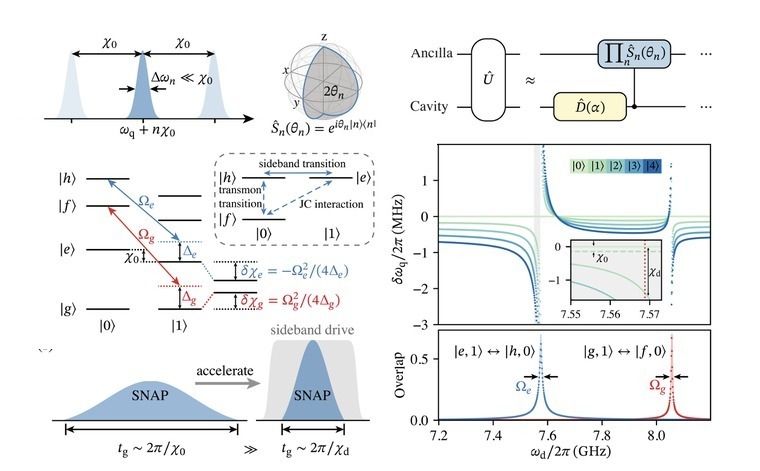 SNAP gates apply photon number dependent phases to a cavity and are a key primitive for universal cavity control, but their speed is set by the dispersive interaction, which makes them slow in the weak dispersive regime that preserves cavity coherence. In collaboration with the SQMS Center at Fermilab, we showed that the sideband drive used to implement the JC interaction, when applied off resonantly, dresses the dispersive interaction, and that this can make it an order of magnitude faster than the static coupling allows. This required theoretical developments in implementing optimal control within a Floquet framework that accurately accounts for the strong off resonant drive.
Mitigating quasiparticle poisoning by gap engineering
 Non-equilibrium quasiparticles are a major source of decoherence in superconducting qubits, causing energy relaxation, spurious excitations and the correlated errors that hinder quantum error correction. In collaboration with the group of Michael Gershenson at Rutgers, we developed a gap engineering protocol that suppresses quasiparticle poisoning in aluminium transmons. A simple modification of standard double angle evaporation creates a higher gap aluminium region on one side of the Josephson junction, forming an energy barrier that suppresses non-equilibrium quasiparticle tunnelling by three orders of magnitude and preserves charge parity for minutes, compared with sub millisecond switching in unprotected devices. Achieving this with a gap modulation of only about 0.5 K suggests that most non-equilibrium quasiparticles sit near the gap edge. The technique needs one extra evaporation step, is compatible with standard all aluminium fabrication, and has since been explored and validated by several other groups.