Fresh off the press: new paper!
Inspired by biological insights from fish schools, we introduce a model for collective decision-making for network systems.
Think of everyday situations like:
– a team converging on Tool A vs. Tool B,
– a community tipping toward Policy 1 vs. Policy 2,
– a robot swarm choosing Route left vs. right.
In our framework, each individual has intrinsic decision states and social influence couples individuals through a social network.
An interesting outcome is a set of closed-form algebraic expressions that quantify how the starting conditions (basins of attraction) shape the final group choice.
🔍 What is a “basin of attraction”?
It is simply the region of starting states that will end up in the same final outcome, that is how “easy” it is for the group to end up choosing A versus B.
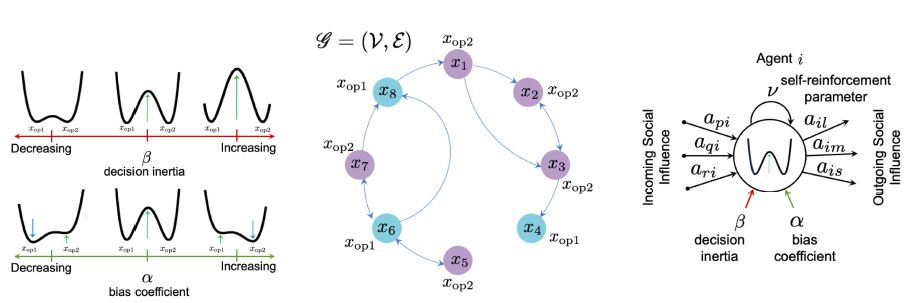 📌 We show how these basins depend on:
– social influence strength and network topology (who influences whom),
– internal traits like stubbornness and bias.
✅We validate the theory on real data, including the Kapferer Tailor Shop strike-decision network, and find that topology can dramatically reshape which outcome becomes likely, even when individual tendencies stay the same.
read more: https://ieeexplore.ieee.org/abstract/document/11368740