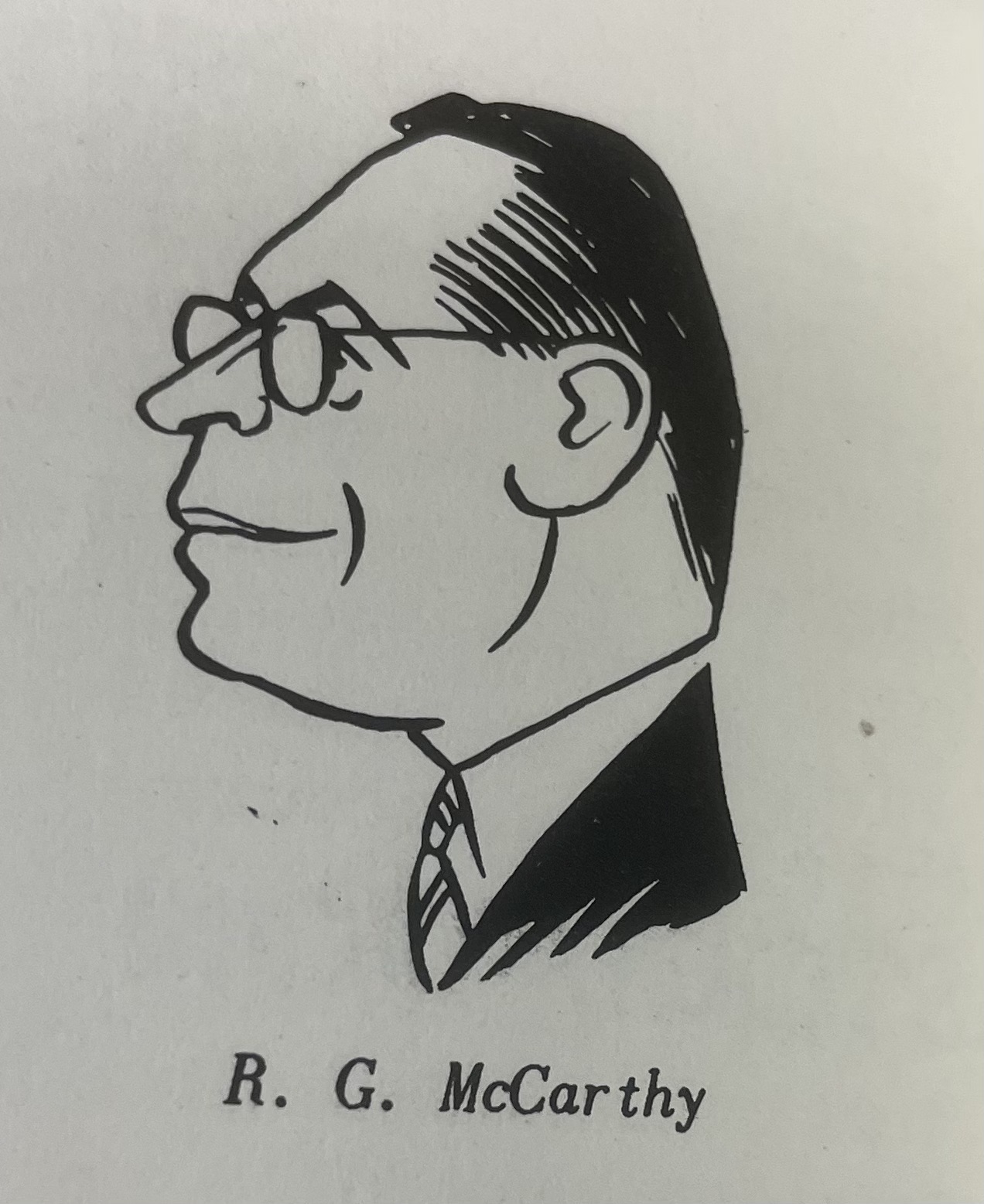
 When tracing the roots of alcohol education in the United States, Raymond G. McCarthy (1901–1964) stands as a prominent figure. A career changer from the public school system, he became a defining voice in alcohol education—shaping alcohol education, curricula in schools, education policy, clinics, and even the archives at Rutgers. He is also known as the first major figure to rise to prominence from within the alcohol studies field itself.
Started in June 2025, my latest project focuses on compiling Raymond G. McCarthy’s comprehensive bibliography, an updated version that merges the existing list of his works with items I have recently uncovered in the Rutgers archives. It follows the four similar completed bibliographies of major scholars in alcohol studies: E. M. Jellinek, Howard Haggard, Selden Bacon, and Mark Keller.
Raymond G. McCarthy at a Glance
| Born / Died | April 30, 1901 – born in Brockton, MA June 25, 1964 – died in New Brunswick, NJ |
|---|---|
| Education | Master’s in Education, Harvard (1939) MA, Harvard (1928) BA in Social Work, Boston College (1925) |
| Key Roles | Executive Director, Yale Plan Clinics Director, Rutgers Summer School of Alcohol Studies Professor of Education at Rutgers |
| Publication Highlights | Alcohol and Social Responsibility (1949) Teen-agers and Alcohol (1956) Alcohol Education for Classroom and Community (1964) |
| Archive | Raymond G. McCarthy Memorial Collection (428 file boxes) |
| Project Outcome | Comprehensive bibliography sorted by genre, combining the original 84-item list with many newly discovered items |
From Teacher to Alcohol Education Pioneer

Born in Brockton, Massachusetts, on April 30, 1901, McCarthy earned a Master’s degree in education from Harvard in 1939, after receiving his MA from Harvard and a BA from Boston College. Early in his career, he served as a teacher in Meriden, Connecticut and a teacher and superintendent in Kingston, Massachusetts.
His interest in alcohol studies was sparked by Richard R. Peabody’s writings, leading him to attend Yale’s inaugural Summer School of Alcohol Studies in 1943. There, E. M. Jellinek quickly recognized his talent and recruited him to join the staff of the newly founded Yale Plan Clinics in 1944, where McCarthy eventually became executive director.
- McCarthy’s influence extended from the classroom to the clinic—bridging academic insight with practical intervention.
From 1948 to 1961, he served first as an assistant, then associate director of the Yale Summer School of Alcohol Studies. After a brief hiatus, he rejoined the School when it moved to Rutgers, and, from 1962 until his death, he directed it. He is known about revamping the curriculum significantly to emphasize graduate-level training. He also taught as a professor of education and was instrumental in founding national public health and alcohol education professionals organizations, in which he held leadership positions.
A Prolific Writer and Editor
In addition to his various roles as an administrator, McCarthy was also a prolific writer, creating materials that ranged from scholarly analyses to practical teaching guides and pamphlets. Many of his numerous conference presentations were shared and preserved in scholarly journals, educational magazines, and newsletters.
Selected Works
- McCarthy, R. G., & Douglass, E. M. (1948). Instruction on Alcohol Problems in the Public Schools. Quarterly Journal of Studies on Alcohol, 8(4), 609–635.
- McCarthy, R. G., & Douglass, E. M. (1949). Alcohol and social responsibility; a new educational approach. Crowell.
- McCarthy, R. G. (1951). Facts about alcohol. Science Research Associates.
- McCarthy, R. G. (1956). Teen-agers and alcohol; a handbook for the educator. Publications Division, Yale Center of Alcohol Studies.
He was also the editor of Drinking and Intoxication (1959), a seminal book of its time, and the innovative Alcohol Education for Classroom and Community: A Source Book for Educators (1964).
These publications reflect his belief that alcohol education should be systematic, research-based, and accessible both to professionals and the public.

The Raymond G. McCarthy Memorial Collection
McCarthy’s intellectual legacy is fittingly preserved in the Raymond G. McCarthy Memorial Collection, housed in striking red archival cases at the Rutgers University Libraries Annex. This remarkable print repository contains full texts of documents abstracted in the Classified Abstract Archive of the Alcohol Literature (CAAAL).
The content of the 428 file boxes is organized by CAAAL or McCarthy numbers. The collection is accompanied by an author index spanning three volumes: Section A (ca. 1935–1950), Section B (1951–1965), and Section C (1966–1976).The microfiche version has yet to be digitized. The McCarthy Collection is a treasure trove for anyone exploring the evolution of alcohol studies.
The Project: Building the Full Picture
The goal of my work is to compile a comprehensive bibliography of Raymond G. McCarthy, bringing together what’s already been gathered with the hidden gems in archival holdings.
Where I Started
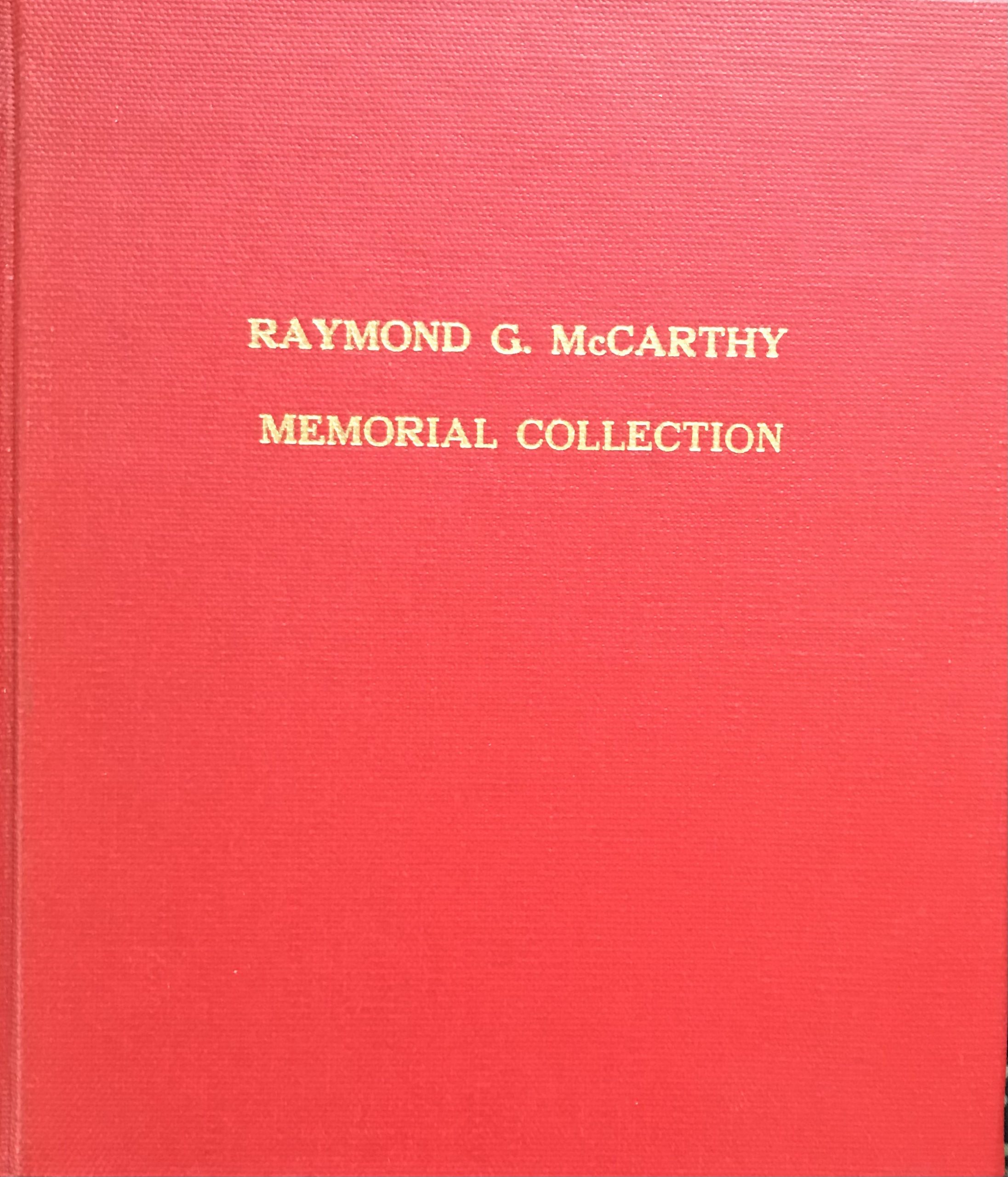 I began with bibliography in the booklet The Raymond G. McCarthy Memorial Collection, which opens with Selden Bacon’s introduction and includes 84 items listed by year. It was also published in the Journal of Alcohol Education, a scholarly journal that evolved from the newsletter, then bulletin of the Association for the Advancement of Instruction on Alcohol and Narcotics (AAIAN), a professional organization McCarthy initiated at the 1951 Summer School.
Expanding the Search
From there, I explored the three inventory volumes (Sections A–C) of the McCarthy Memorial Collection to verify and locate additional publications. I also hand searched alcohol journal publishers’ sites and print indexes, library catalogs and digitized resources to extend the list beyond what was previously documented.
Verification and Cross-Checking
The process of creating these bibliographies includes verifying each record against the full text of the original records wherever possible, using online catalogs, the Digital Alcohol Studies Archives, and journal backfiles. Once again, the SALIS Collection of the Internet Archive and our incredibly fast Interlibrary Loan department proved invaluable for accessing hard-to-find items.
Organizing the Final List
The result is a bibliography sorted by genre, listing the known works along with many newly identified items absent from earlier lists. Following the Jellinek and Keller bibliographies, separating scholarly (books, chapters, journal articles, and conference presentations) and non-scholarly, popular (pamphlets, films, magazine and newsletter articles) seems to provide a better understanding of the breadth and depth of McCarthy’s work.
Why This Project Matters
McCarthy’s scholarship and advocacy helped shape the field of alcohol education at a time when the concept was still evolving in both public health and academic contexts. By listing his contributions, this bibliography will preserve a complete picture of his intellectual and pragmatic legacy, and it will make his works accessible to future scholars, educators, and historians.
The process also reflects something larger: the value of bibliographic reconstruction as a scholarly act in its own right. Creating a comprehensive list of a scholar’s works points beyond searching, it’s also a way of mapping influence and tracing the spread of ideas, which contributes to the understanding the history of a field.
 Lessons from the Bibliographies Project
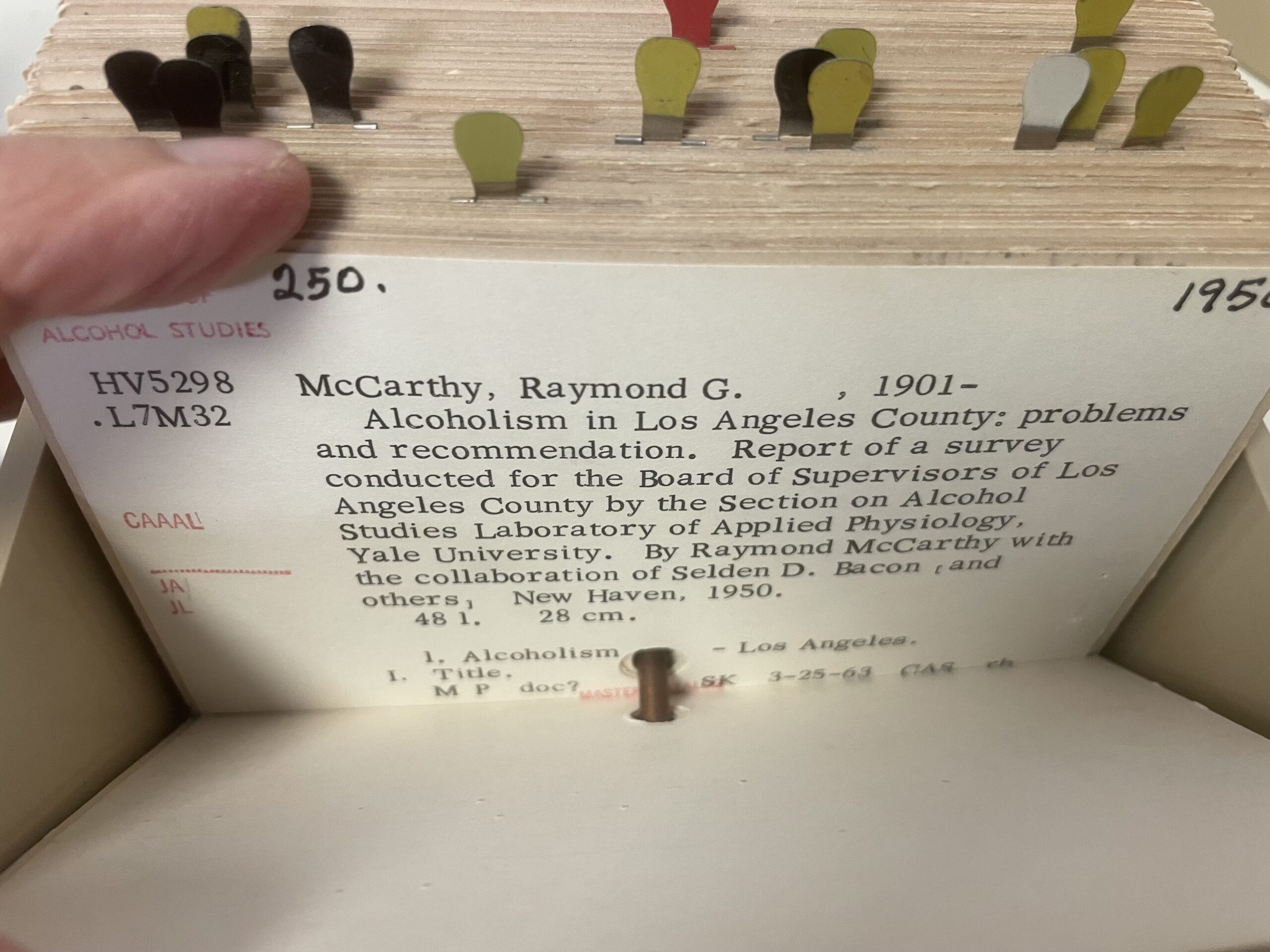
Reflecting on multiple bibliography projects always made the next one easier but not repetitive or tedious. Even with a starting list, each record has to be individually verified with full text to ensure accuracy and completeness. Title variations, republished and reprinted texts, missing or incorrect page numbers and publication years might sound like nuisances, but, looking at them from the detective-librarian perspective, the final bibliography presents itself, eventually, with a huge sense of achievement.
The current process also confirmed the benefits of being able to access and work across multiple formats and platforms, calling attention to the changes in research since I started this work more than ten years ago. The physical repositories, card catalogs, and microfiche each can reveal items not found in online catalogs. Conversely, digitized journal archives and online library holdings made it possible to quickly confirm or correct details that would have been far slower to verify in the past.
Looking Ahead
As soon as the final interlibrary loan items arrive and I finish verifying all data, my McCarthy bibliography will stand as the most complete account of his published works to date, bringing together the original 84-item list from the Memorial Collection booklet with many new discoveries.
McCarthy dedicated his career to making alcohol education rigorous, accessible, and relevant. Consistent with his legacy, the effort to preserve and document his own work follows those same principles. Presenting the publications by genre will make it easier for others to navigate and appreciate his contributions, whether they are historians, public health professionals, or simply curious readers interested in the evolution of alcohol studies.
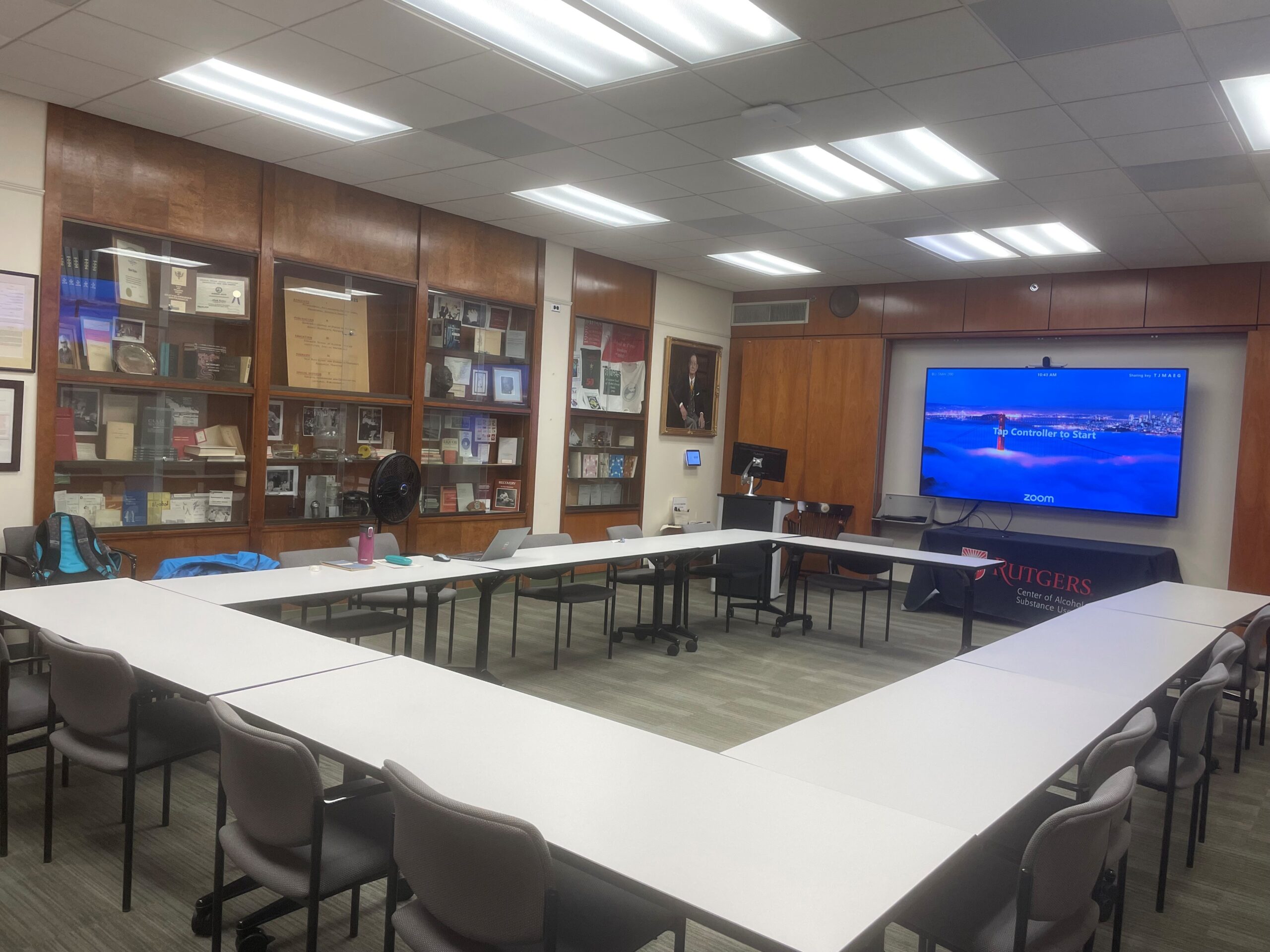
McCarthy would love the new look of the CAS Conference Room, with his work also displayed in the cabinets. Image by JH Ward, August 2025.
Related articles introducing new bibliographies
The full bibliography is available as supplementary material that accompanies the article online.
- Allred, N., Bejarano, W., & Ward, J. H. (2023). A Sociologist and the Problems of Alcohol Studies: The Life and Legacy of Selden D. Bacon. Journal of Studies on Alcohol and Drugs, 84(5), 791–796.
- Allred, N., Bejarano, W., & Ward, J. (2017). Howard Wilcox Haggard and the Institutionalization of Modern Alcohol Studies. Journal of Studies on Alcohol and Drugs, 78(2), 325-329.
- Ward, J. H., & Bejarano, W. (2016). A tribute to Bunky at 125: A comprehensive bibliography of E. M. Jellinek’s publications. Journal of Studies on Alcohol and Drugs, 77, 371–374.
- Ward, J. H., Bejarano, W., & Allred, N. A. (2025).Mark Keller, Alcohol Studies “Documentalist.” Journal of Studies on Alcohol and Drugs. (Preprint)