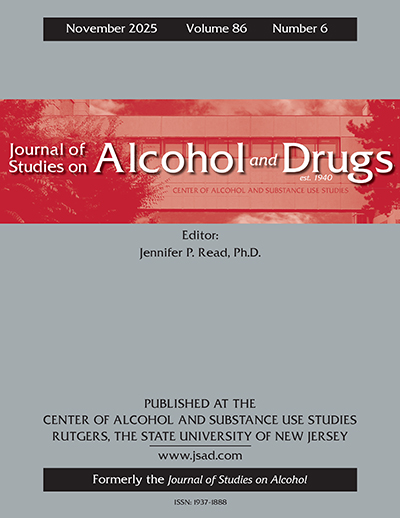
 Eighty-five years ago, the innovative idea to make the study of alcohol a legitimate scientific pursuit became reality with the launch of the Quarterly Journal of Studies on Alcohol (QJSA). Known today as the Journal of Studies on Alcohol and Drugs (JSAD), the Journal stands as the oldest and longest-running publication in the United States dedicated entirely to substance use studies. Published by Alcohol Research Documentation, Inc. based at the Rutgers Center of Alcohol and Substance Use Studies, JSAD continues to set the standard for rigorous, multidisciplinary scholarship in the field, as envisioned by its founders.
Origins and Vision
The Journal’s story began at Yale University. In the wake of Prohibition’s repeal, scholars recognized the urgent need for scientific inquiry into alcohol’s effects on health and society, with an emphasis on the “scientific” approach. Led by E.M. Jellinek, a review of the scattered literature on alcohol was launched, thanks to a Carnegie Corporation grant in 1939. The project was so successful that its staff was invited to continue their operations at the Laboratory of Applied Physiology at Yale, under the leadership of Howard W. Haggard, M. D., a scholar with strong interest in alcohol research.
With Haggard as its first editor, the Quarterly Journal of Studies on Alcohol developed from these efforts to collect, index, and abstract alcohol-related literature, published in the Journal and collected in the Classified Abstract Archive of the Alcohol Literature (CAAAL). As the main venue to publish related articles and news about the field, QJSA was instrumental in shaping early substance use research and turning it into a legitimate academic discipline over time.
The Laboratory of Applied Physiology soon established its Section of Alcohol Studies, later renamed the first Center of Alcohol Studies. The Journal and the Center that evolved around it were part of a larger international revival of alcohol studies that started after World War II, and were also linked to many other “firsts” in alcohol studies at Yale, such as the Summer School of Alcohol Studies, founded in 1943. Archival materials, now preserved in the Digital Alcohol Studies Archives, showcase these early milestones.
At Rutgers since 1962
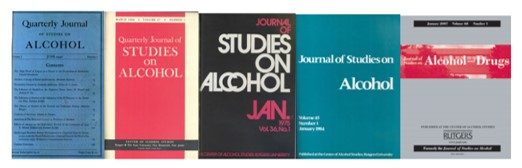
Covers of the journal over time
The name changes tell the story over time, as it evolved from Quarterly Journal of Studies on Alcohol to Journal of Studies on Alcohol and Drugs. Established as the Quarterly Journal of Studies on Alcohol in 1940, it published original articles, essay, reviews, and news related to alcohol studies in four issues per year. As alcohol research expanded in the 1970s, the Journal grew from a quarterly to monthly publication in 1975, and its name was changed to the Journal of Studies on Alcohol. With this change, the journal began publishing research articles and abstracts in alternating months, dropping the latter due to the lack of funding. Beginning with the January 2007 issue, the journal name changed to its current Journal of Studies on Alcohol and Drugs to indicate expanding coverage in addiction science.
List of Editors (1940-present)
The editor-in-chief of the Journal, called the “Editor,” always played a central leadership role in maintaining the Journal’s academic integrity, reputation, and overall quality. Many of the Editors had a chance to truly engage with authors, reviewers, and readers, building visibility and trust, and creating a community around the Journal. Setting the vision and the scope, Editors include:
-
Howard W. Haggard (1940-1958)
-
Mark Keller (1959-1976)
-
Timothy G. Coffey (1977-1980)
-
Mark Keller (1981-1983)
-
Jack H. Mendelson and Nancy K. Mello (1984-1991)
-
John A. Carpenter (1992-1994)
-
Marc A. Schuckit (1995-2015)
-
Thomas F. Babor (2015-2023)
-
Jennifer P. Read (2023-current)
JSAD today
Today, with a 4-month average time from submission to acceptance and 7 months from acceptance to publication, JSAD accepts approximately 20-25% of the research submitted following a rigorous peer-review process. It is indexed in all major scientific databases, including Web of Science, PubMed/PubMed Central, Scopus, Google Scholar, PsycINFO, and MEDLINE. The editorial board consists of top researchers and leaders in the field.
Industry-standard publishing practices, such as gold open access and electronic publication before print, are available, while the Journal in 2025 still remains genuinely nonprofit. As their website suggests, “the funds generated go directly back to fund the day-to-day operations of the journal itself. It doesn’t fund any other operations at the university, and no one at the university gets their office refurnished by journal funds.”
Impact and future
JSAD’s contributions to science extend far beyond its pages in print or online. Research published in the Journal has informed public health campaigns, shaped legislation, and guided clinical practice. High-impact publications often highlight JSAD’s relevance for broad audiences. One of the recent articles that went viral was a 2024 study, which concluded that no level of alcohol use is safe, overturning decades of conventional wisdom. The methodology, evidence-based research presented in the popular genre of a systematic review, also hallmarks the Journal’s continued commitment to its legacy of innovation, rigorous scholarship, and scientific excellence.
 Following QJSA founders and early Center’s principles, the Journal makes a conscious effort to translate addiction science to lay language as it was customary before, such as in the Lay Supplements and the Pamphlet Series.
For the 21st century readers, mostly online, this trend is indicated by publishing popular versions of scholarly content as JSAD FastTakes: Updates, News, and Opinion From the World of ATOD Research and Policy, as well as by the JSAD collection of freely available stock photos in the Alcohol, Tobacco, and Other Drug Public Domain Photo Database.
As JSAD marks its 85th anniversary, its mission is more vital than ever. Substance use continues to remain a global challenge, making evidence-based solutions essential. More broadly, scholarly publications play a critical role in safeguarding scientific freedom, just as the Journal’s founders envisioned, through unbiased publishing. By upholding its commitment to high-quality scholarship and fostering multidisciplinary collaboration, JSAD aims to continue guiding the way forward for many years to come.
Learn more about the history of the Journal
- Candon, P. M., Ward, J. H., & Pandina, R. J. (2014). The Journal of Studies on Alcohol and Drugs and the Rutgers Center of Alcohol Studies: a history of the evolution of alcohol research. Journal of Studies on Alcohol and Drugs. Supplement, 75 Suppl 17(s17), 8–17.)
- Ward, J. H., Babor, T. F., Allred, N., & Bejarano, W. (2024). The Modern History of Alcohol Research: Introducing the Rutgers Digital Alcohol Studies Archives. Journal of Studies on Alcohol and Drugs, 85(3), 289–295.