
Tony Carpenter (1924-2001)
John Anthony (“Tony”) Carpenter belongs on the short list of modern alcohol research figures alongside Howard Haggard, E. M. Jellinek, Selden Bacon, and Mark Keller, with a career that spanned research, editorial service, and academic leadership.
Biosketch
Born in 1924 in Nice, France, Carpenter entered U.S. academia after significant service during World War II. As a member of the 14th Air Force, he served as a radio operator on B-24 Liberator bombers flying long-range missions over China. In early 1945, during one such mission, his crew encountered a severe storm, struggled with failing engines, and ultimately bailed out when the aircraft could no longer remain airborne. Carpenter and the other crew members landed in unfamiliar territory and were captured by Chinese bandits, who held them for nineteen days before ransoming them back to American forces. He later received the Distinguished Flying Cross for his service.
After the war, Carpenter took full advantage of the GI Bill, earning a B.A. (1950) and an M.A. (1951) degree at Johns Hopkins and a Ph.D. from Brown University in 1954. Fresh out of graduate school, he joined the emerging field of alcohol research at Yale, the newly established Center of Alcohol Studies (CAS), a scholarly community whose founders were nearing the height of their careers. Carpenter represented a new generation of alcohol scientists, entering the discipline straight from his doctoral work and helping ensure continuity as the field matured.
He completed a postdoctoral fellowship at Yale under biometrician Chester Bliss and went on to make substantial contributions to research design and the analysis of alcohol and drug effects on behavior. He also held key roles in the editorial and administrative operations of the Journal of Studies on Alcohol. Carpenter began his academic career at Yale in 1954, joining the Center as the field of alcohol research was taking shape. In 1962, he moved with the Center to Rutgers, where he continued his work and remained affiliated until retiring in 1996.
Scholarship
John Anthony Carpenter’s research focused on the behavioral and physiological effects of alcohol, emphasizing careful experimental design and statistical modeling. His work examined measures such as skin conductance, visual reaction time, short‑term memory, problem solving, and aggression, as well as alcohol’s impact on complex performance relevant to driving. Trained in biostatistics during his postdoctoral fellowship, Carpenter integrated biometric methods into his research program, strengthening the field’s methodological standards and analytic precision.
His contemporaries recognized both the rigor and the influence of his designs and models. Mark Keller, the deeply versed scholar in the alcohol literature, described Carpenter’s statistical models as among the most “elegant” in the field and his experimental designs as ranking with the best. At the same time, Keller observed that Carpenter published less than the breadth of his investigations might have warranted, noting that some interesting results remained unpublished.
Leadership
When the Center of Alcohol Studies moved from Yale to Rutgers in 1962, Carpenter moved with it, eventually becoming CAS Director in 1975, succeeding Selden Bacon. His tenure came during a period of intense transformation in the field: the rise of federal research funding, emerging public policy debates, and structural changes within alcohol studies in academia. Under Carpenter’s leadership, the Center achieved major milestones in longitudinal research, graduate education, and the documentation of alcohol literature.
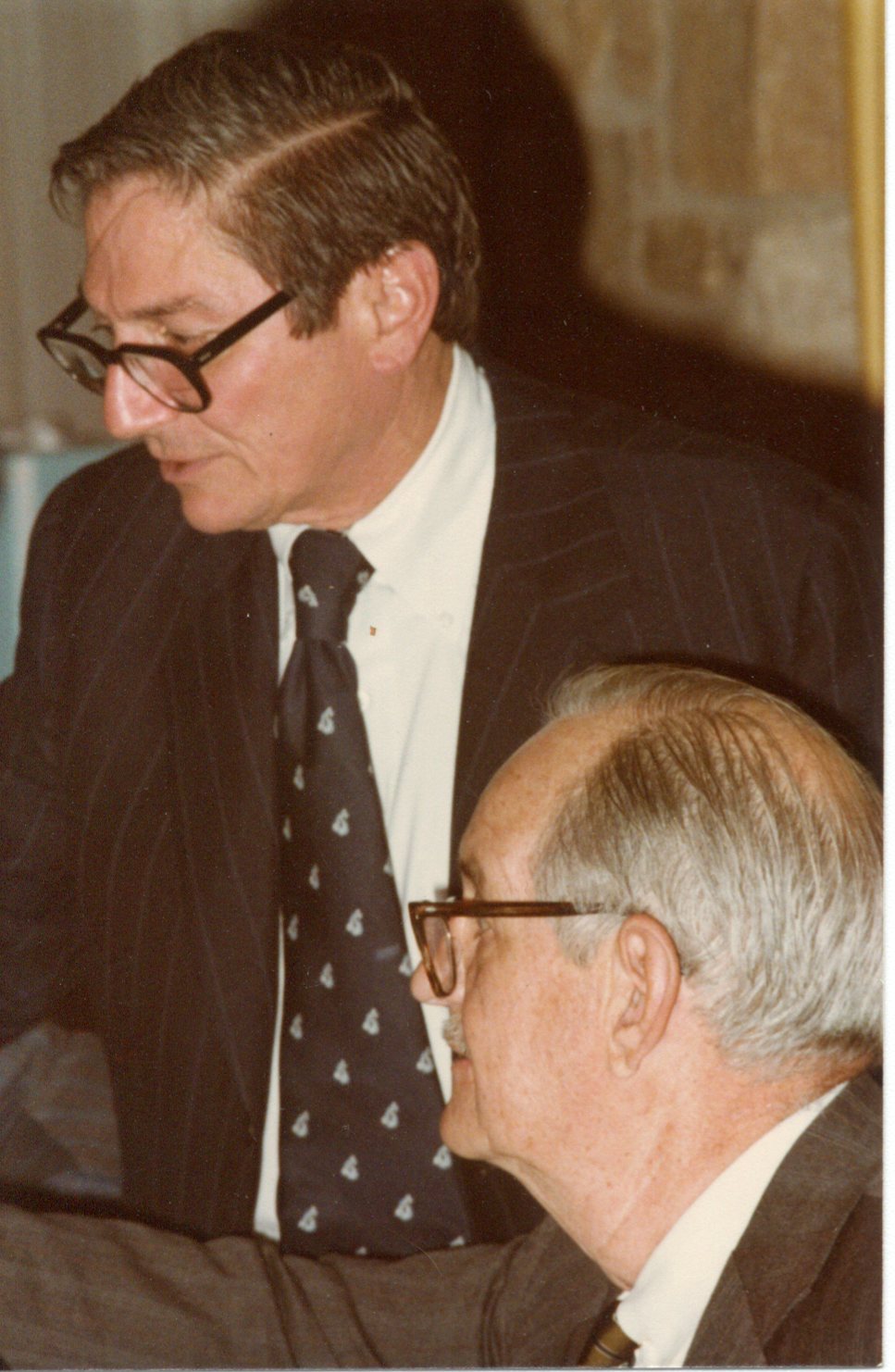
Tony Carpenter (top) with Brinkley Smithers
Carpenter held a wide range of leadership and editorial roles connected to the Journal of Studies on Alcohol and related publishing efforts at CAS. He served on the Editorial Board of the Quarterly Journal of Studies on Alcohol (1957–1962), then as Associate Editor of QJSA (1973–1974) and Associate Editor of the Journal of Studies on Alcohol beginning in 1975. He also took on fiscal and corporate responsibilities for the Journal’s parent organization, serving as Assistant Treasurer in 1972 and Secretary from 1973 onward. Later, he continued his long association with the Journal as Managing Editor and Vice President of its parent corporation, positions he held until his death in 2001.
Carpenter was also a strong public voice for alcohol research. During his directorship, he testified before Congress, served on a White House Blue Ribbon Panel, and helped shape legislation supporting the National Alcohol Research Centers of NIAAA. But despite his public-facing roles, colleagues consistently recalled his quiet dignity and “grace under fire” during the tumultuous early 1980s, when the Center faced shifting federal priorities and budgetary challenges.
A lifelong academic
Carpenter officially became Professor Emeritus in 1996, but, like many lifelong academics, he never fully retired. He maintained his editorial work with the Journal of Studies on Alcohol, continued supporting professional organizations, and remained active in research discussions until his death.
John Anthony Carpenter was interred at Arlington National Cemetery in 2001 with full military honors, a fitting final recognition for a man whose life combined service, scholarship, and dedication to building alcohol studies as a discipline.
The Carpenter Papers
The four Paige boxes contain materials documenting John A. Carpenter’s extensive administrative, policy, and institutional work at the Center of Alcohol Studies (CAS), reflecting his long relationship with both Yale and Rutgers. The earliest materials date from the 1960s, including correspondence from 1967–68 and progress reports for 1966–70, which provide insight into CAS research directions and Carpenter’s involvement in federally funded projects. The collection also includes external reviews from 1965 and 1970, showing how the Center’s performance and priorities were evaluated by outside bodies during this period of institutional transition.
A substantial portion of the documents concern the 1970s, a decade marked by CAS’s growing national prominence and Carpenter’s emerging leadership role. Materials include CAS policies from 1970–76, drafts of CAS bylaws, and planning documents related to facilities such as the Smithers Hall expansion (1977–). The files also contain public policy–related correspondence from 1975, including exchanges with Bill Lyons and Winkler regarding the role of CAS in public debates on alcohol. Notably, the box includes Carpenter’s statements before the Senate Subcommittee (1976, 1978, 1979) and related correspondence with Senators Harrison Williams and Bill Hathaway, documenting his direct engagement with national alcohol policy formation.
The 1980s are represented through governance documents such as materials from the NCA Blue Ribbon Panel on Alcoholism and Aging (1980), RCAS Advisory Board records (1981), and financial summaries and accounts (1976–78; 1986–87). These files illustrate Carpenter’s involvement in budgeting, staffing, and strategic planning during a period of shifting federal research support. Additional folders contain fundraising files, minutes from 1977–79, and external reviews from 1980, 1985, and 1995, showing how the Center continued to evaluate and adapt its mission.
A separate group of materials documents CAS’s academic and scholarly programs at Rutgers. These include records of programs, conferences, and symposia from the 1970s–1980s, the Graduate Certificate Program in Alcohol Studies, faculty presentations, and the 1988 search committee. Also included are research proposals, NIMH and USPHS grant materials, and the document “Research at CAS” (circa 1981), summarizing the Center’s scientific activities.
The Carpenter Papers provide an extensive record of the administrative, policy, and institutional landscape of CAS, illustrating Carpenter’s sustained role in shaping the Center’s development at Rutgers across three decades.
From the Digital Alcohol Studies Archives
- Notable People at CAS: John Anthony Carpenter (his profile page)
- Content of the Carpenter Papers
- John Anthony Carpenter: An Appreciation (1924-2001). Journal of Studies on Alcohol, 62(5), 549–551 (2001).
- History of the Center, presented by J. A. Carpenter in 1988 (1 video file, 77 min., sound, color)
- Download documents related to John Anthony Carpenter in RUcore, the Rutgers University Community Repository