
J. George Strachan (Source: Alcoholism treatment and prevention programs in Alberta, p. 12)
The history of alcohol studies is told through major institutions (Yale and Rutgers) and well-known figures, such as E. M. “Bunky” Jellinek, Selden D. Bacon, and Mark Keller. Less frequently do we acknowledge people who connected those institutions and individuals, who moved ideas across borders, translated theory into practice, and, most importantly, saved the paper trail. One of those figures was J. George Strachan, a Canadian researcher whose career helped shape modern alcohol studies in Canada and whose careful documentation now lives on in a surprisingly small archival collection at Rutgers University Libraries.
Strachan’s professional life links the Yale Center of Alcohol Studies and its Summer School directly to the development of alcohol research, treatment, and policy in Canada. His long relationship with Yale faculty, his intellectual debt to Jellinek, and his determination to preserve records allow us to trace those connections in remarkable detail. All of that history, decades of collaboration, influence, and institutional formation, fits into just two archival boxes known as the Strachan Collection.
Biosketch
J. George Strachan (1910–1996) was a Canadian researcher, writer, educator, administrator, and consultant whose work was instrumental in establishing alcoholism as a treatable illness within Canadian public health systems. Born in Montreal in 1910, Strachan came to the field with both administrative expertise and lived knowledge. He achieved long-term recovery from alcoholism in the 1940s, an experience that shaped how he understood the condition: not only as a clinical problem, but as a social responsibility.
 After early work in business and service in the U.S. Army Air Forces during the Second World War, Strachan moved into alcohol education and program development in the late 1940s. In 1951, he organized the Alcoholism Foundation of Alberta, one of Canada’s earliest comprehensive provincial programs addressing alcoholism through education, treatment, and research. As its executive director during its formative years, he helped lay the groundwork for what would become an integrated provincial system. Later, he served as a consultant to the Government of Alberta and worked with national and international addiction organizations.
Strachan was a prolific and gifted writer. His books, such as Alcoholism: Treatable illness, Practical alcoholism programming, and Recovery from Alcoholism, translated emerging scientific ideas into language that clinicians, policymakers, and the general public could understand. Throughout his work, he insisted that alcoholism should be recognized not only as an individual illness, but as a public health issue requiring coordinated response.
The Summer School and the Yale Center of Alcohol Studies
The year 1950 became a turning point came in Strachan’s career, when he and his wife Jane attended the Yale Summer School of Alcohol Studies (SSAS). Like many North American professionals who passed through the Summer School in the postwar period, Strachan was exposed to a radically different way of thinking about drinking problems, one grounded in interdisciplinary research rather than moral judgment.
At Yale, he was introduced to the ideas of as E. M. Jellinek, Selden D. Bacon, Leon Greenberg, Raymond McCarthy, and others who were redefining alcoholism as a disease process that could be studied, classified, and treated. The Summer School’s integrated curriculum focusing on research, clinical practice, and public policy left a lasting impression and it became the model Strachan would later adapt for Alberta.
 The Yale connection evolved into decades of exchange of ideas with lots of practical outcomes. In the 1950s, faculty from the Center of Alcohol Studies regularly traveled to Alberta to lecture at conferences and training events. The first Alberta Conferences on Alcohol Studies was held in 1954 and 1955, sponsored by the Alcoholism Foundation of Alberta and the University of Alberta. These conferences, featuring Yale-affiliated speakers such as Selden Bacon, Leon Greenberg, and Raymond McCarthy, mirrored the Summer School’s structure and content, effectively translating the Yale model into a Canadian setting.
Strachan served as both alumnus and ambassador, embracing and adopting the groundbreaking programs at the Yale Center of Alcohol Studies as a model for Canadian alcoholism education and treatment.
Strachan and Jellinek
Among all of Strachan’s professional relationships, none was more significant or more thoroughly documented than his relationship with E. M. Jellinek. The first introduction at the 1950 Summer School quickly grew into a close professional bond and personal friendship.

Bunky’s Doodle, or the Progression Phases of Alcoholism by Dr. E. M. Jellinek, which was presented to Jane and George Strachan at the Summer School of Alcohol Studies on July 18, 1950, at Pearson College of Yale University in New Haven, CT.
During that Summer School session, Jellinek introduced what would become one of his most significant contributions to the field: the concept of the progressive phases of alcoholism. In the classroom, he sketched a simple visual diagram, the famous “Bunky’s Doodle,” to illustrate the course of the illness. Jellinek later gave a copy of this drawing to George and Jane Strachan, a small gesture that might suggest both generosity and recognition of Strachan as someone who would carry these ideas forward.
The mutual trust deepened in the mid-1950s. As Jellinek’s formal role with the World Health Organization was coming to an end, Strachan, working closely with H. David Archibald (another SSAS alumnus) in Ontario, played a central role in shaping the next phase of Jellinek’s career. Letters preserved in the Strachan Collection document Strachan advocating for, organizing, and facilitating Jellinek’s work in Canada between 1957 and 1961.
During those years, Jellinek served as Chief Consultant to the Alcoholism Foundation of Alberta. He advised on program philosophy, evaluation, and education, reinforcing Strachan’s belief that alcoholism should be addressed through integrated systems linking treatment, research, and public policy. Jellinek’s international reputation helped legitimize these approaches at the governmental level in Canada.
“Alcoholism is a public health problem and therefore a public responsibility.” (Strachan, 1960. p. 3)
Equally significant was Strachan’s role as Jellinek’s informal historian. In the 1960s, Strachan compiled detailed manuscripts, timelines, appendices, and correspondence tracing Jellinek’s Canadian years. As board member of the Jellinek Memorial Fund, he collected and preserved correspondence related to its early years. In the late 1980s, he consolidated many of these in a manuscript entitled E. M. Jellinek, Sc.D, M. Ed., M. D. (Hon.): His stay in Canada. These materials, often including drafts and marked up copies, were not prepared for publication, but for documentation and accuracy. Today, they are among the most important primary sources for understanding the final chapter of Jellinek’s career. Without Strachan’s meticulous record-keeping, Jellinek’s work in Canada would be fragmentary at best.
From Jellinek to Canadian Alcohol Studies
Jellinek’s intellectual influence on Strachan is clearly visible throughout Strachan’s published work. Strachan embraced and expanded the disease concept of alcoholism, emphasizing symptom patterns, progression, and the importance of early intervention. His explanations of the phases of alcoholism closely reflected Jellinek’s framework, while adapting it to Canadian clinical, community, and policy contexts.
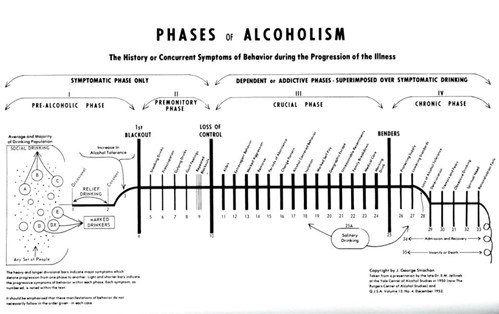
Phases of “Phases of Alcoholism” in George Strachan, Alcoholism: Treatable Illness (Orca Book Publishers, 1990), p. 108.
Through provincial programs, national conferences, and training initiatives, Strachan helped disseminate this approach across Canada. His work contributed to a broader shift away from punitive and moralistic responses toward coordinated health services, a shift that continues to shape contemporary addiction systems.
The Strachan Collection at Rutgers
 The Strachan Collection came to Rutgers University Libraries through Strachan’s long-standing relationship with the Rutgers Center of Alcohol Studies and its leadership. In 1989, Strachan donated some of his papers to the Rutgers Center of Alcohol Studies Archives, working closely with Dr. Gail Milgram, then Director of Education and Training and the Summer School of Alcohol Studies. When the Center’s Library and Archives closed in 2016, the collection was moved to Rutgers Libraries.
The Strachan Collection features professional and personal correspondence, unpublished manuscripts, conference planning materials, and biographical research related to E. M. Jellinek. As he wrote in an introductory note to his Jellinek manuscripts:
“These notes are prepared from memory, available correspondence, and discussions, and are intended to preserve the record accurately.”
— J. George Strachan, introductory note to Jellinek manuscripts
The donation was deliberate and historically minded. Strachan understood that letters, memos, drafts, notes, and administrative records could preserve and highlight not just his own career but also international networks that shaped modern alcohol studies.
Though modest in size, the collection is incredibly rich in content, reflecting decades of engagement with Yale, Rutgers, WHO, and Canadian provincial agencies. Digitized materials available in RUcore include Strachan’s unpublished manuscript Dr. E. M. Jellinek Comes to Alberta, Canada, a detailed chronological account of Jellinek’s activities in Canada, extensive correspondence with E. M. Jellinek and with his daughter, Ruth Jellinek, conference documentation, bibliographic compilations, and letters reflecting Strachan’s continued advocacy for the Center of Alcohol Studies after its move from Yale to Rutgers in 1962.
Together, these materials make the small Strachan Collection a critical resource. By presenting how ideas moved from Yale classrooms to provincial policy and from individual mentorship to institutional change, they help researchers understand today how science and scholarship can be translated into practice and policy.
Collection Highlights and Digitized Materials in RUcore
Digitized materials from the Strachan Collection available in RUcore, the Rutgers University Community Repository, include:
- Dr. E. M. Jellinek Comes to Alberta, Canada: An 8-page unpublished manuscript written by Strachan documenting the conception, execution, and impact of Jellinek’s Canadian activities provides contextual biographical details.
- Dates of Events Concerning Dr. E. M. Jellinek’s Coming to Alberta and His Stay in Canada: A chronological account created by Strachan to preserve historical accuracy covering February 25, 1957 – December 13, 1961.
- Correspondence between Strachan and E. M. Jellinek, including letters written during Jellinek’s stays in Toronto and Alberta.
- Correspondence with Ruth Jellinek, created as part of biographical research into Jellinek’s life.
- Appendices and bibliographic compilations related to Jellinek’s work in Canada.
- Letters between Strachan and Rutgers President Edward J. Bloustein, demonstrating Strachan’s continued advocacy for the Center of Alcohol Studies and the Summer School.

This Jellinek portrait was taken in November 1959 in Strachan‘s office and was used on the first page of a report called E. M. Jellinek, Sc. D., M. Ed., M. D. (Hon); His stay in Canada, by J. George Strachan, dated January 19, 1989.
A Witness Who Became a Historian
George Strachan’s legacy is inseparable from the institutions and individuals he connected. Through his engagement with the Yale Summer School of Alcohol Studies, his collaboration with E. M. Jellinek, and his conscientious preservation of records, Strachan ensured that the intellectual foundations of modern alcohol studies across borders were properly preserved.
Strachan was more than a beneficiary of Jellinek’s influence. He was the central figure responsible for extending Jellinek’s work beyond Yale and WHO into Canadian provincial and national policy as well as for preserving that history. From arranging Jellinek’s visit in 1957 to documenting his Canadian years up to the 1960s, Strachan acted as trusted colleague, facilitator, and historical recorder of Jellinek’s final professional chapter.
“Without such documentation, much of this history would inevitably be lost.”
— J. George Strachan
Today, the Strachan Collection at Rutgers makes it possible to reconstruct those networks. It reminds us that the history of alcohol studies is not only a story of theories and institutions, but also of people who understood the importance of moving ideas forward and leaving records behind.
References

Click on the image to read the full text in the SALIS Collection of the Internet Archive
- Alberta Conference on Alcohol Studies. (1954). Quarterly Journal of Studies on Alcohol, 15(4), 684–685.
- Alberta Conference on Alcohol Studies. (1955). Quarterly Journal of Studies on Alcohol, 16(3), 604.
- Strachan, J. G. (1960). A handbook on alcohol and alcoholism. Alcoholism Foundation of Alberta.
- Strachan, J. G. (1966). Dates of events concerning Dr. E. M. Jellinek’s coming to Alberta and his stay in Canada (Draft manuscript). Rutgers Center of Alcohol Studies Archives.
- Strachan, J. G. (ca. 1965). Dr. E. M. Jellinek comes to Alberta, Canada (Unpublished manuscript). Rutgers Center of Alcohol Studies Archives.
- Strachan, J. G. (1968). Alcoholism: Treatable illness. Mitchell Press.
- Strachan, J. G. (1971). Practical alcoholism programming: an honorable approach to man’s alcoholism problem. Mitchell Press.
- Strachan, J. G. (1975). Recovery from alcoholism. Mitchell Press.
- Strachan, J. G. (1989). E. M. Jellinek, Sc.D, M. Ed., M. D. (Hon.): His stay in Canada. Unpublished manuscript. Draft No. 3. Rutgers Center of Alcohol Studies Archives.
- Strachan, J. G. (1991). Alcoholism Treatment and Prevention Programs in Alberta, 1951-71. Their Origins, Growth and History, the First Twenty Years: a Personal Recollection. Alberta Alcohol and Drug Abuse Commission.
- T.G.C. (1960). Dr. E. M. Jellinek at seventy. Progress, 2(1), 1.
George Strachan (1910–1996)
- 1910 – J. George Strachan is born in Canada.
- 1940s – Strachan achieves long‑term recovery from alcoholism, later cited as more than 45 years of sobriety and foundational to his professional work.
- 1951 – Organizes the Alcoholism Foundation of Alberta, one of Canada’s earliest provincial alcoholism treatment systems.
- 1951–1965 – Serves in a leadership role with the Alcoholism Foundation of Alberta during its formative years.
- 1965 – Alberta’s alcoholism services transition into the Division of Alcoholism, continuing programs Strachan helped establish.
- 1968 – Publishes Alcoholism: Treatable Illness, asserting alcoholism as a diagnosable and treatable condition.
- 1968 – Introduces the influential “Phases of Alcoholism” conceptual model used in training and education.
- 1971 – Publishes Practical Alcoholism Programming, a programmatic guide for treatment systems and administrators.
- 1973 – Publishes “The Alberta Impaired Drivers’ Project” in Canadian Psychologist, linking behavioral treatment principles to public‑safety policy.
- 1970s – Co‑founds the Canadian Addictions Foundation, contributing to national coordination of addiction research and services.
- 1983 – Receives the Alberta Alcohol and Drug Abuse Commission’s first Distinguished Service Award.
- 1985 – Appointed a Member of the Order of Canada for pioneering work in alcohol rehabilitation.
- 1991 – Publishes Alcoholism Treatment and Prevention Programs in Alberta, documenting the province’s first 20 years of alcoholism services (1951–1971).
- 1996 – J. George Strachan dies, leaving a lasting legacy in Canadian addiction research, treatment, and policy.
Content of the Strachan Collection

This portrait was taken in the office of J. George Strachan in November 1959.
Box 1
- Correspondence (Misc)
- Jellinek’s visit to Canada
- Appendix to Jellinek’s visit
- Leaflet – “The Society of A.A.” by William Vl. (Co-Founder) Nov. 1949
- Leaflet – “What We Know About Drinking” – Chester Walker, July 1950
- Leaflet – ”The Alcoholic – A Public Responsibility” J. Hirsh, May 1947
- Booklet – A. A. Comes to the B. C./Yukon Area
- Booklet – A. A. Comes to the Stempede City
- Booklet – Saskatchewan A. A. Legacy
Box 2
- Correspondence: Jellinek Memorial Fund (1964-65) – Pt. 1
- Correspondence: Jellinek Memorial Fund – Pt. 2
- Correspondence re: Jellinek Biography.
- Correspondence: NAAAP (1959-67)
- Early history of the Canadian Council on Alcoholism and the Canadian Foundation on Alcoholism (1954-1961). Released December 1959, Edmonton, Alberta, Canada, J. George Strachan, secretary.
- Binder -“Government Programs on Alcoholism” by E. M. Jellinek, April 1963