Seasonal Mites
Seasonal Mites (Tetranychidae)
Mites are major economic pests in New Jersey nurseries and commercial landscapes. Mite species fall into two seasonal categories based on optimum temperature thresholds for reproduction and feeding.
Cool Season Mites are active during the spring and fall months, at temperatures that fall between 45 and 80 degrees F, and reaching a dormant state as eggs in the hotter summer months, when temperatures consistently exceed 85 degrees. Damage from cool season mites often goes unnoticed until summer heat reveals earlier spring feeding as leaves turn brown.
Warm Season Mites are active in mid summer, at temperatures between 80 and 90 degrees F and above, and reproduce quite rapidly in high heat, with new generations arising every 5-7 days. wr
Quarantine and Management Policies
- Mites can spread quite rapidly through nursery production blocks via wind currents, infested propagation stock, clothing, and machinery. Establishing sanitation and quarantine protocols can prevent costly nursery-wide outbreaks.
- Preserving Natural Enemies: Avoid unnecessary broad-spectrum pyrethroid or carbamate sprays that can eliinate native predatory mites (Phytoseiulus, Neoseiulus, Typhlodromus), minute pirate bugs (Orius), and ladybeetle predators (Stethorus).
- Isolating Incoming Stock: Quarantine incoming woody ornamental liners, container plants, and greenhouse stock in an isolated area for 10-14 days. Inspect the leaf undersides with a hand lens before integrating the stock into the main growing area.
- Environmental Management and Sanitation:
- Avoid Plant Stress: Water-stressed plants attract mites and increase mite reproduction by producing high amino acid concentrations in their sap.
- Border Controls: Maintain 10 to 15 feet of weed-free area around nursery containers and field borders, as broadleaf weeds can serve as reservoirs for mites.
- Propagation Sanitation: Inspect plants before cuttings are taken, and treat propagation material with horticultural oil or insecticidal soap.
- Equipment Practices: Disinfect pruning tools, gloves, and machinery when moving in between growing areas.
- Miticide Resistant Management:
- Mites (specifically Two-Spotted Spider Mites) can develop resistance to chemical miticides quite quickly.
- Targeting Life Stages: Pair chemicals that target adult insects with insect growth regulators (IGRs) that target eggs, treating with both early in the season to target all life stages and prevent rapid reproduction.
- Chemical Rotation: Do not apply products from the same IRAC (Insecticide Resistance Action Committee) group more than twice in a row, or for more than two consecutive generations.
- Mites (specifically Two-Spotted Spider Mites) can develop resistance to chemical miticides quite quickly.
Diagnostic and Scouting Guidelines
- Monitor Emergence:
-
- Use a 10X hand lens for spider mites, eggs, and predatory mites.
- Scouting for Cool Season Mites should be done in early spring (March through May) and autumn (September through November). Pay close attention following mild winter conditions or early warm spells.
- Scouting for Warm Season Mites should be done during hot, dry summer periods (June through August). Increase scouting frequency every 3-5 days when the daily temperatures begin to exceed 85F, as hot weather can shorten reproduction cycles.
- Symptom identification:
- Foliar Stippling: Fine white, yellow, or bronze speckling on upper leaf surfaces
- Silky Webbing: Webbing can indicate heavy populations of spider mites (Tetranychus or Oligonychus spp.).
- “Beat Sheet” Tests: A piece of white paper on a clipboard can be used to detect mites. Holding the paper under the branch in question, firmly strike the branch with a stick or your hand, and observe the paper for 10-15 seconds.
- Spider Mites (Tetranychidae): Appear as tiny, slow-moving specs (green, yellow, or dark red). Crushing them with your finger leaves a green or red streak.
- Predatory Mites (Phytoseiidae): Move significantly faster across the paper, hunting other mites. These are beneficial insects and should not be targeted in management practices.
- Thrips: Elongated bodies that crawl rapidly or hop.
- Identify Weak Plants and Risk:
- Protective scouting and early identification is crucial for detection and management of mites to keep their populations down.
- Take special care of plants to avoid plant stress. Pay close attention to plants when they are stressed, particularly in hot or dry weather.
- Submit Samples
- If you are unable to identify an insect, submit samples to the Rutgers Plant Diagnostic Laboratory.
- Website: Rutgers Plant Diagnostic Lab
- Location: Ralph Geiger Center, CVI, 20 Dudley Road, New Brunswick, NJ 08901
- Contact: 848-932-9140 | plant-clinic@njaes.rutgers.edu
- If you are unable to identify an insect, submit samples to the Rutgers Plant Diagnostic Laboratory.
Cool-Season Mites
-
Spruce Spider Mite (Oligonychus ununguis)

Although a Fir & not a Spruce, the older needle discolorations are stippling symptoms from spruce spider mites. Photo Credit: Steven K. Rettke of Rutgers Coop. Ext. Spruce spider mites are small arachnids, about 0.5mm in length, and are one of the most destructive cool-season spider mites in coniferous landscapes and nurseries. Adult females are oval, dark green to blackish-red with pale, tan legs. Young nymphs are light green. Overwintering eggs are tiny, red, spherical, and often tucked beneath needle bases and bud scales.
- Hosts:
- Conifers
- Picea (Spruce, especially Dwarf Alberta Spruce, Colorado Blue Spruce, and Norway Spruce), Thuja (Arborvitae), Juniperus (Juniper), Tsuga (Hemlock), Abies (Fir), Chamaecyparis (False Cypress), and Pinus (Pine).
- Conifers
- Signs and Symptoms:
- Fine whitish yellow speckling (stippling) on inner needle bases that progresses outward towards new growth
- Needles turn yellow, bronze, or grayish-brown
- Fine, silky webbing across needle clusters
- Premature needle drop, leading to bare interior branches
- Canopy thinning
- Twig dieback
- Crawler Windows and Life Cycle:
- Multiple Generations per Year in NJ:
- Overwintered eggs hatch in early spring
- Active feeding and reproduction during cool weather from April to early June 9100-800 GDD), and resumes in autumn, from September through November.
- Populations go dormant as eggs during July and August, when heat peaks
- Multiple Generations per Year in NJ:
- Control & Management Strategy:
- Perform regular beat sheet tests in spring and fall
- Apply 2-3% horticultural oil in late winter and early spring (March) before bud break to target overwintering eggs
- Apply selective miticides such as hexythiazox, etoxazole, spiromesifen, or bifenazate during peak spring or autumn feeding windows.
- Avoid broad-spectrum pyrethroid sprays during active windows that will destroy native predatory mites and cause secondary outbreaks
- Important Regulatory Note: Always strictly adhere to product label guidelines. THE LABEL IS THE LAW.
- For detailed IPM protocols and diagnostic assistance, visit the Spruce Spider Mite Page
- Additional Resources & Extension Factsheets
- Hosts:
-
Southern Red Mite (Oligonychus ilicis)
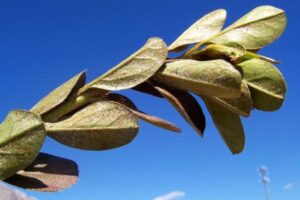
Southern Red Mite, Photo: Steven K. Rettke, Rutgers Cooperative Extension Southern red mites are 0.5mm long arachnids that are among the most prevalent cool-season spider mites on broadleaf evergreens in New Jersey landscapes and nurseries. Adult females are oval, shiny, and dark reddish-purple to brown, with pale tan legs. Larvae and nymphs are light red to orange. Overwintering eggs are tiny, bright red, spherical, and located on leaf undersides.
- Hosts:
- Prefers broadleaf evergreens
- Particularly Ilex (Holly, especially Japanese Holly, Inkberry, and American Holly), Rhododendron, Azalea, Camellia, Pieris (Andromeda), Kalmia (Mountain Laurel), and Leucothoe.
- Prefers broadleaf evergreens
- Signs and Symptoms:
- Heavy, uniform bronze, reddish-brown, or gray discoloration on upper leaf surfaces
- Fine yellow stippling marks that can coalesce into large bronzed patches
- Cast nymph skins
- Fine silk webbing accumulation along midribs on leaf undersides
- Premature leaf drop
- Interior canopy thinning
- Aesthetic decline in hot summer months
- Crawler Windows and Life Cycle:
- Multiple Generations per Year in NJ:
- Overwintered eggs hatch in early spring
- Active feeding and reproduction in cool, humid weather from April through June (7-91 GDD for initial hatch, populations increase through 800 GDD).
- Populations become dormant in mid-summer heat and resume activity in autumn from September through November.
- Multiple Generations per Year in NJ:
- Control & Management Strategy:
- Examine leaf undersides using a 10X hand lens or using a beat-sheet test starting in April
- Apply 2-3% horticultural oil in late winter to target overwintering eggs on lower leaf surfaces.
- Apply selective miticides such as hexythiazox, etoxazole, spiromesifen, or bifenazate during peak spring or autumn feeding windows.
- Apply 1% summer horticultural oil or insecticidal soap sprays, ensuring thorough coverage of lower leaf surfaces where mites congregate.
- Important Regulatory Note: Always strictly adhere to product label guidelines. THE LABEL IS THE LAW.
- For detailed IPM protocols and diagnostic assistance, visit the Southern Red Mite Page
- Additional Resources & Extension Factsheets
- Hosts:
-
Hemlock Rust Mite (Nalepella tsugifoliae)
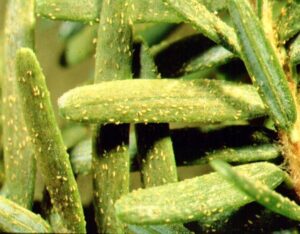
Hemlock Rust Mite on needles. Photo: Ohio State Cooperative Extension Hemlock rust mites are microcsopic (0.15-0.2 mm) eriophyid mites. They are pinkish-orange to light yellow in color, wedge-shaped, and have only two pairs of legs at the front of their body. They are invisible to the naked eye, and require a 20-40X hand lens or pocket microscope to detect.
- Hosts:
- Prefers Tsuga canadensis (Eastern Hemlock) and Tsuga caroliniana (Carolina Hemlock). Occasionally found feeding on Abies (Fir) and Picea (Spruce).
- Signs and Symptoms:
- Needles develop a dull, grayish-blue, green, or bronze-sheen, before turning rust-colored and dropping prematurely
- Heavy cast white skins lining the undersides of needles
- Foliage appears dusty or dirty
- Canopy thinning
- Needle loss starting on lower branches or inner foliage
- Symptoms are frequently misdiagnosed as drought stress, nutrient deficiency, or damage from hemlock wooly adelgids
- Crawler Windows and Life Cycle:
- Multiple Generations per Year in NJ:
- Emerges and begins feeding early in late winter or spring from March through May (7-200 GDD).
- Secondary feeding periods occur during cool autumn months.
- Activity ceases during peak summer heat.
- Multiple Generations per Year in NJ:
- Control & Management Strategy:
- Examine leaf undersides using a 20-40X hand lens or using a beat-sheet test starting in April
- Standard spider miticides (such as bifenazate) generally lack activity against Eriophyids.
- Apply materials labeled for Eriophyids, such as abamectin, spiromesifen, or bifenthrin.
- Apply 1-2% horticultural oil or insecticidal soap sprays in early spring as soon as active mites are observed to prevent major damage
- Important Regulatory Note: Always strictly adhere to product label guidelines. THE LABEL IS THE LAW.
- For detailed IPM protocols and diagnostic assistance, visit the Hemlock Rust Mite Page
- Additional Resources & Extension Factsheets
- Hosts:
Warm-Season Mites
-
Two-Spotted Spider Mite (Tetranychus urticae)

Multiple life stages of Two spotted spider mites. Photo: Steven Rettke, RCE. Two-spotted spider mites are destructive, polyphagous warm-season pests. Adults are 0.5 mm in length, oval, pale greenish-yellow, and characterized by two dark spots on each side of the body. Mated females overwintering in leaf litter or bark crevices turn bright red-orange.
- Hosts:
- Polyphagous, attacking over 300 species
- Specifically woody ornamentals, including Rosa (Rose), Buddleja (Butterfly Bush), Salix (Willow), Euonymus, Hydrangea, as well as herbaceous perennials, annuals, and greenhouse container crops.
- Polyphagous, attacking over 300 species
- Signs and Symptoms:
- Fine whitish-yellow stippling on leaf surfaces, progressing to bleached, bronzed, and scorched leaves
- Dense sheets of fine silk webbing covering the undersides of leaves, growing tips, and flower buds during severe infestations
- Severe defoliation
- Plant stunting
- Rapid death of nursery stock
- Crawler Windows and Life Cycle:
- Multiple Generations per Year in NJ:
- Overwintered orange females emerge in spring as temperatures warm (360-700 GDD).
- Populations increase during hot, dry summer months (June to August, 1000-2800 GDD).
- During peak heat (85-95F+), development from egg to adult takes as little as 5 to 7 days.
- Multiple Generations per Year in NJ:
- Control & Management Strategy:
- Due to resistance risks, rotate miticide IRAC chemical classes across generations Use targeted materials like cyflumetofen, bifenazate, etoxazole, acequinocyl, or chlorfenapyr.
- Avoid plant drought stress and high-nitrogen fertilizer applications
- Conserve native predatory mites (Phytoseiidae) or release commercial biocontrol agents (Phytoseiulus persimilis or Neoseiulus californicus) early in the season
- Important Regulatory Note: Always strictly adhere to product label guidelines. THE LABEL IS THE LAW.
- For detailed IPM protocols and diagnostic assistance, visit the Two-Spotted Spider Mite Page
- Additional Resources & Extension Factsheets
- Hosts:
-
Honeylocust Spider Mite (Platytetranychus multidigituli)

Honeylocust Spider Mites will primarily feed on leaf undersides & concentrate at the base of the leaflets. (Photo Credit: Steven K. Rettke, Rutgers Coop. Ext.) Honeylocust spider mites are tiny, host-specific warm-season spider mites Adults are about 0.3mm long, oval, greenish-yellow, and blend in with foliage. Overwintering adult females turn bright orange-red and are found in clusters under trunk bark scales and around branch crotches.
- Hosts:
- Almost exclusively targets Gleditsia triacanthos (Honeylocust) and its cultivated varieties (‘Shademaster’, ‘Sunburst’, and ‘Skyline’).
- Signs and Symptoms:
- Fine yellow stippling along compound leaflets
- Early season foliage yellowing that transitions into a bronze or brown color by mid-summer
- Premature leaflet drop in July and August
- Bare leaf stems and thinning canopies
- Light webbing accumulation on leaf undersides during summer infestations
- Crawler Windows and Life Cycle:
- Multiple Generations per Year in NJ:
- Overwintered females emerge around bud break in May
- Populations build through early summer, and peak during hot, dry weather from July through August (1000-2200 GDD).
- Multiple Generations per Year in NJ:
- Control & Management Strategy:
- Inspect bark crevices and bud scales with a 10-15X hand lens during late winter or early April
- Apply selective miticides such as bifenazate, hexythiazox, or etoxazole when leaf stippling appears in June
- Apply 1% summer horticultural oil or insecticidal soap sprays to leaf undersides
- Important Regulatory Note: Always strictly adhere to product label guidelines. THE LABEL IS THE LAW.
- For detailed IPM protocols and diagnostic assistance, visit the Honeylocust Spider Mite Page
- Additional Resources & Extension Factsheets
- Hosts:
-
Maple Spider Mite (Oligonychus aceris)
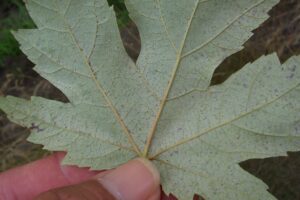
Maple spider mite on leaf underside. Photo: Steven K. Rettke (RCE) Maple spider mites are specialized warm-season spider mites. Adults are 0.4mm long, oval, dark red to greenish-brown, with lighter pale legs. Overwintering eggs are tiny, red spheres laid in clusters around bark crevices, leaf scars, and branch crotches.
- Hosts:
-
Prefers Acer species, specifically Acer rubrum (Red Maple), Acer saccharum (Sugar Maple), Acer palmatum (Japanese Maple), and Acer x freemanii (Freeman Maple cultivars).
-
- Signs and Symptoms:
- Fine yellow stippling on leaf undersides along main veins
- Leaves become scorched, bronze, or rusty brown in color by mid-to-late summer
- Light webbing and white cast skins on leaf undersides
- Crawler Windows and Life Cycle:
- Multiple Generations per Year in NJ:
- Overwintered eggs hatch shortly after maple leaf expansion in spring (May)
- Active feeding builds throughout warm summer weather, reaching peak populations in July and August (800-2000 GDD)
- Multiple Generations per Year in NJ:
- Control & Management Strategy:
- Apply 2-3% dormant horticultural oil in late winter (March), prior to bud break to target overwintering eggs
- Monitor leaf undersides starting in June.
- Apply targeted miticides such as hexythiazox, bifenazate, or spiromesifen when nymph counts increase.
- Avoid using broad-spectrum pyrethroid insecticides on maples, which eliminate predatory mites and cause spider mite surges
- Important Regulatory Note: Always strictly adhere to product label guidelines. THE LABEL IS THE LAW.
- For detailed IPM protocols and diagnostic assistance, visit the Maple Spider Mite Page.
- Additional Resources & Extension Factsheets
- Hosts:
-
Oak Spider Mite (Oligonychus hirtellus)

Active oak spider mites and eggs can be washed off leaves with a strong jet-spray of water. (Photo Credit: David Shetlar, Ohio State Coop. Ext.) Oak spider mites are warm-season spider mites adapted to broadleaf hardwood foliage. Adults are 0.4mm long, oval, dark green to reddish-brown, with prominent dorsal bristles across their body. Overwintering red eggs are deposited on small twigs, bark scales, and around bud bases.
- Hosts:
- Prefers Quercus species (Oaks), including Red Oak (Quercus rubra), Pin Oak (Quercus palustris), Willow Oak (Quercus phellos), and White Oak (Quercus alba).
- Signs and Symptoms:
- Yellowish stippling along leaf midribs and primary lateral veins
- Upper leaf surfaces are dirty bronze, yellow, or scorched
- Accumulation of white cast skins along leaf undersides
- Canopy thinning
- Early leaf drop on nursery liners and landscape shade trees during periods of drought
- Crawler Windows and Life Cycle:
- Multiple Generations per Year in NJ:
- Overwintered eggs hatch in the spring after leaf expansion (May)
- Populations increase quickly during warm, dry periods from June through August (1000-2200 GDD)
- Multiple Generations per Year in NJ:
- Control & Management Strategy:
- Use beat-sheets routinely starting in June to tack active mite numbers
- Apply selective miticides such as bifenazate, hexythiazox, etoxazole, or acequinocyl covering leaf undersides completely.
- Apply 1% summer horticultural oil or insecticidal soap during early summer.
- Important Regulatory Note: Always strictly adhere to product label guidelines. THE LABEL IS THE LAW.
- For detailed IPM protocols and diagnostic assistance, visit the Oak Spider Mite Page.
- Additional Resources & Extension Factsheets
- Hosts: