Actionable Diseases
Actionable Diseases of Concern for New Jersey Nurseries
Actionable plant diseases present pressing biological and economic threats to the commercial nursery industry, landscape ecosystems, and timber resources in New Jersey. Caused by fungi, bacteria, oomycetes, and nematodes, these pathogens can cause tissue necrosis, vascular wilt, canopy decline, and tree mortality. Many of these organisms are subject to strict regulatory quarantines or cause irreversible crop loss, and early identification, strict biosecurity, and rapid reporting are vital to protecting commercial nursery production.
What Defines an Actionable Disease?
Actionable diseases are prioritized in plant pathology, triggering immediate regulatory interventions, quarantine protocols, and intensive eradication measures when they are detected. In nursery production settings, these pathogens are often characterized by their potential for rapid spread, severe economic damage, and status as state or federally regulated entities (i.e. USDA Select Agents). The discovery of an actionable pathogen within a facility can lead to mandated stop-sale orders, destruction of host blocks, or long-term soil quarantine restrictions.
Quarantine Policies
- National Regulations (USDA-APHIS): The USDA Animal and Plant Health Inspection Service (APHIS) establishes federal quarantines to prevent the interstate movement of plant material that carries actionable diseases. USDA-APHIS mandates strict compliance agreements, pre-shipment certifications, and sanitary standards for nurseries that are propagating or shipping host material out of established regulated regions.
- State Regulations (NJDA): The New Jersey Department of Agriculture (NJDA) Division of Plant Industry enforces state-level plant health standards, conducts routine health surveys, and oversees eradication efforts in the event that high consequence pathogens are detected in commercial production or nearby natural habitats.
Mandatory Reporting
If you suspect or confirm the presence of a regulated invasive pest (such as vascular wilt, severe interveinal leaf banding, unusual stem cankers, or unexplained root rot) in your nursery stock:
- Isolate the Affected Stock: Stop all movement or shipping of suspected plant material immediately. Flag and isolate all affected blocks or field rows. Discontinue overhead irrigation to prevent waterborne pathogen dispersal and spread.
- Collect Details: Note the host plant species, location, photos of symptoms/pests, and the extent of the infection.
- Implement Sanitation Measures: Disinfect tools, pruning shears, footwear, and equipment with approved sanitizers (70% ethanol, 10% bleach) before moving between production areas.
- Notify State & Federal Authorities:
- NJDA Division of Plant Industry: Call 609-406-6939 or email plantindustry@ag.nj.gov.
- USDA-APHIS NJ State Plant Health Director: Call 609-259-5260.
- Rutgers Cooperative Extension: Contact your local county agriculture agent for field-level evaluation.
Diagnostic Support
Symptoms of actionable diseases often mimic abiotic stress or secondary infections, so lab verification is recommended and often necessary. For official confirmation and diagnosis, submit samples to the Rutgers Plant Diagnostic Laboratory.
- Website: Rutgers Plant Diagnostic Lab
- Location: Ralph Geiger Center, CVI, 20 Dudley Road, New Brunswick, NJ 08901
- Contact: 848-932-9140 | plant-clinic@njaes.rutgers.edu
- Submission Guidelines:
- Double-bag live tissue samples showing early-to-intermediate symptoms
- Avoid completely dead material
- Keep the samples cool during transport
- Do not add wet paper towels to avoid tissue rot
Common Actionable Diseases of Concern
-
Sudden Oak Death (Phytopthora ramorum)

Sudden Oak Death. Photo via Joseph O’Brien, USDA APHIS Sudden Oak Death (SOD) is a destructive, soil- and water-borne disease caused by the oomycete pathogen Phytopthora ramorum. It impacts forest trees, with the pathogen also being the cause of Ramorum Leaf Blight/Twig Canker in woody nursery stock. It thrives in cool, wet environments and spreads through water (rain splash, wind-blown fog, irrigation), and contaminated potting media or nursery stock.
- Hosts:
- More than 100 species across woody and herbaceous genera (specifically Quercus (oak), Rhododendron, Camellia, Kalmia (mountain laurel), Lithocarpus (tan oak), Pieris, Viburnum, and Syringa (lilac).
- Signs and Symptoms:
- Bleeding trunk cankers – brownish-black sap that oozes through the bark on the host’s lower trunk
- Rapid wilting
- Foliar blight.- irregular water-soaked leaf spots, tip necrosis
- Shoot dieback
- Tree death
- Control & Management Strategy:
- Inspect incoming nursery stock for foliar blight and dark bleeding sap
- Isolate new host material in dedicated quarantine blocks
- Ensure proper drainage in containers
- Sanitize pruning tools and equipment with approved disinfectants (quaternary ammonium compounds, 70% alcohol)
- Apply preventative systemic treatments on high-value stock to lessen infection incidences
- Phosphonates (potassium phosphite, mefenoxam)
- Important Regulatory Note: Always strictly adhere to product label guidelines. THE LABEL IS THE LAW.
- For detailed IPM protocols and diagnostic assistance, visit the Rutgers Plant Diagnostic Lab.
- Additional Resources & Extension Factsheets
- Hosts:
-
Sudden Oak Death (Bretziella fagacearum)

Red oak infected with oak wilt. Photo via Joseph O’Brien, USDA Forest Service Oak Wilt is a fatal vascular wilt disease caused by the fungus Bretziella fagacearum. The pathogen works by clogging the water-conducting xylem vessels of the host trees, causing rapid wilting of foliage and eventual tree mortality. The fungus spreads short distances underground through natural root grafts, and longer distances aboveground through sap-feeding nitidulid beetles that are attracted to fresh tree wounds.
- Hosts:
- Infects Quercus species.
- Red oaks are highly susceptible (Q. rubra, Q. velutina, Q. palustris)
- White oaks show moderate tolerance or slower progression of symptoms (Q. alba, Q. bicolor)
- Infects Quercus species.
- Signs and Symptoms:
- Rapid leaf bronzing and defoliation – leaves discolor from the outer margins inward and drop while still partially green
- Dark brownish-black vascular streaking in the outer sapwood when outer bark is removed
- Sweet-smelling fungal spore mats form beneath the bark of dead trees – causes bark to crack open, attracting beetle vectors
- Mortality within weeks of symptoms appearing
- Control & Management Strategy:
- Look for leaves browning from the outer margins inward
- Do not prune oaks from March through November to lessen the presence of beetle vectors
- Sever root grafts around infected trees
- Inject high-value plants with propiconazole to prevent fungal establishment if the disease or vectors are present in the area
- Important Regulatory Note: Always strictly adhere to product label guidelines. THE LABEL IS THE LAW.
- For detailed IPM protocols and diagnostic assistance, visit the Rutgers Plant Diagnostic Lab.
- Additional Resources & Extension Factsheets
- Hosts:
-
Laurel Wilt (Harringtonia lauricola)

Laurel wilt on sassafras. Photo via A.E. Mayfield III, USDA Forest Service Laurel wilt is a vascular fungal diseases caused by Harringtonia lauricola. The fungus is introduced to host trees by the Radbay Ambrosia Beetle (Xyleborus glabratus) which carries the pathogen in its mouthparts. The fungus colonizes the host’s xylem vessels and forces the tree to shut down its water transport system, causing rapid wilting and eventual plant death.
- Hosts:
- Infects Lauraceae family members (including Sassafras albidum (sassafras), Lintera benzoin (spicebush), Persea borbonia (redbay), and Persea americana (avocado))
- Signs and Symptoms:
- Canopy wilting and discoloration – leaves rapidly droop, turn reddish-brown or purple, and remain hanging on dead branches
- Wood discoloration – dark brownish-black streaks in outer sapwood when bark is stripped away from trunks and stems
- Ambrosia beetle frass, 1-2 mm entrance holes, and sawdust toothpicks protruding from the bark
- Rapid mortality
- Control & Management Strategy:
- Immediately chip and burn or double-bag infested wood on-site
- Do not transport unseasoned firewood or wood chips
- Apply residual pyrethroid sprays (bifenthrin, permethrin) to main stems when ambrosia beetle activity is high
- Inject high-value trees with preventative fungicides (such as propiconazole)
- Important Regulatory Note: Always strictly adhere to product label guidelines. THE LABEL IS THE LAW.
- For detailed IPM protocols and diagnostic assistance, visit the Rutgers Plant Diagnostic Lab.
- Additional Resources & Extension Factsheets
- Hosts:
-
Beech Leaf Disease (Litylenchus crenatae mccannii)
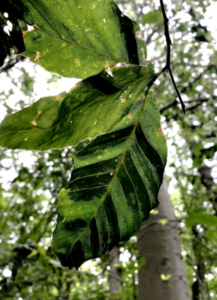
Banding on leaves from beech leaf disease. Photo via Jean Epiphan. Beech leaf disease (BLD) is caused by an invasive foliar nematode, Litylenchus crenatae mccannii that overwinters inside leaf buds and feeds within expanding foliage tissue in the spring. It causes severe leaf degradation, canopy loss, and tree death in forests and nurseries within 2-6 years of infection.
- Hosts:
- Infects beech species (Fagus spp.), including American beech (F. grandifolia), European beech (F. sylvatica), and Oriental beech (F. orientalis).
- Signs and Symptoms:
- Dark, thick, greenish-black bands between leaf veins that can be seen when looking through the leaf canopy against sunlight
- Leaves become distorted – thickened, puckered, leathery, and curled, worsening as the season progresses
- Bud mortality, widespread bud abortion
- Canopy dieback and thinning
- Reduced spring leaf-out
- Tree mortality
- Control & Management Strategy:
- Collect and destroy fallen leaves in autumn to reduce habitat for overwintering nematodes
- Carefully inspect all incoming Fagus material for interveinal banding and quarantine before introducing it to the field
- Apply injectible trunk formulations of thiabendazole or foliar phosphite sprays (i.e. potassium phosphite) on high-value stock.
- Important Regulatory Note: Always strictly adhere to product label guidelines. THE LABEL IS THE LAW.
- For detailed IPM protocols and diagnostic assistance, visit the Rutgers Plant Diagnostic Lab.
- Additional Resources & Extension Factsheets
- Hosts:
-
Bacteria Wilt (Ralstonia solanacearum (Race 3 Biovar 2))

Ralstonia in geranium leaves. Photo via USDA APHIS website. Ralstonia solanacearum (Race 3 Biovar 2) is a soil-borne bacterium that causes severe bacterial wilt through inhibiting xylem function. It is classified as a USDA Select Agent due to its imminent threat to agriculture. The pathogen infects hosts through roots or stem cuttings, and clogs vascular tissue, leading to rapid plant collapse under warm conditions.
- Hosts:
- Infects solanaceous crops (including potato, tomato, eggplant), and multiple key greenhouse and nursery ornamentals (specifically Pelargonium (geranium), Dipladenia, and Mandevilla)
- Signs and Symptoms:
- Lower leaf wilting, drooping, and yellowing or browning
- Dark browning of xylem tissues inside stems
- Cut stem sections suspended in water stream milky white bacterial threads
- Formation of adventitious roots along lower stems
- Symptoms progress rapidly and eventually lead to full-plant collapse and death
- Control & Management Strategy:
- Immediately isolate suspect shipments and notify state and federal plant health officials
- Infected plants must be destroyed under official supervision
- Disinfect greenhouse benches, irrigation lines, tools, and potting areas with registered sanitizers
- Enforce strict hand-sanitizing procedures between crop handling
- Purchase only certified disease-free, tested cuttings from established and accredited propagators
- Important Regulatory Note: Always strictly adhere to product label guidelines. THE LABEL IS THE LAW.
- For detailed IPM protocols and diagnostic assistance, visit the Rutgers Plant Diagnostic Lab.
- Additional Resources & Extension Factsheets
- Hosts:
-
Southern Blight (Agroathelia rolfsii / Sclerotium rolfsii)
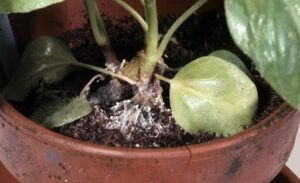
Southern blight on octopus tree. Photo via Florida Division of Plant Industry, Florida Department of Agriculture and Consumer Services, Bugwood.org. Southern blight is a soil-borne fungal disease that is caused by Agroathelia rolfsii (formerly Sclerotium rolfsii). The pathogen attacks plant stems at the soil line during periods of high temperature (>85F) and high relative humidity. It survives in nursery soil and container media for multiple years as sclerotia.
- Hosts:
- Extremely broad host range of over 500 plant species
- Including herbaceous perennials, annuals, woody nursery stock (Hosta, Paeonia, Sedum, Salvia, Buxus), and vegetable crops.
- Extremely broad host range of over 500 plant species
- Signs and Symptoms:
- Dense, fan-like white fungal growth spreading across soil surface and wrapped around stem bases
- Small, round, tan-to-brown sclerotia (resting structures) forming on the fungal mats on the soil
- Rapid yellowing, wilting, and collapse of foliage
- Death of host plants due to crown girdling
- Control & Management Strategy:
- Immediately remove and destroy infected plants and surrounding soil and potting media
- Do not compose infected material
- Solarize field soil or use steam-sterilized potting substrates to kill sclerotia before planting
- Apply soil drenches using fungicides labeled for Sclerotium or Agroathelia (i.e. flutolanil, azoxystrobin, tebuconazole) in hot summer weather
- Important Regulatory Note: Always strictly adhere to product label guidelines. THE LABEL IS THE LAW.
- For detailed IPM protocols and diagnostic assistance, visit the Rutgers Plant Diagnostic Lab.
- Additional Resources & Extension Factsheets
- Hosts: