Christmas Tree Growing Guide
Growing Christmas Trees in New Jersey
Christmas tree production in the Mid-Atlantic requires proactive Integrated Pest Management (IPM), careful site selection, and active monitoring of growing degree days (GDD) to manage pest cycles effectively. Christmas trees are long-term perennial crops that can take 6 to 10 years to reach marketable size, so early site planning and routine field maintenance are essential to preventing chronic pest pressure and tree loss.
Throughout the growing cycle, growers can face a range of insect pests, fungal pathogens, weed competition, and environmental stressors which can degrade foliage quality, deform tree architecture, or lead to total crop loss.
An IPM framework is essential to maintaining plantation health while optimizing economic and environmental sustainability. By aligning cultural operations with targeted IPM strategies, growers can build resilient plantations, protect tree aesthetics, and maximize marketable yields.
Introduction to Christmas Tree Growing and Management
- Target Crops:
- True Firs (Abies spp. – Fraser, Balsam, Canaan)
- Pines (Pinus spp. – Eastern White, Scots)
- Spruces (Picea spp. – Colorado Blue, Norway).
- Douglas-fir (Pseudotsuga menziesii)
- Alternative Christmas trees:
- Turkish fir
- Nordman fir
- China fir
- Korean fir
- Soil & Site Requirements:
- Christmas trees (especially true firs) often require deep, well-drained soils, specifically loams or sandy loams
- Poorly drained or saturates soils can lead to anaerobic conditions that foster root rot pathogens
- pH should be maintained between 5.5 and 6.5 for most conifer species
- Test the soil prior to planting, and apply lime or sulfur as recommended
- Weed suppression and ground covers
- Competitive weeds and brush between rows should be controlled using mowed sod grass strips or directed herbicides.
- Weed management reduces competition for soil moisture and nutrients, removes hosts plants for pests, and improves air circulation around the lower limbs to prevent diseases.
- Christmas trees (especially true firs) often require deep, well-drained soils, specifically loams or sandy loams
- Cultural Practices:
- Shearing/pruning schedules:
- Pines should be sheared during active growth in early summer, before new wood hardens. This encourages lateral bud formation on current-year growth.
- Firs and spruces should be sheared during the dormant season (late summer through early spring), or after the shoot growth has expanded and hardened.
- Terminal leader management:
- Terminal leaders are the topmost vertical shoots of the trees that grow straight up. These shoots determine the tree’s height and crowning shape and are essential for Christmas tree grower management.
- Excessively long terminal leaders should be pruned to maintain the ideal tree taper and density.
- If the leader is damaged by pests, prune it back and train a side branch to grow upright using terminal stakes.
- Stress reduction:
- During prolonged summer droughts, use supplemental irrigation to reduce plant stress and prevent secondary pest attacks from opportunistic organisms (i.e. bark beetles and spider mites)
- Shearing/pruning schedules:
Common Tree Types
-
True Firs (Abies spp.)
Frasier Fir (Abies fraseri)
- Characteristics:
- Known for exemplary post-harvest needle retention and strong branches
- Dark green needles with silver bands on the undersides
- Site and Soil Requirements:
- Requires cool sites with well drained, fertile soils
- pH target near 6.0
- Thrives on cooler, northern-facing slopes and elevated terrain
- Management and IPM Notes:
- Susceptible to Phytopthora root rot in saturated soils
- Key insect pests include Cryptomeria scale and balsam twig aphid
- Dormant-season shearing is recommended for density maintenance

Frasier Fir (Abies fraseri) tree by Brent Moore CC BY-NC 2.0 Balsam Fir (Abies balsamea)
- Characteristics:
- Fragrant with good needle retention
- Soft, flat, dark green needles
- Good needle retention with adequate post-harvest watering
- Site and Soil Requirements:
- Suited best for cooler northern regions
- Prefers cool, moist, well-drained sandy loams
- Sensitive to late spring frosts and poorly drained soils
- Management and IPM Notes:
- Key insect pests include balsam twig aphid, and early-season scouting is highly recommended prior to bud break
- Prone to heat stress in lower Mid-Atlantic zones

Balsam Fir (Abies balsamea) by Douglas Goldman, USDA Canaan Fir (Abies balsamea var. phanerolepis)
- Characteristics:
- Good mix of traits from Fraser and Balsam firs
- Deep green foliage
- Strong branch structure
- Good post-harvest needle retention
- Site and Soil Requirements:
- Tolerance for more poorly drained soils than Frasers
- Greater adaptability to heavier soils and moderately wetter sites compared to Frasers
- Soil drainage is critical to avoid anaerobic conditions
- Management and IPM Notes:
- Bud breaks slightly later than Balsam fir, reducing susceptibility to late spring frost damage
- Monitor for Cryptomeria scale and spruce spider mites.

Cannaan Fir (Abies balsamea var. phanerolepis) by Daderot CC0 1.0 - Characteristics:
-
Pines (Pinus spp.)
Eastern White Pine (Pinus strobus)
- Characteristics:
- Fast-growing, with blue-green needles
- Flexible branches, so less suited for heavier ornaments
- Very light aroma
- Site and Soil Requirements:
- Adaptable across various soil textures when drainage is adequate
- Target pH is 6.0
- Management and IPM Notes:
- Requires regular shearing for density maintenance
- Shearing should take place in the summer while new growth is actively expanding (before the wood hardens). This forces lateral buds to develop.
- Major pests include White Pine Weevil and Nantucket Pine Tip Moth.
Eastern White Pine (Pinus strobus) by Jim Robbins CC BY-NC-ND 4.0 Scots Pine (Pinus sylvestris)
- Characteristics:
- Traditional, resilient tree
- Features stiff, slightly twisted blue-green needles
- Easily supports heavy ornaments
- Excellent needle retention post-harvest
- Site and Soil Requirements:
- Adaptable to low-fertility soils, sandy ground, and drier areas
- Target pH is 6.0
- Management and IPM Notes:
- Shearing should be performed in early summer during active shoot growth
- Highly susceptible to Nantucket Pine Tip Moth, pine needle scale, and pine shoot beetle.

Scots Pine (Pinus sylvestris ‘Watereri’) by Jardin des Plantes CC BY 1.0 - Characteristics:
-
Spruces (Picea spp.)
Colorado Blue Spruce (Picea pungens)
- Characteristics:
- Known for its bright blue to silvery-green foliar color and stiff branches
- Easily supports heavy decorations
- Site and Soil Requirements:
- Tolerant of diverse soil conditions
- Requires wide row spacing and good air circulation
- Management and IPM Notes:
- Monitor for spruce spider mites during cooler windows in the spring and fall
- Prone to needle cast diseases and inner needle discoloration
- Can be impacted by white pine weevil on the terminal leaders.
- Shearing should take place during dormancy or after the new growth hardens.

Colorado Blue Spruce. Image via USU Extension Tree Browser. Norway Spruce (Picea abies)
- Characteristics:
- Rapid grower with dark green foliage
- Known for its classic, symmetrical shape.
- Strong branches
- Post-cut needle retention is lower than firs and pines.
- Site and Soil Requirements:
- Performs well on medium to heavy moist loams
- pH target of 5.5 to 6.5
- Management and IPM Notes:
- Best harvested closer to Christmas because of needle drop after cutting
- Good candidate for “choose-and-cut” operations
- Key pests include white pine weevil and spruce spider mite.

Norway Spruce Trees – Photos by Paul Wray, Iowa State University - Characteristics:
-
Douglas-fir (Pseudotsuga menziesii)
While not a true fir, the Douglas-fir is historically one of the most widely grown and sold Christmas tree species in New Jersey.
- Characteristics:
- Known for its sweet fragrance, soft dark-green or blue-green needles, and medium-strong branches.
- Site and Soil Requirements:
- Requires light-to-medium, well-draining soils with good air drainage to prevent needle cast diseases.
- Highly sensitive to wet, waterlogged soils
- Management and IPM Notes:
- Highly susceptible to Rhabdocline and Swiss needle casts, as well as Douglas-fir needle midge
- Sensitive to Phytophthora root rot.
- Susceptible to spring frost damage
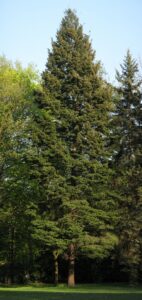
Douglas Fir tree by Crusier CC BY 3.0 via NCSU - Characteristics:
-
Turkish Fir (Abies bornmuelleriana)
Native to northern Turkey, the Turkish fir is gaining popularity among growers as a climate-resilient alternative to Fraser and Balsam firs.
- Characteristics:
- Features thick, glossy, deep green needles with silver-white bands on the undersides.
- Growth habit is symmetrical and dense, with rigid, horizontal branches that easily support heavy ornaments.
- Exceptional needle retention.
- Site and Soil Requirements:
- Stronger drought tolerance and heat resistance than Frasers
- Management and IPM Notes:
- Resistant to Phytophthora root rot and drought, fitting well into fields with a history of root disease.
- Late budbreak helps to protect against early spring freeze events.

Turkish Fir tree. Photo via Wilson Bros Gardens. Nordmann Fir (Abies nordmanniana)
Nordmann makes up the vast majority of the European market, but remains a specialty crop in North America.
- Characteristics:
- Long, flat, dark green needles with a soft, blunt tip smooth to the touch
- Foliage has a rich, waxy sheen and a full growth habit
- Industry-leading needle retention
- Needles rarely drop even as the tree dries
- Mild scent compared to the Balsam fir
- Site and Soil Requirements:
- Requires well-drained loam to sandy-loam soils.
- Requires adequate air movement to minimize foliar disease.
- Management and IPM Notes:
- Strong resistance to Phytophthora root rot and other root pathogens.
- Shearing during dormant season is recommended to manage leader length and branch taper.

Nordmann fir tree. Photo via Judy Kowalski. Korean Fir (Abies koreana)
Native to South Korea, the Korean Fir offers one of the most distinctive looks among alternative Christmas tree species.
- Characteristics:
- Short, broad, bright green needles that curve upward to reveal white undersides, creating a two-toned “frosted” effect.
- Known for producing striking, upright purple-blue cones even on young trees, adding natural decoration.
- Slow-growing and compact with a tight pyramidal shape
- Site and Soil Requirements:
- Prefers well-drained, fertile soils with a pH of 5.5 to 6.5
- Management and IPM Notes:
- Requires regular leader management and shearing to shape

Korean Fir tree. Photo via aha CC BY-SA 3.0. China Fir (Cunninghamia lanceolata)
The China Fir is a broad-leaf conifer in the Cypress family (Cupressaceae) and is not a true fir.
- Characteristics:
- Unique, sharp needles (1–2 inches long) that spiral around stiff branches.
- Bright green to blue-green in summer, and bronze or reddish-brown in cold winter weather.
- Very fast-growing with a coarse, open texture.
- Foliage is quite stiff and spiky compared to traditional soft-needled firs.
- Site and Soil Requirements:
- Prefers acidic, well-drained soils
- Should be protected from extreme winter desiccation.
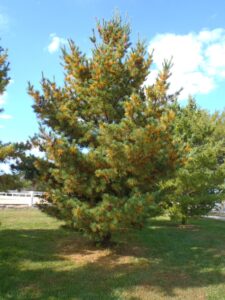
- Management and IPM Notes:
- Pruning is required to maintain a centralized leader

China Fir ‘Chason’s Gift.’ Photo via Jim Robbins CC BY-NC-ND 4.0. - Characteristics:
Christmas Tree Primary Pests
-
Cryptomeria Scale (Aspidiotus cryptomeriae)
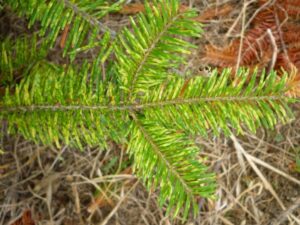
Symptoms on Frasier-fir by Cryptomeria Scale at undersides of needles. (Photo Credit: Steven K. Rettke, Rutgers Coop. Ext.) Cryptomeria scale is an invasive armored scale pest that poses a major economic threat to conifer plantations in the Mid-Atlantic. Feeding on needle undersides, these pests sap sap and degrade foliage aesthetics, leading to rapid needle drop and reduced crop marketability.
- Hosts: Frasier fir, Canaan fir, Hemlock
- Signs and symptoms:
- Female scales on needle undersides appear as small, flat, white ovals with a prominent yellow center.
- Yellowish mottling or chlorotic banding on the upper surface of needles.
- Premature inner needle drop.
- Dirty appearance from scale armor.
- Translucent yellow crawlers appear in late spring (June) and late summer (August).
- Management:
- Prune out isolated, heavily infested branches or rogue out severely damaged trees to prevent field spread.
- Time contact spray applications or insect growth regulators (IGRs) to target active crawlers during peak Growing Degree Days (533–820 GDD).
- Apply horticultural oil or targeted insect growth regulators
- Utilize targeted systemic applications (e.g., dinotefuran) for severe infestations while preserving beneficial natural predators (lady beetles and parasitic wasps).
Important Regulatory Note: Always strictly adhere to product label guidelines. THE LABEL IS THE LAW.
Click here to be brought to the Cryptomeria Scale Page for more detailed information.
-
Balsam Twig Aphid (Mindarus abietinus)

Balsam twig aphid is an early-season pest targeting true firs. Feeding activity on expanding spring shoots distorts tender growth, permanently disfiguring current-year foliage and reducing tree value right before shoot elongation completes.
- Hosts: Frasier fir, Canaan fir, Balsam Fir
- Key Symptoms:
- Twisted, curled, or distorted shoot tips on spring growth
- Sticky honeydew and white, waxy secretions.
- Needles on current-year growth become dwarfed and discolored.
- Secondary black sooty mold fungus develops on honeydew deposits along branches.
- Management:
- Inspect terminal and lateral buds in early spring (prior to budbreak) for hatching eggs and stem mothers.
- Apply horticultural oil before budbreak to suppress hatching aphid populations.
- Apply target biorational or systemic insecticides in early spring after aphid hatch, but before expanding shoot needles curl and protect the feeding aphids.
- Protect beneficial insects like lacewings, lady beetles, and hoverfly larvae by avoiding unnecessary broad-spectrum sprays.
- Scout during early spring, prior to budbreak
Important Regulatory Note: Always strictly adhere to product label guidelines. THE LABEL IS THE LAW.
Click here to be brought to the Balsam Twig Aphid Page for more detailed information.
-
Spruce Spider Mite (Oligonychus ununguis)

Although a Fir & not a Spruce, the older needle discolorations are stippling symptoms from spruce spider mites. Photo Credit: Steven K. Rettke of Rutgers Coop. Ext. Spruce spider mite is a major cool-season pest of spruces, firs, junipers, and hemlocks. Mite populations surge during cool spring and fall weather, causing extensive needle damage that often goes unnoticed until hot summer weather sets in.
- Hosts: Fir, Spruce, Hemlock, Juniper
- Key Symptoms:
- Feeding causes minute yellow or flecked stippling marks on needle surfaces.
- Heavily damaged foliage loses bright green color, turning dusty grey, bronze, or brown.
- Fine silken webbing collects dust and debris between needles near branch axils.
- Premature shedding of older, inner needles, leaving sparse, thin canopy architecture.
- Management:
- Tap suspect branches over a white sheet of paper in spring and fall; count slow-moving, dark green-to-black cool-season mites.
- Wash foliage with strong water jets to knock down small populations and suppress dust buildup.
- Apply targeted miticides or horticultural oils during active cool-weather feeding windows (spring and autumn). Avoid broad-spectrum pyrethroids that destroy predatory mites.
- Irrigate trees during prolonged dry spells to mitigate environmental stress that accentuates mite damage.
- Management window: this is a cool-season pest, active in the spring and fall
Important Regulatory Note: Always strictly adhere to product label guidelines. THE LABEL IS THE LAW.
Click here to be brought to the Spruce Spider Mite Page for more detailed information.
-
Nantucket Pine Tip Moth (Rhyacionia frustrana)
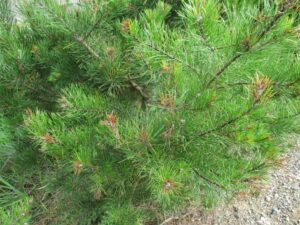
Nantucket Pine Tip Moth infesting multiple twig shoots of this Jersey scrub pine (Pinus virginiana). (Photo Credit: Steven K. Rettke, Rutgers Coop. Ext.) Nantucket pine tip moth is a destructive caterpillar pest primarily affecting two- and three-needle pines. Larval tunneling within terminal and lateral buds kills shoot tips, causing severe loss of tree height and symmetrical architecture.
- Hosts: Eastern White pine, Scots pine, Loblolly pine
- Key Symptoms:
- Terminal and lateral shoots turn yellow, brown, and die in early-to-mid summer.
- Larvae tunnel inside stems; breaking damaged shoot tips reveals hollowed stems filled with frass.
- Small, crusty pitch masses and silken webbing accumulate at needle bases and terminal bud clusters.
- Loss of dominant terminal leaders causes adventitious branching, resulting in crooked trunks and stunted foliage.
- Management:
- Set up pheromone traps in early spring to monitor adult moth flight patterns and pinpoint egg hatch timing.
- Apply contact insecticides or IGRs precisely 10–14 days after peak adult moth flight to target newly hatched larvae before they tunnel into stems.
- Shear and burn infested shoot tips in early summer before adults emerge to reduce subsequent generations.
- Plant resistant pine species or substitute true firs/spruces on sites with heavy historical tip moth pressure.
Important Regulatory Note: Always strictly adhere to product label guidelines. THE LABEL IS THE LAW.
Click here to be brought to the Nantucket Pine Tip Moth Page for more detailed information.
-
White Pine Weevil (Pissodes strobi)

Often by July, an infested terminal will brown & die as the weevil larvae have destroyed the vascular tissues. (Photo Credit: Steven K. Rettke, Rutgers Coop. Ext.) White pine weevil is the most destructive insect pest of Eastern White Pine, Norway Spruce, and Colorado Blue Spruce in the Northeast. Larval feeding girdles the main terminal stem, destroying years of height growth and ruining tree symmetry.
- Hosts: Eastern White pine, Norway spruce, Colorado blue spruce
- Key Symptoms:
- The main terminal leader wilts, turns brown, and curls over into a characteristic “shepherd’s crook” shape in June or July.
- Resin droplets weep from puncture wounds made by feeding adults near the top whorl in spring.
- Small, round adult emergence holes pepper the bark of dead terminal leaders by late summer.
- Side branches turn upward to compete for dominance, resulting in a multi-stemmed, bushy tree.
- Management:
- Apply protective insecticide sprays directly to the upper terminal leader in early spring (April) when overwintered adults emerge to feed and lay eggs.
- Prune out wilting “shepherd’s crook” leaders in mid-summer before adult beetles emerge. Cut down to the highest healthy whorl and burn/bag the infested stems.
- Train a healthy lateral branch to become the new central leader using terminal stakes or clips.
- Regularly inspect top whorls for glistening resin droplets during early spring warm-ups.
Important Regulatory Note: Always strictly adhere to product label guidelines. THE LABEL IS THE LAW.
Click here to be brought to a Plant and Pest Advisory Post regarding this pest.
-
Emerald Ash Borer (Agrilus planipennis)
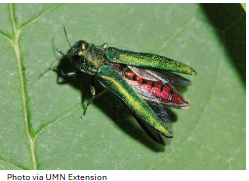
Emerald ash borer (EAB) is a destructive metallic wood-boring beetle that attacks all native North American ash species (Fraxinus spp.). While ash is not a Christmas tree crop, EAB is a high-priority nursery pest across New Jersey. Larvae feed on inner bark tissue, disrupting nutrient transport and causing 100% tree mortality when left untreated.
- Key Symptoms:
- Small D-shaped exit holes (approx. 1/8-inch wide) on trunk bark created by emerging adults in late spring.
- S-shaped feeding tunnels packed with frass visible directly beneath peeled bark.
- Canopy dieback starting from top branches, accompanied by prolific epicormic shoots (“water sprouts”) sprouting from lower trunk bark.
- Heavy woodpecker feeding damage where birds strip outer bark to consume larvae underneath.
- Management:
- Promptly remove and chip or burn infested ash trees; strictly observe regional hardwood movement quarantines to prevent human-assisted spread.
- Apply systemic insecticides (e.g., emamectin benzoate injections or imidacloprid/dinotefuran soil drenches) in spring before adult emergence (at 450–500 GDD).
- Carefully inspect bark on incoming ash liner stock or shade tree inventory for exit holes or bark splitting.
- Eliminate ash from production schedules and substitute non-host native shade tree species.
Important Regulatory Note: Always strictly adhere to product label guidelines. THE LABEL IS THE LAW.
Click here to be brought to the Nursery IPM Page for this pest.
- Key Symptoms:
-
Ambrosia Beetle (Xylosandrus)

Photo Credit: Brad Barnd, Bug Guide.net Ambrosia beetles (including the black stem borer and granulate ambrosia beetle) are aggressive wood-boring pests targeting stressed woody plants in nurseries and landscapes. Attracted by stress-induced ethanol emissions (such as from waterlogging or cold injury), adult females bore deep into heartwood and cultivate symbiotic fungi that obstruct plant vascular transport.
- Key Symptoms:
- Delicate, compact cylinders of sawdust and frass protruding outward from pinhole-sized bark entrance holes.
- 1-millimeter circular entry holes along lower trunks, main stems, or root flares.
- Dark brown or black fungal staining in internal sapwood galleries when stems are cut open.
- Sudden wilting, leaf scorching, or branch dieback on stressed trees during early spring warm-ups.
- Management:
- Maintain proper drainage, prevent root waterlogging, and protect from winter/freeze injury to avoid stress-induced ethanol production.
- Hang ethanol-baited traps in early spring when temperatures exceed 60°F–65°F (75–815 GDD window) to detect adult female emergence flight.
- Apply preventative pyrethroid bark sprays (e.g., bifenthrin or permethrin) to lower trunks of susceptible nursery stock before beetles bore into wood.
- Systemics are ineffective once beetles are inside.
- Immediately cull, bag, and destroy heavily infested nursery plants with active gallery holes to eliminate local populations.
Important Regulatory Note: Always strictly adhere to product label guidelines. THE LABEL IS THE LAW.
Click here to be brought to the Nursery IPM Page for this pest.
- Key Symptoms:
Christmas Tree Diseases and Abiotic Issues
-
Inner Needle Discoloration
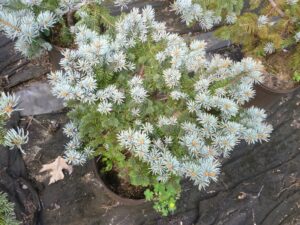
Colorado Spruce showing symptoms of undesirable discoloration of older, inner needles. Photo Credit: Steven K. Rettke of Rutgers Coop. Ext. Inner needle discoloration is a complex disease condition affecting Colorado Blue Spruce and Norway Spruce. Triggered by foliar fungal pathogens interacting with environmental stress, it degrades lower canopy aesthetics and causes severe interior defoliation.
- Hosts: Colorado blue spruce, Norway spruce
- Key Symptoms:
- 2-year-old interior needles turn dull yellow, tan, or purplish-brown in spring while current-year tip growth remains green.
- Foliar discoloration and shedding begin on lower, shaded branches and move progressively upward and outward.
- Infected inner needles drop prematurely, giving branches a bare, see-through, or “tufted” end-growth appearance.
- Tiny black pycnidia or fruiting dots erupt through stomatal rows on infected needles under high humidity.
- Management:
- Space trees properly and control inter-row weeds to maximize sunlight penetration and foliage drying.
- Avoid shearing when foliage is wet to prevent spreading fungal spores across adjacent trees.
- Irrigate during dry periods to prevent drought-induced needle shedding that mimics disease symptoms.
- Apply protective fungicide sprays (e.g., chlorothalonil, mancozeb, or copper compounds) at spring budbreak when new shoots are expanding.
Important Regulatory Note: Always strictly adhere to product label guidelines. THE LABEL IS THE LAW.
Click here to be brought to our Inner Needle Discoloration of Spruce page.
-
Phytophthora Root Rot (Phytophtora spp.)

Phytophthora root rot is the single most destructive disease of true firs (especially Fraser and Douglas-fir) in the Eastern US. This soil-borne oomycete water mold thrives in heavy, poorly drained soils, destroying root systems and causing tree mortality.
- Hosts: Fraser fir, Douglas-fir, White pine
- Key Symptoms:
- Foliage turns pale green, yellow, and eventually dull reddish-brown across the entire canopy.
- Scraping bark off the trunk base at or below the soil line reveals dark brown wood instead of healthy white tissue.
- Feeder roots become dark brown and decayed, lacking healthy white growing tips.
- Stunted growth followed by rapid wilting and tree mortality during warm summer weather.
- Management:
- Plant sensitive true firs (Fraser/Balsam) exclusively on deep, well-draining loams. Use disease-resistant species (Turkish/Nordmann fir) on heavier or marginal sites.
- Install sub-surface tile drains, plant on raised beds, and eliminate standing water in low-lying field blocks.
- Burn infected trees along with surrounding soil; do not replant susceptible firs in infected root spots.
- Apply preventative oomycete-targeted fungicides (e.g., mefenoxam, phosphonates) in high-risk nursery blocks or seedling beds.
- Ensure site selection has adequate drainage
- Apply preventative oomycete-targeted fungicide drenches in susceptible blocks.
Important Regulatory Note: Always strictly adhere to product label guidelines. THE LABEL IS THE LAW.
Click here to be brought to our Root Disease Oomycetes page.
-
Rhabdocline Needle Cast (Rhabdocline spp.)

Rhabdocline Needlecast – Douglas Fir (Steven K. Rettke – RCE) Rhabdocline needle cast is a severe foliar disease specific to Douglas-fir (Pseudotsuga menziesii). Highly active in wet spring weather, unmanaged infections cause severe foliage loss, rendering trees unmarketable as Christmas trees.
- Hosts: Douglas-fir
- Key Symptoms:
- Yellow spots or blotches appear on 1-year-old needles in late autumn, turning reddish-brown to purple by early spring.
- Orange/reddish-brown apothecia erupt on needle undersides along the midrib in spring.
- Severely infected needles drop in early summer, leaving only current-year green tip needles attached.
- Repeated years of infection cause bare inner branches, severely thinning the tree.
- Management:
- Prune lower branches and maintain low weed competition to accelerate foliage drying within the canopy.
- Plant Douglas-fir seed sources/varieties resistant to Rhabdocline.
- Remove and destroy severely infected trees that act as inoculum sources for surrounding blocks.
- Apply protective fungicide sprays (e.g., chlorothalonil, mancozeb) when new spring shoots are 1/2 to 1 inch long; reapply according to label intervals until needle growth hardens.
Important Regulatory Note: Always strictly adhere to product label guidelines. THE LABEL IS THE LAW.
Click here to be brought to our Rhabdocline Needle Cast page.
-
Rhizosphaera Needle Cast (Rhizosphaera spp.)

Rhizosphaera Needle cast – Spruce (Steven K. Rettke – RCE) Rhizosphaera needle cast is the primary fungal needle disease of Colorado Blue Spruce and White Spruce. Stress, dense tree spacing, and high spring humidity accelerate spore release, causing progressive branch defoliation from the bottom up.
- Key Symptoms:
- 1-year-old needles turn fuzzy yellow, then purplish-brown or reddish-brown in late summer or spring.
- Fuzzy black fruiting bodies (pycnidia) erupt through white stomatal pores along rows on discolored and green needles (visible with a hand lens).
- Symptoms start on inner lower branches where humidity is highest and move outward/upward over time.
- Continuous defoliation over 3 to 4 consecutive years leads to complete branch mortality.
- Management:
- Space plantings adequately, avoid planting in low fog pockets, and prune lower ground-touching branches.
- Use drip irrigation or water early in the morning to allow foliage to dry.
- Consider replacing highly susceptible Colorado Blue Spruce with more resistant spruce species (e.g., Norway Spruce) on humid sites.
- Apply protective fungicides (e.g., chlorothalonil) in spring when new shoots are 1/2 to 2 inches long; make a second application 3 to 4 weeks later.
Important Regulatory Note: Always strictly adhere to product label guidelines. THE LABEL IS THE LAW.
Click here to be brought to our Rhizosphaera Needle Cast page.
- Key Symptoms:
-
Swiss Needle Cast (Nothophaeocryptopus gaeumannii)
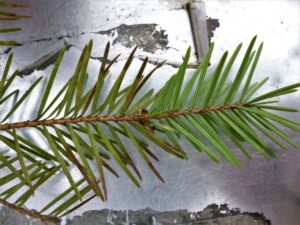
Swiss Needlecast – Douglas Fir (Steven K. Rettke – RCE) Swiss needle cast is a widespread fungal disease affecting Douglas-fir (Pseudotsuga menziesii). By clogging needle stomata with fruiting structures, the fungus impairs photosynthesis, causing premature needle shedding and sparse, unmarketable crowns.
- Key Symptoms:
- Microscopic, soot-like black dots (pseudothecia) emerge in clean, double lines along stomatal rows on the underside of needles.
- 1- to 2-year-old needles turn yellow-green, then light brown before dropping prematurely.
- Trees retain only the current year’s growth tips, resulting in a thin, sparse, hollow canopy structure.
- Tree height and lateral branch expansion slow significantly following multi-year infections.
- Management:
- Control weeds and maintain open tree spacing to reduce relative humidity in the lower canopy.
- Inspect incoming nursery liners for stomatal black dots before planting out field blocks.
- Maintain balanced soil fertility based on regular soil tests to help infected trees replace lost foliage.
- Apply protective fungicides (e.g., chlorothalonil, copper formulations) in spring when new needles are expanding (late May) and repeat 4–6 weeks later.
Important Regulatory Note: Always strictly adhere to product label guidelines. THE LABEL IS THE LAW.
- Key Symptoms:
-
Cankers (Sphaeropsis/Diplodia and Cytospora Canker)
Swiss Needlecast – Douglas Fir (Steven K. Rettke – RCE) Conifer cankers are fungal stem diseases primarily affecting stressed pines (Sphaeropsis/Diplodia) and spruces (Cytospora). Canker fungi destroy cambium tissue, girdling branches and trunk leaders, leading to branch death and unsightly white pitch deposits.
- Key Symptoms:
- Bluish-white, crusted pitch/resin runs down stems and branches below infected canker sites.
- Individual branches die back scattered throughout the tree, with dead needles turning reddish-brown and remaining attached.
- Sunken, dark brown bark lesions girdle twigs, branches, and terminal leaders.
- Diplodia causes stunt, browning, and twisting of newly expanding tip shoots in spring.
- Management:
- Prune out infected branches several inches below visible cankers during dry weather in late winter or early spring.
- Disinfect tools between cuts.
- Avoid mechanical wounds to trunk bark and branches during shearing, mowing, or harvesting operations.
- Irrigate trees during hot summer dry periods and avoid excessive high-nitrogen fertilization.
- Apply protective fungicides during spring budbreak for Diplodia tip blight control on high-value pine blocks.
- Prune out infected branches several inches below visible cankers during dry weather in late winter or early spring.
Important Regulatory Note: Always strictly adhere to product label guidelines. THE LABEL IS THE LAW.
Resources:
- Key Symptoms: