Boxwood Growing Guide
Boxwood (Buxus spp.)
Boxwoods are popular evergreen landscape plants in New Jersey, often valued for their appearance in areas with formal hedging and high deer pressure. While widely used across the state, they are susceptible to a number of pests and diseases, and require proper planting and management practices to ensure their successful growth.
- Hardiness Zones: USDA Zones 5 through 7
- Growing Preferences: Full sun to partial shade, well-draining soil, neural-to-alkaline pH
- Deer Resistance: Highly resilient against deer pressure due to the alkaloid content in their leaves.
Why Boxwoods?
- Over 11 million plants are sold nationally each year
- Valued at over $126 million
- Used in landscaping for about 6,000 years
- First used in Egyptian gardens in about 4,000 BC
- The name “boxwood” is derived from the ancient Greeks
- Planted in George Washington’s Mt. Vernon Estate

Common Pests and Diseases
-
Box Tree Moth (Cydalima perspectalis)

Left: BTM Damage. Center: BTM Caterpillars. Right: Adult BTM moths.
The box tree moth is a destructive invasive Lepidoptera native to eastern Asia that is spreading throughout the country, and now the state of New Jersey.
- It is currently found throughout most of Europe
- in Europe, they have been found feeding on burning bush (Euonymus alatus), Japanese spindletree (E.japonicus), purple holly (Ilex chinensis), and orange jessamine (Murraya paniculata) once the nearby boxwoods are completely defoliated.
- First detection in North America was in Toronto in 2018
- It has ben spreading and found in the Great Lakes Region (OH, PA, MI, NY) and DE
- Federal quarantines are in effect NOW
- It was recently found (in the summer of 2026) in Cape May County, New Jersey. It is extremely important for growers to be on the lookout for the pest and take preventative measures to stop its spread.
- Blind preventative pesticide applications are not advisable
- Monitor your boxwoods April – October!
- The USDA and NJDA have established monitoring zones surrounding current infestations, and a quarantine has been established for all of Cape May County, NJ which applies to anyone moving boxwoods out of the county

- Signs and symptoms:
-
- Box tree moth caterpillars cause complete defoliation of boxwood leaves, consume inner bark, and eventually kill the plants.
- There are NO native caterpillars that DEFOLIATE boxwoods
- Box tree moth caterpillars cause complete defoliation of boxwood leaves, consume inner bark, and eventually kill the plants.
-
- The larvae spin silken webbing and leave large amounts of green and brown frass.
- If you see this pest:
-
- Report it!
- Eradicate it!
- Treat the infested plants with Compliance Agreement cited materials (Compliance Agreement – Appendix 1)
- Follow all label requirements, especially REIs. THE LABEL IS THE LAW.
Active IRAC Bifenthrin [3] Lambda cyhalothrin [3] Permethrin [3] Chlorantraniliprole [28] Cyantraniliprole [28] 
- Remove it!
-
-
- After the REI is complete and BTM has been eradicated, remove the infested plants by double bagging them and taking them to an in-county municipal dump.
-
- Stay Educated: Box Tree Moth Resources:
- Video: “Demystifying Box Tree Moth” – HRI
- Factsheet: Box Tree Moth: Fact Sheet, Management & Visual Guide
- USDA-APHIS Box Tree Moth : APHIS BTM Landing page
- [Draft] Compliance agreement: National Plant Board – Box Tree Moth
- Plant and Pest Advisory: Box Tree Moth Confirmed in NJ
- Box Tree Moth – NJ.gov
- National Invasive Species Information Center BTM Page
- It is currently found throughout most of Europe
-
Boxwood Leaf Miner (Monarthropalpus flavus)

Photo Credit: Steven K. Rettke, Rutgers Coop. Ext. The boxwood leafminer is a tiny, orange, gnat-like fly whose larvae feed on the tissue inside boxwood leaves. It is widely considered one of the most destructive pests affecting boxwoods across the Mid-Atlantic region.
- Signs and Symptoms:
- Underside Leaf Blisters: Raised, blister-like spots on the lower leaf surface.
- Foliage Discoloration: Yellowing, bronzing, or water-soaked appearance of leaves.
- Premature Leaf Drop: Early defoliation, leading to sparse branching.
- Exit Holes: Pinprick-sized translucent windows or exit holes left by emerging adult flies in late spring.
- Control & Management Strategy:
- Cultural & Mechanical: Prune infested branch tips before larvae mature, and select resistant cultivars (e.g., Buxus microphylla varieties).
- Chemical Control: Apply surface (foliar) or systemic insecticides as a last resort when populations exceed economic thresholds.
- Important Regulatory Note: Always strictly adhere to product label guidelines. THE LABEL IS THE LAW.
- For detailed IPM protocols, visit the Rutgers Boxwood Leafminer Control Page.
- Additional Resources & Extension Factsheets
-
- Rutgers Plant & Pest Advisory:
-
- Industry & Extension Guides:
- Signs and Symptoms:
-
Boxwood Mites (Eurytetranychus buxi)

Boxwood spider mite feeding symptoms. This mite species creates linear streaks on leaves. (Photo Credit: Steven K. Rettke, Rutgers Coop. Ext.) The boxwood mite is a tiny, spider-like pest that feeds on the undersides of boxwood foliage by piercing cell walls and sucking out plant fluids. Active primarily during cool spring weather, heavy feeding degrades plant vigor and leaves foliage looking dull or bronze.
- Signs and Symptoms:
- Stippling: Tiny yellow, white, or light green speckling along the leaf veins and surface.
- Bronzing Foliage: Heavily infested leaves take on a dull, rusty-bronze or chlorotic color.
- Cast Skins: Tiny yellowish eggshells and white cast skins visible on the leaf undersides.
- Lack of Webbing: Unlike standard spider mites, boxwood mites produce little to no webbing.
- Control & Management Strategy
- Mechanical: Knock off mite populations with a hard stream of water early in the spring.
- Biological: Conserve natural predators like predatory mites (Phytoseiidae) and lacewings by avoiding unnecessary broad-spectrum sprays.
- Chemical Control: Apply horticultural oil or insecticidal soap during spring egg hatch. Use targeted miticides as a last resort for severe infestations.
- Important Regulatory Note: Always strictly adhere to product label guidelines. THE LABEL IS THE LAW.
- For detailed IPM protocols, visit the Rutgers Boxwood Mite Control Page
- Additional Resources & Extension Factsheets
- Signs and Symptoms:
-
Boxwood Psyllid (Pachypsylla buxi)

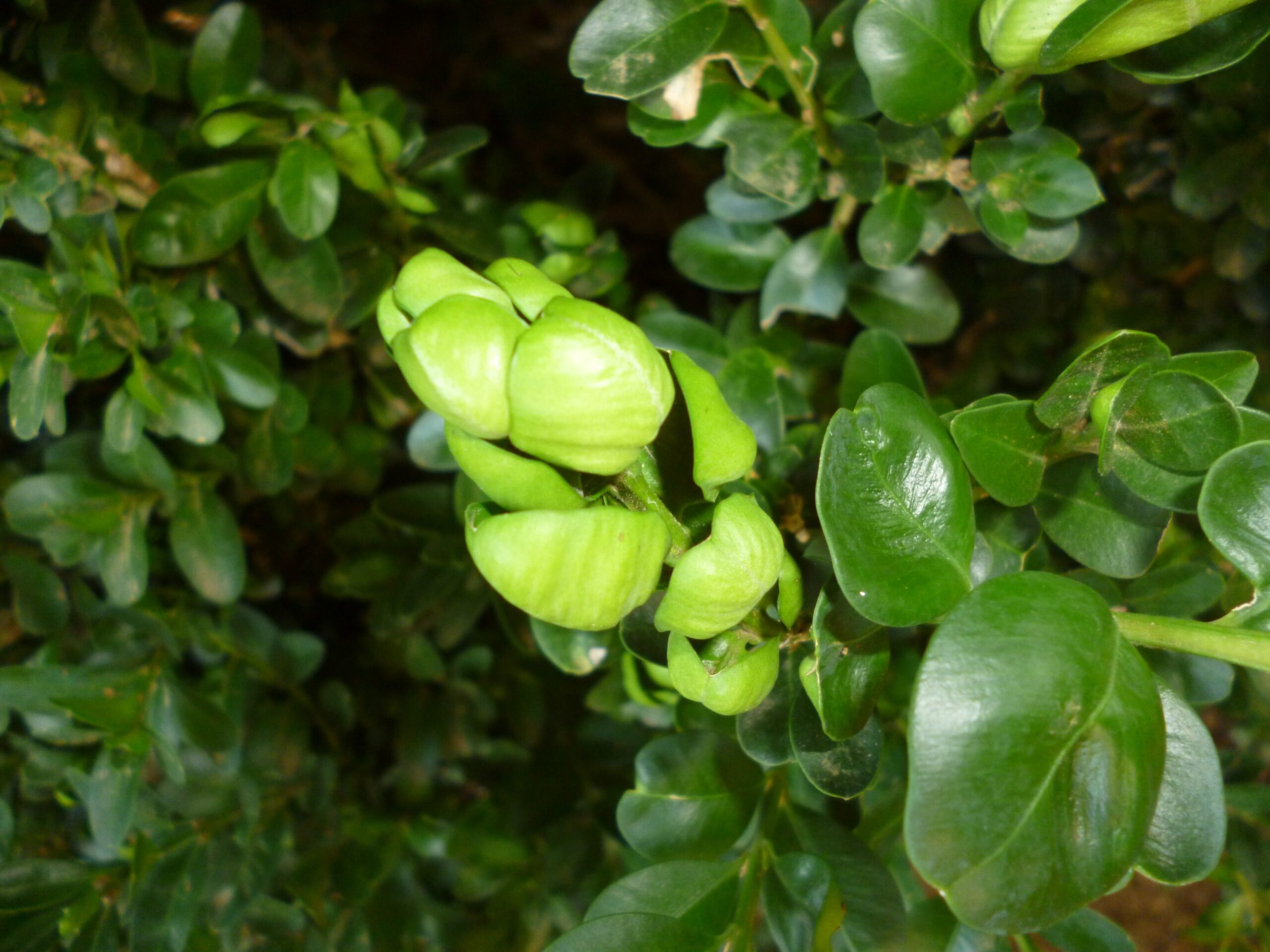
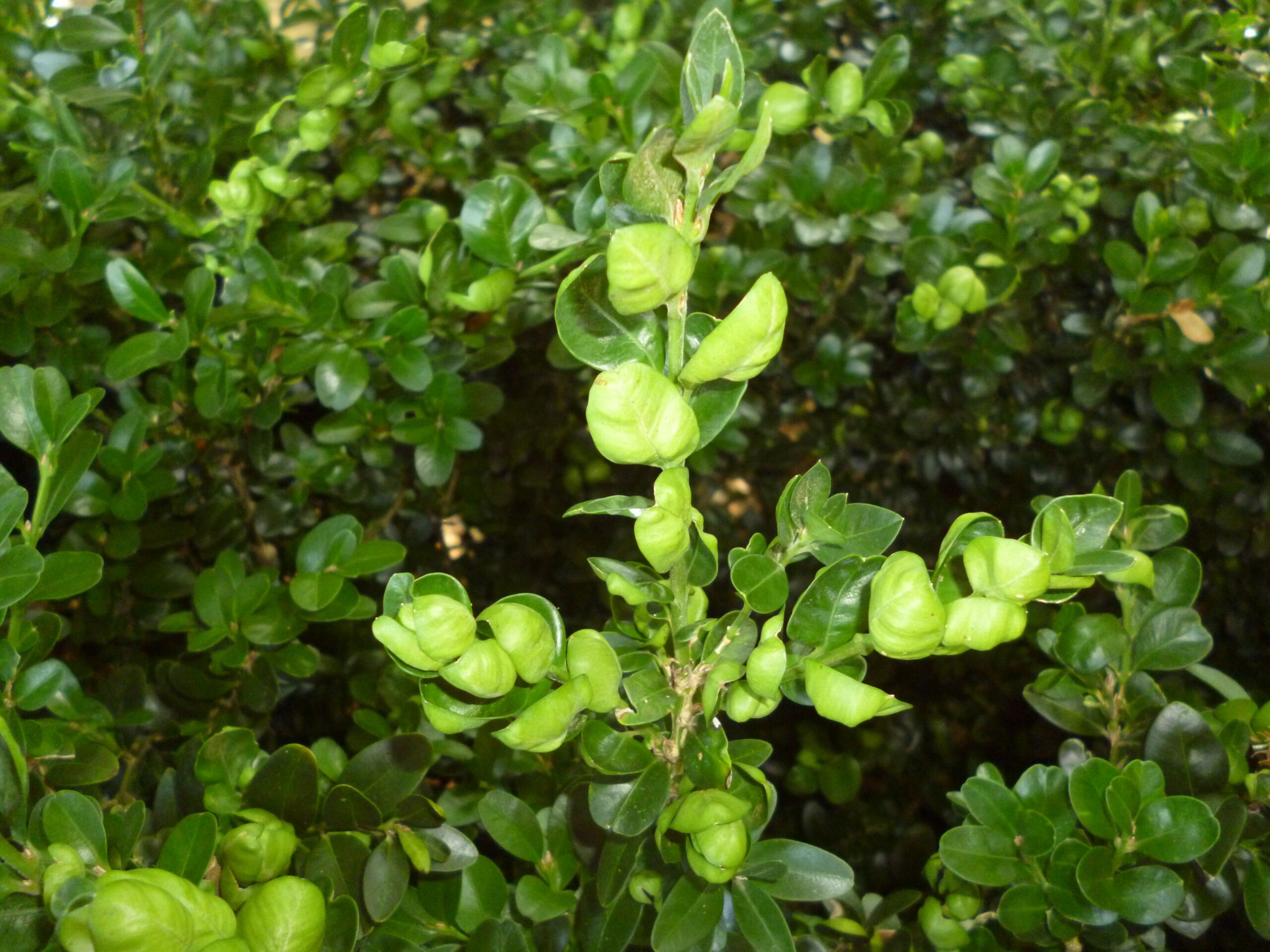
Photo: Steven K. Rettke, Rutgers Coop. Ext. The boxwood psyllid is a small, greenish insect whose nymphs attack emerging tender spring growth. While primarily an aesthetic pest, their feeding causes characteristic leaf curling that shelters the insects and disfigures branch tips.
- Signs and Symptoms:
- Cupped Foliage: Bowl-like cupping or curling of new leaf terminals in late spring.
- Waxy Residue: White, cottony, or powdery waxy secretions produced by nymphs inside the cupped leaves.
- Stunted Terminal Growth: Twig development may be temporarily slowed or deformed.
- Presence of Adult Jumping Plantlice: Small green adults with transparent wings jumping or flying around the canopy in early summer.
- Control & Management Strategy
- Cultural & Mechanical: Shear or prune cupped terminal growth before adults emerge in early summer.
- Resistant Cultivars: Plant less susceptible species like American boxwood (Buxus sempervirens); English boxwood is more susceptible.
- Chemical Control: Spray horticultural oil, insecticidal soap, or systemic insecticides in early spring right as new growth expands and nymphs begin feeding.
- Important Regulatory Note: Always strictly adhere to product label guidelines. THE LABEL IS THE LAW.
- For detailed IPM protocols, visit the Rutgers Boxwood Psyllid Control Page
- Additional Resources & Extension Factsheets
- Signs and Symptoms:
-
Boxwood Blight (Calonectria pseudonaviculata)
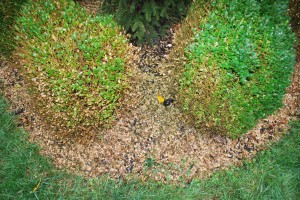
Photo: Richard Buckley, Rutgers PDL Boxwood blight is a devastating fungal disease capable of causing severe defoliation and plant mortality in nursery stock and established landscapes. Warm, humid conditions favor rapid spore production, making sanitation and preventative management critical.
- Signs and Symptoms:
- Dark Leaf Spots: Circular, dark brown or black spots on leaves, often surrounded by a darker border or yellow halo.
- Stem Cankers: Dark brown-to-black streak-like lesions running along green stems.
- Rapid Defoliation: Severe, sudden leaf drop starting from lower branches and moving upward.
- White Spore Clusters: Fluffy white fungal spores visible on leaf undersides and stems during high humidity.
- Cool and wet conditions can cause black cankers and white hyphae to form
- Control & Management Strategy
- Sanitation & Exclusion: Quarantine new plant material for 3–4 weeks. Clean and sanitize pruning tools between plants with a disinfectant (e.g., 70% alcohol or bleach solution).
- Cultural Practices: Avoid overhead irrigation, increase plant spacing for airflow, and rake/bag fallen leaves immediately.
- Pathogen spreads VERY easily in water
- Preventative Fungicides: Apply preventative fungicides on high-value plantings during warm, wet weather. Fungicides protect uninfected tissue but cannot cure diseased plants.
- Chlorothalonil [M5], Trifloxystrobin [11] + Fluopyram [7], Mancozeb [M3}, Tebuconazol [3]
- Important Regulatory Note: Always strictly adhere to product label guidelines. THE LABEL IS THE LAW.
- For detailed IPM protocols, visit the Rutgers Boxwood Blight Control Page
- Additional Resources & Extension Factsheets
- Signs and Symptoms:
-
Boxwood Dieback (Colletotrichum theobromicola)

Boxwood dieback is an emerging fungal disease caused by a prolifically sporulating pathogen that poses a serious threat to nursery stock and established landscape hedges. Because symptoms closely mimic other boxwood issues like Phytophthora root rot or Volutella blight, accurate diagnosis is essential for effective intervention.
- Signs and symptoms:
- Light tan or straw-colored dead leaves that stay attached to infected stems.
- Individual twigs and branches die back (“flagging”) randomly throughout the canopy, lower crown and roots remain healthy.
- Stripping the outer bark off dead twigs reveals a distinct, bright black discoloration running along the underlying wood.
- Small, light-centered leaf spots with dark brown margins.
- Tiny black fungal fruiting bodies may form under warm, wet conditions.
- Control and management:
- Sanitize all pruning and shearing tools between plants and blocks using a disinfectant.
- Infected plants should be dug up, bagged, and destroyed immediately.
- Thoroughly inspect incoming nursery stock and liners, particularly English (Buxus sempervirens), Japanese (B. microphylla), and Korean (B. sinica) varieties, which are highly susceptible.
- Avoid overhead irrigation or working in infected blocks when foliage is wet.
- Signs and symptoms:
-
Volutella Blight (Pseudonectria buxi)

Leaf spot phase of Volutella Leaf and Stem Blight. Photo: Richard Buckley, Rutgers PDL Volutella blight is a common fungal disease of boxwood that often enters through tissue damaged by winter injury, late spring frost, or improper shearing. While less aggressive than boxwood blight, it can cause significant stem dieback and foliar discoloration under warm, wet conditions.
- Signs and symptoms:
- Leaves turn straw-colored, tan, or light bronze in late spring, often remaining attached to infected stems rather than dropping immediately.
- Pinkish-orange fuzzy fungal spore clusters appear on the undersides of leaves and along twigs during moist, humid weather.
- Dark, sunken lesions along stems and twigs, causing the bark to loosen and peel back.
- Branch dieback in scattered patches throughout the canopy (“flagging”)
- Control and management:
- Prune out infected stems and branches several inches below visible lesions during dry weather.
- Clean and sanitize tools with a disinfectant (i.e. 70% alcohol or 10% bleach) between cuts.
- Prune inner branches to increase airflow and sunlight penetration within the canopy.
- Rake, bag, and destroy dead leaves that accumulate in branch crotches and at the base of the plant to eliminate primary overwintering inoculum.
- Apply protective fungicides (i.e. copper-based or chlorothalonil formulations) in early spring prior to initial growth flushes on beds with a chronic disease history.
Important Regulatory Note: Always strictly adhere to product label guidelines. THE LABEL IS THE LAW.
For detailed IPM protocols, visit the Rutgers Volutella Blight Control Page (https://sites.rutgers.edu/nursery-ipm/volutella-blight/)
Additional Resources and Extension Factsheets:
- Rutgers PPA: Boxwood blight update: https://plant-pest-advisory.rutgers.edu/boxwood-blight-update-for-6-2020/
- Penn State Extension: Boxwood Volutella Blight Identification & Management (https://extension.psu.edu/boxwood-diseases)
- Signs and symptoms:
-
Macrophoma Leaf Spot (Macrophoma candollei)

Black, raised fruiting bodies of Macrophoma leaf spot on boxwood. Photo: David L. Clement, University of Maryland Macrophoma leaf spot is a secondary fungal disease that primarily attacks weakened, stressed, or senescent boxwood tissue. Though rarely fatal on its own, its presence indicates underlying cultural or environmental stress that requires management to prevent secondary decline.
- Signs and symptoms:
- Leaves turn straw-colored or tan and become dotted with tiny black pimple-like structures (pycnidia) on upper and lower leaf surfaces.
- Scattered yellowing or browning of older leaves in the lower or inner portions of the canopy.
- Infected leaves remain on the plant longer than those affected by boxwood blight, gradually dropping over time.
- Symptoms are usually restricted to already weakened twigs or leaves damaged by winter burn or drought.
- Control and management:
- Reduce plant stress: maintain uniform soil moisture, avoid over-fertilization, and ensure proper site drainage.
- Rake and remove dead leaf litter beneath plants to reduce overwintering fungal structures.
- Prune out dead wood and thin dense growth during dry periods to improve light penetration and air circulation.
- Fungicide applications are generally not recommended for Macrophoma, as addressing root health and cultural care will resolve secondary infections.
- Additional Resources and Extension Factsheets:
- Rutgers PPA: https://plant-pest-advisory.rutgers.edu/were-baaackkk/
- Purdue Plant Doctor: https://purdueplantdoctor.com/factsheet/tree-493
- UMD Extension: https://extension.umd.edu/resource/macrophoma-leaf-spot-boxwood/
- Signs and symptoms:
-
Phytophthora Root and Crown Rot (Phytophthora spp.)

Phytophthora root and crown rot is a soil-borne oomycete pathogen that attacks boxwood roots in saturated, poorly drained soils. Because it destroys the plant’s vascular absorption system, severe infections lead to plant collapse and death.
- Signs and symptoms:
- Leaves turn light green, dull yellow, bronze, or straw-colored across large sections or the entire plant.
- Dark brown or black water-soaked discoloration beneath the bark at the root crown.
- Feeder roots become soft, brown, sloughing, and decaying, lacking healthy white tips.
- Reduced shoot extension, overall decline, and sudden plant wilting/collapse during hot, dry summer periods.
- Control and management:
- Plant only in well-draining soils or raised beds. Avoid low areas where standing water accumulates.
- Avoid over-irrigation.
- Destroy infected plants immediately; do not reuse soil or unsterilized containers from infected stock.
- Apply preventative oomycete-targeted fungicide drenches or foliar sprays in susceptible nursery blocks or field sections with high risk.
Important Regulatory Note: Always strictly adhere to product label guidelines. THE LABEL IS THE LAW.
For detailed IPM protocols, visit the Rutgers Phytophthora Control Page (https://sites.rutgers.edu/nursery-ipm/root-disease-oomycetes/)
Additional Resources and Extension Factsheets:
- Signs and symptoms:
-
Winter Injury & Desiccation

Winter damage symptoms on boxwood. Picture credits: UMD Extension Winter injury is a non-parasitic abiotic condition caused by cold winds, rapid temperature drops, or winter desiccation (when frozen soils prevent roots from replacing water lost to wind and sun). Damaged tissue frequently serves as an entry point for opportunistic fungal pathogens like Volutella buxi.
- Signs and symptoms:
- Orange, bronze, reddish-brown, or yellow foliage on outer exposed branches on the south or windward side of the plant.
- Inner canopy leaves and foliage protected from winter wind and direct sunlight remain green.
- Longitudinal cracks along stems or main trunks from rapid freezing and thawing cycles.
- Terminal shoots fail to break bud in spring, becoming dry and brittle.
- Control and management:
- Ensure plants receive enough deep watering in late autumn prior to soil freezing to maximize tissue hydration.
- Create temporary burlap windbreaks
- Plant in sheltered areas protected from drying winter winds and harsh afternoon sun.
- Apply a 2–3 inch layer of mulch over root zones to insulate soil against freezing and reduce moisture loss.
- Prune away dead or desiccated tips only in late spring after new growth begins.
- Additional Resources and Extension Factsheets:
- Iowa State University: https://yardandgarden.extension.iastate.edu/how-to/managing-winter-injury-boxwood
- UMD Extension: https://extension.umd.edu/resource/winter-damage-landscape-plants
- Signs and symptoms:
Resistant Buxus Cultivars


Alternatives to Boxwoods
If pests, diseases, or winter damage have taken a toll on your boxwoods, these resilient evergreen alternatives offer the same polished aesthetic with far fewer maintenance demands.
-
Inkberry holly (Ilex glabra)
- Growing requirements:
- Full sun to part shade
- Moist but well-drained soils
- Prefers acidic pH
- USDA Hardiness Zones 5 to 9
- Benefits:
- Native to New Jersey
- Deer resistant
- Cultivars of choice:
- ‘Gem Box’ is known for its small, boxwood-like leaves and dwarfed growing habit
- ‘Squeeze Box’ has tight, rounded, small leaves similar to boxwoods
- Notes:
- Broadleaf evergreen with a dense growth habit
- Immune to boxwood blight and boxwood leafminer


Photo courtesy of http://www.netpsplantfinder.com/ - Growing requirements:
-
Bayberry (Myrica pennsylvanica)
- Growing requirements:
- Full sun to part shade
- Well adapted to dry, sandy soils and poor quality soils
- USDA Hardiness Zones 3 to 7
- Benefits:
- Native to New Jersey
- Salt tolerant for coastal areas or plantings near roadways
- Fixes atmospheric nitrogen
- Cultivars of choice:
- ‘Silver Dollar’ has a compact, rounded growth habit with heavy berry production
- ‘Bobbee’ has a dense, semi-evergreen appearance
- Notes:
- Female plants produce small gray fruits that are attractive to some birds

Photo courtesy of http://www.netpsplantfinder.com/ - Growing requirements:
-
Plum Yew (Cephalotaxus harringtonia)
- Growing requirements:
- Partial to full shade
- Well-drained soil
- Protect from harsh winds in winter season
- USDA Hardiness Zones 6 to 9
- Benefits:
- Responds well to pruning to maintain its shape
- High heat and drought tolerance once established
- Resistant to deer pressure
- Cultivars of choice:
- ‘Duke Gardens’ has a slow growing habit, and grows as a compact, spreading mound
- ‘Fastigiata’ has an upright, columnar habit that makes it great for formal hedging
- Notes:
- Features dark green, flattened needle-shaped leaves
- Responds well to shearing and shaping

Photo courtesy of http://www.netpsplantfinder.com/ - Growing requirements:
-
Littleleaf Myrtle-Leaf Holly (Iex crenata)
- Growing requirements:
- Full sun to part shade
- Well-drained, acidic soil
- USDA Hardiness Zones 5 to 8
- Benefits:
- Very similar appearance to boxwoods, featuring tiny, dark green, oval leaves
- Cultivars of choice:
- ‘Helleri’ grows with a mounding dwarf form
- ‘Soft Touch’ is compact and soft-textured
- ‘Sky Pencil’ has a narrow, upright hedge form
- Notes:
- Immune to boxwood blight
- Requires good soil drainage to reduce susceptibility to Phytophthora root rot when planted in NJ clay soils

Myrtle Leaf Holly. Image via David J. Stang
CC BY-SA 4.0 - Growing requirements:
-
Dwarf Horned Holly (Iex cornuta)
- Growing requirements:
- Full sun to part shade
- Well drained soil with various pH
- USDA Hardiness Zones 7 to 9
- Benefits:
- Glossy green foliage that holds color throughout the winter
- Deer resistant
- Cultivars of choice:
- ‘Carissa’ has a dense, naturally round, dwarf growing habit that requires minimal pruning
- Notes:
- Serves as a great foundation planting

Chinese Holly. Image via Susan Strine CC BY 2.0 - Growing requirements:
Boxwood and Alternative Shrub Trials
Click the image below to be taken to our Boxwood and Alternative Shrub Trials PDF.
