Invasive Pests
Invasive Pests of Concern for New Jersey Nurseries
Invasive pests pose severe threats to New Jersey’s nursery industry, forest resources, and agricultural infrastructure. Because these non-native insects disrupt ecosystems and trigger economic quarantines, commercial growers must remain vigilant in early detection, containment, and mandatory regulatory reporting.
What Defines a Regulatory Invasive Pest?
A regulatory invasive pest is a non-native insect or plant pathogen whose introduction causes, or is likely to cause, economic or environmental harm, or harm to human health. In a nursery setting, these organisms are designated by state and federal authorities as quarantine pests. Their presence in a commercial facility can lead to hold orders, mandatory destruction of stock, or restrictions on shipping host plants across county or state lines.
Quarantine Policies
- National Regulations (USDA-APHIS): The USDA Animal and Plant Health Inspection Service (APHIS) establishes federal quarantines to prevent the interstate movement of regulated pests, egg masses, and infested wood or soil. Federal permits and compliance agreements are required to move host stock out of regulated zones.
- State Regulations (NJDA): The New Jersey Department of Agriculture (NJDA) Division of Plant Industry enforces state-level quarantines, conducts nursery inspections, and oversees compliance agreements within New Jersey. Growers operating within a quarantined county must complete training and inspect outgoing shipments to certify that stock is free of live life stages.
Mandatory Reporting
If you suspect or confirm the presence of a regulated invasive pest (such as Box Tree Moth, Asian Longhorned Beetle, or Emerald Ash Borer) on your nursery property:
- Isolate the Affected Stock: Stop all movement or shipping of suspected plant material immediately.
- Collect Details: Note the host plant species, location, photos of symptoms/pests, and the extent of the infestation.
- Notify State & Federal Authorities:
- NJDA Division of Plant Industry: Call 609-406-6939 or email plantindustry@ag.nj.gov.
- USDA-APHIS NJ State Plant Health Director: Call 609-259-5260.
- NJ Invasive Pest Hotline: Call 1-833-BAD-BUG0 (1-833-223-2840).
Diagnostic Support
For assistance with pest identification, tissue analysis, or distinguishing invasive species from common native pests, submit samples to the Rutgers Plant Diagnostic Laboratory.
- Website: Rutgers Plant Diagnostic Lab
- Location: Ralph Geiger Center, CVI, 20 Dudley Road, New Brunswick, NJ 08901
- Contact: 848-932-9140 | plant-clinic@njaes.rutgers.edu
Common Invasive Pests of Concern
-
Box Tree Moth (Cydalima perspectalis)

Left: BTM Damage. Center: BTM Caterpillars. Right: Adult BTM moths.
The box tree moth is a destructive invasive Lepidoptera native to eastern Asia that is spreading throughout the country, and now the state of New Jersey.
- It is currently found throughout most of Europe
- in Europe, they have been found feeding on burning bush (Euonymus alatus), Japanese spindletree (E.japonicus), purple holly (Ilex chinensis), and orange jessamine (Murraya paniculata) once the nearby boxwoods are completely defoliated.
- First detection in North America was in Toronto in 2018
- It has ben spreading and found in the Great Lakes Region (OH, PA, MI, NY) and DE
- Federal quarantines are in effect NOW
- It was recently found (in the summer of 2026) in Cape May County, New Jersey. It is extremely important for growers to be on the lookout for the pest and take preventative measures to stop its spread.
- Blind preventative pesticide applications are not advisable
- Monitor your boxwoods April – October!
- The USDA and NJDA have established monitoring zones surrounding current infestations, and a quarantine has been established for all of Cape May County, NJ which applies to anyone moving boxwoods out of the county

- Signs and symptoms:
-
- Box tree moth caterpillars cause complete defoliation of boxwood leaves, consume inner bark, and eventually kill the plants.
- There are NO native caterpillars that DEFOLIATE boxwoods
- Box tree moth caterpillars cause complete defoliation of boxwood leaves, consume inner bark, and eventually kill the plants.
-
- The larvae spin silken webbing and leave large amounts of green and brown frass.
- If you see this pest:
-
- Report it!
- Eradicate it!
- Treat the infested plants with Compliance Agreement cited materials (Compliance Agreement – Appendix 1)
- Follow all label requirements, especially REIs. THE LABEL IS THE LAW.
Active IRAC Bifenthrin [3] Lambda cyhalothrin [3] Permethrin [3] Chlorantraniliprole [28] Cyantraniliprole [28] 
- Remove it!
-
-
- After the REI is complete and BTM has been eradicated, remove the infested plants by double bagging them and taking them to an in-county municipal dump.
-
- Stay Educated: Box Tree Moth Resources:
- Video: “Demystifying Box Tree Moth” – HRI
- Factsheet: Box Tree Moth: Fact Sheet, Management & Visual Guide
- USDA-APHIS Box Tree Moth : APHIS BTM Landing page
- [Draft] Compliance agreement: National Plant Board – Box Tree Moth
- Plant and Pest Advisory: Box Tree Moth Confirmed in NJ
- Box Tree Moth – NJ.gov
- National Invasive Species Information Center BTM Page
- It is currently found throughout most of Europe
-
Spotted Lanternfly (Lycorma delicatula)

Spotted lanternfly gravid female. The enlarged yellow-colored abdomen indicates this female will soon begin to lay egg masses. (Photo Credit: Steven K. Rettke, Rutgers Coop. Ext.) The spotted lanternfly is an invasive planthopper native to Asia. Early nymphs are black with white spots, while late nymphs turn red and black. Adults have grey forewings with black spots and red-and-black hindwings. Eggs are laid in greyish, mud-like egg masses on flat surfaces.
- Hosts:
- Feeds on over 70 species
- Heavily prefers grapes, fruit trees, and hardwood trees
- Tree of Heaven is the main host
- Feeds on over 70 species
- Signs and Symptoms:
- Feeds on phloem, excreting honeydew which grows black sooty mold and attracts stinging insects
- Leads to reduced crop yield, branch die-off, weeping wounds (grayish black trails along the trunk)
- Causes reduced photosynthesis and plant vigor, wilting or curled leaves, and sap oozing from wounds
- Control & Management Strategy:
- Monitor trunks for egg masses from fall to spring
- Use circle traps from May to October
- Scrape egg masses from trunks
- Use neonicotinoids or pyrethroids when populations surge
- Important Regulatory Note: Always strictly adhere to product label guidelines. THE LABEL IS THE LAW.
- For detailed IPM protocols, visit the Rutgers Spotted Lanternfly Control Page.
- Additional Resources & Extension Factsheets
- Hosts:
-
Asian Longhorned Beetle (Anoplophora glabripennis)
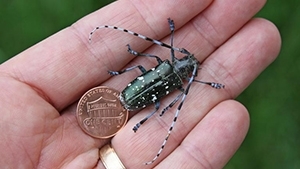
Asian longhorned beetle (ALB) pictured next to a penny for size reference. Photo courtesy of USDA APHIS. The Asian longhorned beetle is a large, glossy black wood-boring beetle with white spots and distinctly long, black-and-white banded antennae. Larvae are large cream-colored grubs that bore into heartwood.
- Hosts:
- Maples, birches, elms, horsechestnuts, and willows
- Signs and Symptoms:
- Larval tunneling weakens the structural integrity of branches and trunks, causing branch drop, canopy dieback, and host death
- 3/8-inch round exit holes
- Frass at tree bases and crotches
- Unseasonal yellowing foliage
- Control & Management Strategy:
- Infested trees must be removed and destroyed according to quarantine guidelines
- Early detection is key
- Important Regulatory Note: Always strictly adhere to product label guidelines. THE LABEL IS THE LAW.
- To report the beetle or tree damage, click here for the link to the online reporting site, or call the ALB hotline at 866-702-9938
- Additional Resources & Extension Factsheets
- Hosts:
-
Emerald Ash Borer (Agrilus planipennis)
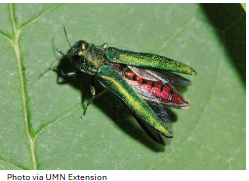
The Emerald Ash Borer (EAB) is a small (1/3″ long), bullet-shaped wood-boring beetle that is bright metallic green in color. Its larvae are 1-1.25″ long white, flattened grubs with ten bell-shaped segments and brown pincers at the abdominal tip.
- Hosts:
- Fraxinus spp. (white ash, black ash, green ash)
- Signs and Symptoms:
- Larvae feed in the phloem and cambium layer, creating S-shaped galleries under the bark.
- Canopy thinning
- Epicormic sprouting
- Bark splitting
- D-shaped exit holes
- Tree death within 3-5 years
- Control & Management Strategy:
- Adult activity peaks in early summer (emerging through D-shaped exit holes)
- Systemic insecticides (emamectin benzoate trunk injections, imidacloprid soil drenches) should be applied before heavy infestations take place
- Removal of heavily infected trees is encouraged
- Do not move ash wood – EAB usually travels only 0.5-1 miles per year, but humans make the problem worse by carrying wood across distances
- Important Regulatory Note: Always strictly adhere to product label guidelines. THE LABEL IS THE LAW.
- For detailed IPM protocols, visit the Rutgers Emerald Ash Borer Control Page.
- Additional Resources & Extension Factsheets
-
- Rutgers Nursery IPM EAB Page
- EAB Information Network
- 2nd Edition North Central IPM Insecticide Options for Protecting Ash Trees from Emerald Ash Borer
- Herms, D. (2014, Mar 20). 2014 Research Update on Emerald Ash Borer [Webinar]
- Hosts:
-
Crape Myrtle Bark Scale (Acanthococcus lagestroemiae)

A very heavy infestation of crapemyrtle bark scale on a crapemyrtle branch.
Photo: Jim Robbins, Univ. of Ark. CES, Bugwood.orgThe Crape Myrtle Bark Scale (CMBS) is a small whitish-gray felty scale insect native to Asia that has become a threat to Lagerstroemia species across the US.
- Hosts:
- Lagerstroemia spp. (crape myrtle)
- Also known to target American beautyberry (Callicarpa americana), henna (Lawsonia inermis), St. John’s wort (Hypericum spp.), and pomegranate (Punica granatum).
- Signs and Symptoms:
- When crushed, adult females exude a pinkish fluid
- Feeds on sap along stem and trunks
- Stunted growth
- Branch dieback
- Reduced bloom quality, smaller flower panicles
- Delayed spring leaf-out
- Severe black sooty mold accumulation
- Control & Management Strategy:
- Inspect branch crotches and lower limbs for white felt-like encrustations
- Horticultural oil sprays during crawler emergence
- Systemic neonicotinoids (dinotefuran, imidacloprid) as soil drenches in the spring
- Important Regulatory Note: Always strictly adhere to product label guidelines. THE LABEL IS THE LAW.
- Additional Resources & Extension Factsheets
- Hosts:
-
Spongy Moth (Lymantria dispar)

Spongy Moth adult. Photo credits: Steven K. Rettke, Rutgers Coop. Ext The Spongy Moth (formerly known as the Gypsy moth), starts as a dark, hairy caterpillar with 5 pairs of blue spots and 6 pairs of red spots along their backs. Adult males are brown and fly, while females are larger, whiteish, and flightless.
- Hosts:
- Over 300 species of trees and shrubs (specifically oaks, maples, birches, and pines)
- Signs and Symptoms:
- Causes rapid defoliation, weakening trees and making them vulnerable to other pests and disease
- Heavy infestations look barren and wintery in the summer
- 3 years of 75% defoliation sets trees up to be killed
- Control & Management Strategy:
- Inspect for tan, felt-like egg masses on trunks during the winter
- Apply Bt or insect growth regulators to young larvae in the spring
- Report sightings to agriculture officials
- Follow quarantine regulations
- Crush pupae or brush them into a container of soapy water
- Apply traps or sticky bands to capture caterpillars
- Important Regulatory Note: Always strictly adhere to product label guidelines. THE LABEL IS THE LAW.
- For detailed IPM protocols, visit the Rutgers Spongy Moth control page
- Additional Resources & Extension Factsheets
- Hosts:
-
Camphor Shoot Borer (Cnestus mutilatus)

Adult female camphor shot beetle. Photo courtesy of Rachel Osborn, Ambrosia Beetle ID, USDA APHIS PPQ, Bugwood.org The Camphor Shoot Borer (Camphor Shot Borer) is a tiny, dark brown to black ambrosia beetle (approximately 3.5 to 4 mm long) that tunnels into small branches and trunks of stressed, weak, or dying hardwood plants. Rather than feeding directly on wood, camphor shoot borers introduce ambrosia fungi into their tunnels, which serves as the primary food source for developing larvae.
- Hosts:
- Various woody ornamentals (i.e. sweetgum (Liquidambar), dogwood (Cornus), maple (Acer), and black walnut (Juglans nigra)).
- Signs and Symptoms:
- Entrance holes are about 2mm in diameter and exhibit T-shaped internal galleries
- Causes shoot flagging, stem wilting, and dieback
- Control & Management Strategy:
-
- Ethanol-baited funnel traps can be deployed in early spring to detect adult flight activity.
- Prune out and burn infected shoots before adults emerge
- Prevent plant stress to reduce ethanol emission cues that attract beetles
- Apply protective trunk sprays using residual pyrethroids (bifenthrin or permethrin) prior to emergence in the spring
- Important Regulatory Note: Always strictly adhere to product label guidelines. THE LABEL IS THE LAW.
-
- Additional Resources & Extension Factsheets
- Hosts:
-
Pine Shoot Beetle (Tomicus piniperda)

Adult pine shoot beetle. Photo by Pest and Diseases Image Library, Bugwood.org. The Pine Shoot Beetle is a destructive bark beetle that is native to Eurasia. Growing 3.5-5mm long, overwintered adults emerge early in the spring and bore into healthy pine shoots to feed. In late spring, mature beetles move to stressed trees, stumps, or cut logs to lay eggs under the bark.
- Hosts:
- Pinus spp. (preference for Scotch pine (Pinus sylvestris), Austrian pine (P. nigra), and Eastern White pine (P. strobus))
- Signs and Symptoms:
- Maturation feeding inside current year’s shoots hollows the interior of stems, causing brown, drooping, or broken shoot tips (“flagging”).
- Severe infestations reduce annual growth, ruin tree shape, and weaken trees
- Increase susceptibility to other pests and diseases
- Control & Management Strategy:
- Clear cut pine logs, stumps, and fallen timber by early spring to reduce breeding sites
- Prune out and burn hollowed, flagging shoots before new adult broods emerge in the summer
- Apply protective trunk and canopy insecticide treatments in early spring to target overwintered adults before they tunnel into new growth.
- Important Regulatory Note: Always strictly adhere to product label guidelines. THE LABEL IS THE LAW.
- Additional Resources & Extension Factsheets
- Hosts:
-
Brown Marmorated Stink Bug (Halyomorpha halys)

Stink bugs on fruit, A. adults on peach, B. nymphs on peach, C. nymph on apple, D. adult on pear. Photo via Rutgers Marucci Center. The Brown Marmorated Stink Bug (BMSB) is a shield-shaped bug native to East Asia. It is a mottled brown color, with light and dark banding on its antennae and abdominal margins. It has an exceptionally broad host range and feeds on a variety of agricultural and ornamental crops.
- Hosts:
- Highly polyphagous (targets tree fruits, nursery ornamentals, vegetables, and field crops, i.e. lilac (Syringa), maple (Acer), redbud (Cercis), crabapple (Malus), London planetree (Platanus), and ash (Fraxinus))
- Signs and Symptoms:
- Colonizes outer field edges first
- Piercing-sucking mouthparts cause necrosis
- “Cat-facing” on fruit
- Leaf distortion on woody nursery stock
- Stunting of terminal growth
- Localized bark/stem lesions
- Internal corking
- Sap bleeding
- Premature leaf and fruit drop
- Control & Management Strategy:
- Overwintered adults emerge from human structures or sheltered woods in mid to late May
- Monitor canopies using pyramid traps and light traps
- Apply perimeter-focused insecticide sprays to manage populations before inner nursery blocks are infected to reduce overall pesticide usage
- Rotate chemical classes across generations to prevent resistance
- Conserve native predators (i.e. Samurai Wasp (Trissolcus japonicus) to minimize need for pesticide use
- Important Regulatory Note: Always strictly adhere to product label guidelines. THE LABEL IS THE LAW.
- Additional Resources & Extension Factsheets
- Hosts: