Scale Insects
Scale Insects
Scale insects are persistent, economically damaging sap-feeding pests that are often encountered in nursery production settings. There are a number of scale species which vary in their feeding habits, life cycles, and susceptibility to chemical controls. Therefore, effective management requires correct correctly distinguishing between armored scales, soft scales, and other scale-like pests.
Key Differences Between Scale Families
| Key Features | Armored Scales (Diaspididae) | Soft Scales (Coccidae) |
| Hard Protective Cover | Separate from body | Attached to body |
| Feeding Mechanism | Pierces individual cells | Feeds directly in phloem |
| Primary damage | Chlorosis, yellow stippling, leaf/needle drop, dieback | Stunting, overall progressive systemic decline |
| Honeydew Production | None | High (causing sooty mold growth) |
| Target Control Window | Peak crawler emergence only | Crawlers and systemic sap stream uptake |
Quarantine Policies
- National Regulations (USDA-APHIS): The USDA Animal and Plant Health Inspection Service (APHIS) establishes federal quarantines to prevent the interstate movement of plant material that carries actionable diseases. USDA-APHIS mandates strict compliance agreements, pre-shipment certifications, and sanitary standards for nurseries that are propagating or shipping host material out of established regulated regions.
- State Regulations (NJDA): The New Jersey Department of Agriculture (NJDA) Division of Plant Industry enforces state-level plant health standards, conducts routine health surveys, and oversees eradication efforts in the event that high consequence pathogens are detected in commercial production or nearby natural habitats.
Diagnostic and Scouting Guidelines
- Identify the Scale:
- Using a pocket knife, flip over a scale cover.
- If the cover lifts off, leaving the insect body behind, it is an armored scale.
- If the cover is attached to the insect body, it is a soft scale.
- Monitor Crawler Emergence:
- In mid-spring, use yellow double-sided carpet tape wrapped around infested branches to detect scale crawlers.
- Inspect weekly using a 10X hand lens before applying foliar applications
- Submit Samples
- If you are unable to identify an insect, submit samples to the Rutgers Plant Diagnostic Laboratory.
- Website: Rutgers Plant Diagnostic Lab
- Location: Ralph Geiger Center, CVI, 20 Dudley Road, New Brunswick, NJ 08901
- Contact: 848-932-9140 | plant-clinic@njaes.rutgers.edu
- If you are unable to identify an insect, submit samples to the Rutgers Plant Diagnostic Laboratory.
Armored Scales (Diaspididae)
Armored scales secrete a hard, waxy protective cover that is separate from their underlying bodies. They feed by piercing individual cells to drain the cell of chlorophyll, leading to localized tissue death without the production of honeydew.
-
Euonymus Scale (Unaspis euonymi)

Turn over on the undersides of the Pachysandra leaf & signs from mostly males & a few females are found feeding. (Photo Credit: Steven K. Rettke, Rutgers Coop. Ext.) Adult female euonymus scales are dark brown to black in color and shaped like oyster-shells. Males are smaller, narrow, and bright white with ridges along their bodies. They overwinter as mature fertilized females on host stems.
- Hosts:
- Euonymus species (E. fortunei, E. japonica), Pachysandra terminalis, and Celastrus (bittersweet).
- Signs and Symptoms:
- Chlorosis on upper leaf surface
- White incrustations along stems and leaves (these are male scales)
- Defoliation
- Twig dieback
- Plant mortality when unmanaged
- Crawler Windows and Life Cycle:
- Two Generations per Year in NJ:
- First crawler window from late May to early June (500-700 GDD).
- Second crawler window in late July through August (1700–2100 GDD).
- Two Generations per Year in NJ:
- Control & Management Strategy:
- Apply 2-3% horticultural oil in late winter before bud break to smother overwintering females
- Apply IGRs such as pyriproxyfen or buprofezin, or contact insecticides during peak crawler activity
- Apply dinotefuran as a basal bark spray or root drench
- Important Regulatory Note: Always strictly adhere to product label guidelines. THE LABEL IS THE LAW.
- For detailed IPM protocols and diagnostic assistance, visit the Euonymus Scale Page
- Additional Resources & Extension Factsheets
- Hosts:
-
Cryptomeria Scale (Aspidiotus cryptomeriae)
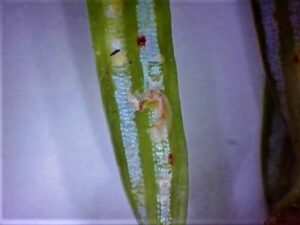
With younger instars the Cryptomeria waxy cover is virtually transparent, as needle stomates are clearly visible. (Photo Credit: Steven K. Rettke, Rutgers Coop. Ext.) Cryptomeria scales are small, flat, oval-shaped, translucent yellow scales (~1mm long), with a yellowish brown spot on the center of their backs. They are often found on the undersides of evergreen needles.
- Hosts:
- Cryptomeria japonica, Abies spp. (Fraser fir, Canaan fir, balsam fir), Tsuga (hemlock), Taxus, and Picea (spruce).
- Especially concerning for New Jersey Christmas tree farmers and conifer nursery stocks.
- Signs and Symptoms:
- Yellow chlorotic banding across conifer needles
- Needle bowning
- Premature needle drop
- Thinning canopies
- Off-color foliage, leading to unmarketable trees
- Crawler Windows and Life Cycle:
- Two Generations per Year in NJ:
- First crawler emergence window in mid-to-late June (800–1050 GDD).
- Second crawler emergence window in August (1700–2000 GDD).
- Two Generations per Year in NJ:
- Control & Management Strategy:
- Tap needles over white paper to identify crawlers in June and August emergence windows
- Apply IGRs such as pyriproxyfen or buprofezin, or contact insecticides during crawler emergence
- Apply dinotefuran as a soil drench in spring
- Important Regulatory Note: Always strictly adhere to product label guidelines. THE LABEL IS THE LAW.
- For detailed IPM protocols and diagnostic assistance, visit the Cryptomeria Scale Page
- Additional Resources & Extension Factsheets
- Hosts:
-
Elongate Hemlock Scale (Fiorinia externa)

Photo Credit: Steven K. Rettke, Rutgers Coop. Ext Elongate hemlock scale females are elongated, yellow-brown, and 1.5-2mm in length. The males produce white felted covers. They secrete a white wax on needle undersides.
- Hosts:
- Tsuga (hemlock), Abies (fir), Picea (spruce), and Pseudotsuga menziesii (Douglas-fir).
- Signs and Symptoms:
- Yellow spots on upper needle surfaces
- Premature needle drop
- Branch dieback
- Canopy decline
- White wax accumulation on undersides of needles
- Crawler Windows and Life Cycle:
- Life stages heavily overlap throughout summer.
- Peak crawler emergence from late May through July (360–700 GDD).
- Life stages heavily overlap throughout summer.
- Control & Management Strategy:
- Apply 1-2% horticultural oils during post-dormant spring windows to reduce overwintering insects
- Apply IGRs such as pyriproxyfen or buprofezin, or contact insecticides during crawler emergence
- Apply dinotefuran as a soil drench or trunk spray in spring
- Important Regulatory Note: Always strictly adhere to product label guidelines. THE LABEL IS THE LAW.
- For detailed IPM protocols and diagnostic assistance, visit the Elongate Hemlock Scale Page
- Additional Resources & Extension Factsheets
- Hosts:
-
Pine Needle Scale (Phenacaspis pinifoliae)

Extreme infestation with many dozens of Pine Needle Scales per individual needle. (Photo Credit: Steven K. Rettke, Rutgers Coop. Ext.) Pine needle scales are pure white scales, 2-3mm in length, with an armor cover, and a yellow exuviae at the narrow end of their bodies. They heavily infest pine needles, making them appear to be covered in white flecks.
- Hosts:
- Pinus species (Mugho pine, Scotch pine, White pine, Austrian pine) and occasionally Picea (spruce).
- Signs and Symptoms:
- Needles turn yellow, then brown
- Premature needle drop
- Stunted shoot growth
- Sparse foliage density
- Crust of white scale covers coating needle surfaces
- Crawler Windows and Life Cycle:
- Two Generations per Year in NJ:
- First generation crawlers (reddish-brown) emerge in mid-to-late May (250–400 GDD).
- Second generation crawlers emerge in July (1300–1500 GDD).
- Two Generations per Year in NJ:
- Control & Management Strategy:
- Apply horticultural oils in early spring, prior to candle elongation
- Time foliar sprays during May and July crawler emergence windows (pyriproxifen, insecticidal soaps, pyrethroids).
- Important Regulatory Note: Always strictly adhere to product label guidelines. THE LABEL IS THE LAW.
- For detailed IPM protocols and diagnostic assistance, visit the Pine Needle Scale Page
- Additional Resources & Extension Factsheets
- Hosts:
-
Japanese Maple Scale (Lopholeucaspis japonica)
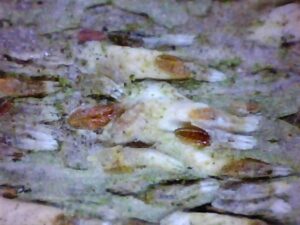
When the white waxy cover of the Japanese Maple Scale is removed, the brownish-purple scale body is exposed. (Photo Credit: Steven K. Rettke, Rutgers Coop. Ext.) Japanese maple scales are small (1-2mm in length), narrow, oyster-shaped armored scales that are covered in a thick, whitish-gray waxy coating. Under the waxy coating, their bodies are dark purple in color. These scales overwinter as immature nymphs on trunks and stems.
- Hosts:
- Polyphagous, impacting a wide host range, specifically targeting woody ornamentals.
- Acer (especially Japanese Maple, Acer palmatum), Cornus (Dogwood), Prunus, Salix (Willow), Styrax, Syringa (Lilac), Malus (Crabapple), Euonymus, Cotoneaster, and Ilex (Holly).
- Polyphagous, impacting a wide host range, specifically targeting woody ornamentals.
- Signs and Symptoms:
- Trunks, stems, and twigs become encrusted in a dusty, white wax layer, resembling bird droppings or white spray paint
- Chlorosis
- Foliar yellowing
- Stunted terminal shoot elongation
- Branch dieback
- Bark cracking
- Overall decline in tree heath
- Crawler Windows and Life Cycle:
- Two Generations per Year in NJ:
- First generation crawlers emerge in late spring, from late May through early June (800-1200 GDD).
- Second generation crawlers emerge in late summer from mid-August to September (2500+ GDD)
- Two Generations per Year in NJ:
- Control & Management Strategy:
- Apply multiple treatments of 2-3% horticultural oils in late winter to early spring, before bud break. Single treatments are often ineffective due to the scales’ thick waxy protective layer.
- Use double-sided tape to monitor for crawlers to time IGR applications (pyriproxyfen, buprofexin) during peak windows, specifically in June and August
- Apply dinotefuran as a soil drench or trunk spray
- Important Regulatory Note: Always strictly adhere to product label guidelines. THE LABEL IS THE LAW.
- For detailed IPM protocols and diagnostic assistance, visit the Japanese Maple Scale Page.
- Additional Resources & Extension Factsheets
- Hosts:
-
Juniper Scale (Carulaspis juniperi)

Juniper Scale removed from leaf to expose yellow scale body. Notice white-ring present on leaf at upper right. (Photo Credit: Steven K. Rettke, Rutgers Coop. Ext.) Juniper scale females are small (1-1.5mm) and circular, and whitish-gray in color with a raised yellowish brown spot. The males are smaller, elongated, pure white in color, and sport three longitudinal ridges. They overwinter as fertilized adult females on conifer needles and twigs.
- Hosts:
- Cypress-family conifers (Cupressaceae), including Juniperus (Juniper), Thuja (Arborvitae), Chamaecyparis (False Cypress), Cupressocyparis leylandii (Leyland Cypress), and Calocedrus (Incense Cedar).
- Signs and Symptoms:
- Yellowing needles that gradually turn grayish-brown
- Thinning canopy
- Reduced annual growth
- Twig and branch dieback
- Trees with heavy infestations appear dusted with small white flecks
- Crawler Windows and Life Cycle:
- One Generation per Year in NJ:
- Crawlers emerge in late-May to mid-June (700-1000GDD)
- One Generation per Year in NJ:
- Control & Management Strategy:
- Apply 2-3% horticultural oil during late winter or early spring before new growth begins to target overwintering adult females
- Do not apply oils to glaucous/blue juniper varieties to avoid unwanted aesthetic impacts on the waxy layer of the tree.
- Apply IGRs (pyriproxyfen, buprofexin), or contact insecticides (pyrethroids) during peak crawler emergence in late May through June.
- Apply dinotefuran as a root drench or basal bark spray.
- Important Regulatory Note: Always strictly adhere to product label guidelines. THE LABEL IS THE LAW.
- For detailed IPM protocols and diagnostic assistance, visit the Juniper Scale Page.
- Apply 2-3% horticultural oil during late winter or early spring before new growth begins to target overwintering adult females
- Additional Resources & Extension Factsheets
- Hosts:
Soft Scales (Coccidae)
Soft scales have a smooth waxy cover that is physically attached to their body. They feed directly within the phloem vessels, consuming large amounts of sap and excreting excessive amounts of honeydew, leading to black sooty mold accumulation.
-
Cottony Camellia Scale (Pulvinaria floccifera)
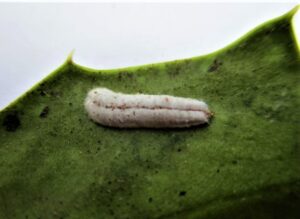
Close-up of a single cottony camellia egg ovisac. Dead female has already detached & fallen-off leaf. Evidence of emerged crawlers can be seen. (Photo Credit: Steven K. Rettke, Rutgers Coop. Ext.) Cottony camellia scale adult females are light brown to yellowish green, oval shaped, and flat (2-3 mm long). The females secrete long, white, cottony ovisacs in late spring, which are up to 6mm long on the undersides of leaves.
- Hosts:
- Camellia, Taxus (yew), Ilex (holly), Euonymus, Rhododendron, and Hydrangea.
- Signs and Symptoms:
- Large, cottony, white egg sacs on leaf undersides in May and June
- Honeydew secretion and black sooty mold on upper leaf surfaces
- Foliar yellowing
- Premature leaf drop
- Loss of vigor
- Crawler Windows and Life Cycle:
- One Generation per Year in NJ:
- Eggs hatch into mobile crawlers in mid-June through July (800–1200 GDD).
- One Generation per Year in NJ:
- Control & Management Strategy:
- Apply imidacloprid or dinotefuran as soil drenches in early spring
- Apply 1-2% horticultural oil or insecticidal soaps to leaf undersides in the summer
- Important Regulatory Note: Always strictly adhere to product label guidelines. THE LABEL IS THE LAW.
- For detailed IPM protocols and diagnostic assistance, visit the Cottony Camellia Scale Page
- Additional Resources & Extension Factsheets
- Hosts:
-
Calico Scale (Eulecanium cerasiforum)
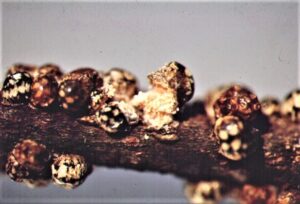
Thousands of calico scale eggs will hatch & emerge as crawlers from under dead female body. After hatching, crawlers will migrate to leaves & feed along leaf veins. (Photo Credit: Steven K. Rettke, Rutgers Coop. Ext.) Calico scale females are globular and smooth, about 6mm in length, and sport a dark brown, helmet-like shell with yellow and white patches.
- Hosts:
- Acer (maple), Gleditsia (honeylocust), Cornus (dogwood), Liquidambar (sweetgum), Prunus, and Zelkova.
- Signs and Symptoms:
- Honeydew production that drips down on lower foliage and surfaces
- Severe sooty mold
- Branch dieback
- Delayed leaf-out
- Overall canopy decline
- Crawler Windows and Life Cycle:
- One Generation per Year in NJ:
- Crawlers emerge in late May through June (700–1000 GDD) and migrate to leaf undersides to feed in the summer.
- One Generation per Year in NJ:
- Control & Management Strategy:
- Apply imidacloprid or dinotefuran as soil drenches in early spring before bloom or after petal fall
- Apply 1-2% horticultural oil or insecticidal soaps to leaf undersides in June
- Important Regulatory Note: Always strictly adhere to product label guidelines. THE LABEL IS THE LAW.
- For detailed IPM protocols and diagnostic assistance, visit the Calico Scale Page
- Additional Resources & Extension Factsheets
- Hosts:
-
indian Wax Scale (Ceroplastes ceriferus)

An easily observed small group of Indian wax scales clustered together feeding on a branch stem. (Photo Credit: Steven K. Rettke, Rutgers Coop’ Ext.) Adult female indian wax scales are hemispherical, white-to-pinkish, and up to 1/4 inch in diameter. They are coated in a thick, sticky layer of white wax and resemble a wad of gum. Crawlers are tiny and rusty-red. The scales overwinter on stems and twigs as adult females.
- Hosts:
- Polyphagous, infecting over 60 plant families.
- Commonly infests evergreen shrubs (Ilex spp. including Inkberry and Japanese holly, Buxus, Euonymus) and deciduous ornamentals (Acer, Spiraea, Chaenomeles, Berberis).
- Polyphagous, infecting over 60 plant families.
- Signs and Symptoms:
- Large white gum-wad-like waxy secretions along twigs and stems
- Heavy honeydew production
- Black sooty mold
- Foliar yellowing
- Premature leaf drop
- Reduced plant vigor
- Branch dieback
- Crawler Windows and Life Cycle:
- One Generation per Year in NJ:
- Overwintered females reproduce by parthenogenesis in spring.
- Crawlers emerge in late May through June (700–1200 GDD).
- One Generation per Year in NJ:
- Control & Management Strategy:
- Prune out infested twigs or hand-pick scale coverings
- Time foliar treatments in June for peak crawler emergence (IGRs – pyriproxyfen, buprofezin; pyrethroids; insecticidal soaps)
- Apply systemic neonicotinoids (dinotefuran, imidacloprid, or acetamiprid) as soil drenches or foliar sprays
- Important Regulatory Note: Always strictly adhere to product label guidelines. THE LABEL IS THE LAW.
- For detailed IPM protocols and diagnostic assistance, visit the Indian Wax Scale Page
- Additional Resources & Extension Factsheets
- Hosts:
-
Magnolia Scale (Neolecanium cornuparvum)
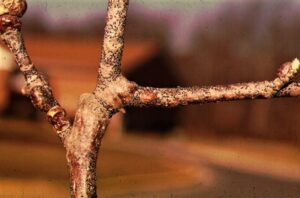
Larger, dark colored 2nd instar soft scale nymphs migrated from leaves to overwinter on branches & stems. They are highly vulnerable to predators during this stage. (Photo Credit: Steven K. Rettke, Rutgers Coop. Ext.) Magnolia scales are one of the largest scale insects in North America, reaching 12.5mm in length. The adult females are smooth, pinkish-orange or dark brown, and covered in a dense, white, powdery wax layer. The late-stage nymphs overwinter on 1- to 2-year-old twigs as tiny, dark reddish brown crawlers.
- Hosts:
- Exclusively feeds on Magnolia species
- Star Magnolia (M. stellata), Saucer Magnolia (M. x soulangeana), Cucumbertree (M. acuminata), and Southern Magnolia (M. grandiflora).
- Exclusively feeds on Magnolia species
- Signs and Symptoms:
- Honeydew production
- Black sooty mold on foliage, branches, and understory plants
- Attracts foraging wasps, hornets, ants, and bees in late summer
- Twig dieback
- Reduced flower bud formation
- Potential plant death under heavy infestations
- Crawler Windows and Life Cycle:
- One Generation per Year in NJ:
- Hatch from late August through September (2100-2800 GDD).
- One Generation per Year in NJ:
- Control & Management Strategy:
- Time contact insecticides, horticultural oils (1-2%), insecticidal soaps, and IGRs to be sprayed during the late August-September crawler hatch window
- Apply dinotefuran or imidacloprid as a soil drench in late spring to early summer.
- Important Regulatory Note: Always strictly adhere to product label guidelines. THE LABEL IS THE LAW.
- For detailed IPM protocols and diagnostic assistance, visit the Magnolia Scale Page
- Additional Resources & Extension Factsheets
- Hosts:
-
Tulip Tree Scale (Toumeyella liriodendri)
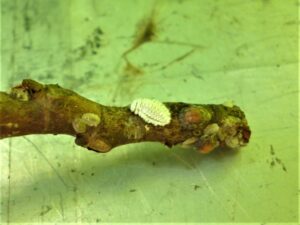
Ladybird beetle larva covered with wax feeding on tuliptree scales. The wax attempts to mimic the appearance of mealybugs in order to avoid attack from ants. (Photo Credit: Steven K. Rettke, Rutgers Coop. Ext.) Tuliptree scales are large, soft scales (8-10 mm). The mature females are smooth, hemispherical domes that range from light orange-brown to dark reddish-brown in color, and they can often be found crowded together along the twigs. The males are small, flat, and grayish-white in color. They overwinter as small, dark 2nd instar nymphs on young twigs.
- Hosts:
- Liriodendron tulipifera (Tuliptree / Yellow Poplar), Magnolia species, and occasionally Tilia (Linden).
- Signs and Symptoms:
- Honeydew production
- Black sooty mold deposits
- Branch distortion
- Leaf yellowing
- Canopy thinning
- Severe branch dieback
- Crawler Windows and Life Cycle:
- One Generation per Year in NJ:
- Females give birth to live crawlers in late August through early September (2000-2800 GDD).
- One Generation per Year in NJ:
- Control & Management Strategy:
- Spray crawlers directly in September using horticultural oil, insecticidal soaps, or pyrethroids.
- Apply dinotefuran or imidacloprid as a soil drench in late spring to early summer.
- Important Regulatory Note: Always strictly adhere to product label guidelines. THE LABEL IS THE LAW.
- For detailed IPM protocols and diagnostic assistance, visit the Tuliptree Scale Page
- Additional Resources & Extension Factsheets
- Hosts:
Other Scales and Scale Lookalikes
Some pests are easily misidentified for scale insects. This can lead to incorrect or unnecessary treatments, costing nursery and landscape owners time and money.
-
Taxus Mealybug (Toumeyella liriodendri)

Taxus mealybug on a branch. Photo: Steve Rettke, RCE While mealybugs and scale insects share the same order (Hemiptera) and suborder (Sternorrhyncha), mealybugs belong to the family Pseudococcidae, whereas armored scales (Diaspididae) and soft scales (Coccidae) occupy distinct families. While mealybugs are still scale insects, they have some features that make them distinctly different from armored and soft scales.
Feature Soft / Armored Scales (Coccidae / Diaspididae) Mealybugs (Pseudococcidae) Mobility Legs are lost or non-functional in adult females; permanently sessile. Retain functional legs and mobility throughout their life. Body Armor Hard waxy shield (Armored) or attached leather-like wall (Soft). Soft, segmented body covered with powder-like white wax. Filaments Smooth edges without lateral filaments. Distinct waxy filaments along body margins and tail. Mealybugs are soft-bodied, oval insects, 3-4 mm in length, and covered in a white, powdery substance with short, soft, waxy filaments along the margins of its body. The adult females retain their legs and move throughout plant foliage. They overwinter as eggs or young nymphs inside white, cottony egg sacs within bark crevices.
- Hosts:
- Primarily Taxus species (Yew / English Yew / Japanese Yew). Occasionally found on Cephalotaxus (Plum Yew).
- Signs and Symptoms:
- White, cottony webbing and powdery wax in the innner canopy along twigs and needle bases
- Honeydew production
- Black sooty mold accumulation
- Foliar yellowing
- Needle drop
- Interior foliage thinning
- Reduced plant vigor
- Crawler Windows and Life Cycle:
- Two Generations per Year in NJ:
- First generation occurs in June (600-1000 GDD)
- Second generation in August (2000-2400 GDD)
- Two Generations per Year in NJ:
- Control & Management Strategy:
- Use high pressure hydraulic sprays to penetrate the foliage, where mealybugs are hiding deep inside.
- Apply horticultural oil (1-2%), insecticidal soap, or acetamiprid during peak nymph activity in June and August.
- Apply dinotefuran as a soil drench in spring.
- Important Regulatory Note: Always strictly adhere to product label guidelines. THE LABEL IS THE LAW.
- For detailed IPM protocols and diagnostic assistance, visit the Taxus Mealybug Page
- Additional Resources & Extension Factsheets
- Hosts:
-
Parasitoid Wasps and Flies (Hymenoptera & Diptera)
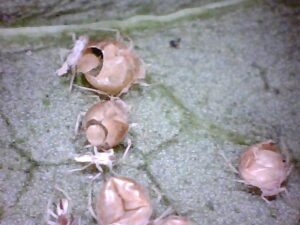
Dead empty shells of parasitized aphids showing exit holes created by the emerging parasitoid wasp adults. (Photo Credit: Steven K. Rettke, Rutgers Coop. Ext.) Parasitoid wasp females lay eggs inside of living soft scales, armored scales, and mealybugs. The wasp larva consumes the pest from the inside, and the scale insect body hardens, inflates, and turns tan to dark brown in color, forming a “mummy.”
These are beneficial insects and should not be targeted with sprays or other management techniques. Their presence will decrease the number of plant-damaging pests.
- How Can I Tell the Difference?
- Look for a tiny, clean, circular emergence hole that is chewed through the top or side of the scale cover.
- Scales with exit holes are dead shell mummies and do not require chemical treatment.
- Management Strategy:
- Inspect scale populations with a 10X hand lens.
- If a high percentage of scale covers exhibit exit holes, biological control is active and you should delay or avoid broad-spectrum sprays (such as pyrethroids) to preserve the beneficial wasp populations.
- Important Regulatory Note: Always strictly adhere to product label guidelines. THE LABEL IS THE LAW.
- For detailed IPM protocols and diagnostic assistance, visit the Parasitoid Wasps and Flies Page
- Additional Resources & Extension Factsheets
- How Can I Tell the Difference?
-
Lady Bird Beetle (Coccinellidae)

Ladybird beetle species have a complete metamorphosis & all stages are shown. After the yellow eggs hatch the remaining egg shells will be white in color. (Photo Credit: Steven K. Rettke, Rutgers Coop. Ext.) Lady Bird Beetle larvae gorw up to 1/2 inch long and produce long, white, waxy filaments over their bodies.When lady beetle larvae transition to adults, they attach themselves to leaves or bark and form immobile, dome-shaped, orangish-brown pupal cases. They can look quite similar to mealybugs or soft scales and can often be mistaken for these pests, but lady beetles are beneficial insects and should not be targeted with pest management techniques.
- How Can I Tell the Difference?
- Lady beetle larvae move much faster than mealybugs and stationary scale insects.
- Lady beetle larvae grow 2-3x larger than mealybugs.
- Flipping lady beetle pupa over will reveal an attachment point at the ends of their bodies rather than the flat, sap-sucking mouthparts that pests use to anchor into plant stems.
- Using a 10x hand lens, it is evident that lady beetle larvae feed on scale crawlers, eggs, and mealybugs.
- Management Strategy:
- Lady beetle larvae and pupae are aggressive, naturally occurring biological controls. A single Cryptolaemus larva can consume over 300 scale eggs or crawlers during its development.
- These should not be sprayed, and when they are present, chemical management should be avoided.
- Avoid using broad-spectrum foliar pyrethroid sprays when they are active.
- Important Regulatory Note: Always strictly adhere to product label guidelines. THE LABEL IS THE LAW.
- For detailed IPM protocols and diagnostic assistance, visit the Lady Bird Beetle Page
- Additional Resources & Extension Factsheets
- How Can I Tell the Difference?