Beneficial Insects
Beneficial Insects and Natural Enemies in the Nursery and Landscape
The integration of biological controls (predatory insects, parasitoids, and predatory mites) is an essential aspect of Integrated Pest Management (IPM). Natural enemies maintain pest populations below economic damage thresholds when protected from broad-spectrum insecticides and given the conditions to thrive.
Scouting and Diagnostic Guidelines for Beneficial Insects
-
Beat-Sheet Scouting: Hold a white clipboard beneath foliage and strike the branch. Beneficial predators (predatory mites, minute pirate bugs, lacewing larvae) move rapidly across the paper compared to slow-moving pests.
- Predatory mites (Phytoseiidae) crawl 2 to 4 times faster than pest spider mites (Tetranychidae).
-
Hand Lens Inspections: Examine leaf undersides, aphid colonies, and scale covers using a hand lens of at least 10X magnification.
-
Look for signs of parasitism, such as swollen, papery aphid “mummies” or small exit holes in armored scale covers.
- Look for larval forms of predatory insects and protect them. The larval stages of lady beetles and lacewings resemble small alligators, while the larvae of flower flies look like legless green maggots. When these beneficial immature stages are present, do not use chemical insecticides.
-
-
Sticky Cards: Yellow sticky cards trap adult parasitoid wasps, syrphid flies, and lacewings, serving as early indicators of natural enemy presence in nursery blocks.
Pesticide Integration and Selective Compatibility
- Avoid Broad-Spectrum Synthetics: Pyrethroids, organophosphates, and carbamates eliminate beneficial insect populations and can trigger severe secondary outbreaks of spider mites and scale insects.
- Use Selective Chemistries: Prioritize biorational materials such as horticultural oils (1-2%), insecticidal soaps, microbial pesticides (Bacillus thuringiensis), and insect growth regulators (pyriproxyfen, tebufenozide) when chemical intervention is deemed necessary.
Beneficial Insect Conservation
Although beneficial insects can be artificially introduced into an area, there are actions that can be taken to naturally foster beneficial insect populations.
- Floral Strips: When possible, plant flowers such as Alyssum, Dill, Yarrow, Coreopsis, and Buckwheat in border areas to provide the nectar and pollen necessary for syrphid flies, lacewings, and parasitoid wasps to reproduce.
- Overwintering Habitat: Maintain perennial border strips and undisturbed leaf litter when possible to shelter overwintering lady beetles, minute pirate bugs, and ground beetles.
- Prioritize sanitation when necessary to control disease.
Predator vs. Parasitoid
Understanding the difference between predators and parasitoids is important for effective IPM scouting, selecting compatible pest management tactics, and monitoring biological control activity.
| Feature | Parasitoid | Predator |
| Size | Larvae are much smaller than the hosts. Adult wasps and flies can vary from microscopic to mid-sized. | Typically larger than their prey. |
| Target Pest Killing | Requires one singular host for a single larvae to complete their development cycle. | Can consume many prey pests throughout their lifetimes to complete their development. |
| Life Stages | Larvae are only parasitic inside or on the host, and free-living adults feed on floral pollen and nectar. | Both immature nymphs/larvae and addults are active predators. |
| Host Specificity | Host-specific, targeting a single genus or species. | Feed on a wide spectrum of pest species. |
| Mortality Speed | Host lives for days or weeds while the internal larva develops. | Attack and consume prey within minutes to hours. |
| Diagnostic Evidence | Swollen aphid mummies, circular exit holes in scale covers, or white eggs on caterpillars | Reduced numbers of pests, chewed leaf tissue, or discarded pest carcasses |
Diagnostic Support
For assistance with pest identification, tissue analysis, or distinguishing invasive species from common native pests, submit samples to the Rutgers Plant Diagnostic Laboratory.
- Website: Rutgers Plant Diagnostic Lab
- Location: Ralph Geiger Center, CVI, 20 Dudley Road, New Brunswick, NJ 08901
- Contact: 848-932-9140 | plant-clinic@njaes.rutgers.edu
Beneficial Insect Post Directory
Explore the pages linked in the table below, or click on the dropdown menus to learn more about some common beneficial insects that might be present in your nursery or landscape.
| Dragonfly | Predacious Mites | ||
| Flower Fly | |||
| Lacewings | |||
| Lady Bird Beetle | |||
| Minute Pirate Bug | |||
| Parasitoid Wasps and Flies |
Notable Beneficial Insects
-
Lady Bird Beetles (Cocconellidae)

Ladybird beetle species have a complete metamorphosis & all stages are shown. After the yellow eggs hatch the remaining egg shells will be white in color. (Photo Credit: Steven K. Rettke, Rutgers Coop. Ext.) Lady bird beetles, commonly referred to as ladybugs, are among the most recognizable predatory beetles. Both adult beetles and larvae are voracious generalist predators of soft-bodied insect pests.
- Target Pests and Prey:
- Generalist predator of aphids, soft scales, armored scale crawlers, mealybugs, whiteflies, spider mites, and small caterpillars.
- Description and Life Stages:
- Adults: Oval, dome-shaped beetles (4-8 mm long), ranging in color from red to orange or yellow, usually with black spots. Common species include the Convergent Lady Beetle (Hippodamia convergens) and the Asian Lady Beetle (Harmonia axyridis).
- Larvae: Elongated, spiky, dark gray-to-black body with bright orange or yellow lateral markings, often described as having an “alligator-like” shape.
- Eggs: Bright yellow, spindle-shaped eggs laid in tight vertical clusters on leaf undersides near active pest colonies.
- Active Windows:
- Most active in spring through autumn
- Overwintered adults emerge in early spring (100-250 GDD) to feed and lay eggs near aphid outbreaks.
- Multiple overlapping generations occur through October.
- Most active in spring through autumn
- Management & Conservation Strategy:
- Conserve native populations by avoiding broad-spectrum foliar insecticide applications when larvae and adults are present in aphid colonies.
- Maintain early-blooming nectar plants (i.e. dandelion, alyssum, and coreopsis) to feed emerging adults in early spring before pest populations build.
- Important Regulatory Note: Always strictly adhere to product label guidelines. THE LABEL IS THE LAW.
- For more information, visit our Lady Bird Beetle Page.
- Additional Resources & Extension Factsheets
- Target Pests and Prey:
-
Green and Brown Lacewings (Chrysoperla & Hemerobius spp.)
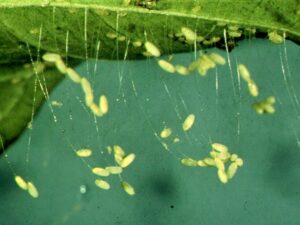
Green Lacewing eggs. Photo: Steve Rettke, RCE. Lacewings are important generalist predators in nursery and landcape settings. Adult green lacewings feed primarily on nectar and honeydew, but their larvae are quite voracious predators that are equipped with curved, hollow jaws.
- Target Pests and Prey:
- Generalist predator of aphids, spider mites, thrips, whiteflies, mealybugs, scale crawlers, insect eggs, and small caterpillars.
- Description and Life Stages:
- Adults: Slender, pale green or brown bodies (12-20 mm long), with large, delicate, transparent wings and prominent gold-colored eyes.
- Larvae: Cream-to-brown alligator-shaped larvae (8-10mm long) with sickle-shaped pincers used to pierce prey and suck out body fluids.
- Eggs: Oval, white eggs suspended individually at the tips of slender, thread-like stalks (6-8mm long) attached to leaves.
- Active Windows:
- Most active in late spring through fall:
- Adults emerge in May (200-400 GDD). Females lay hundreds of stalked eggs near pest colonies.
- Multiple generations develop through September.
- Most active in late spring through fall:
- Management & Conservation Strategy:
- Conserve native populations by avoiding broad-spectrum foliar insecticide applications when populations are detected.
- Plant flowering umbels (dill, fennel, coriander, yarrow) to attract egg-laying adult females.
- Green lacewing eggs and larvae are widely available commercially for release in greenhouse and high-value nursery container blocks.
- Important Regulatory Note: Always strictly adhere to product label guidelines. THE LABEL IS THE LAW.
- For more information, visit our Lacewings Page.
- Additional Resources & Extension Factsheets
- Target Pests and Prey:
-
Flower Flies/Hover Flies (Syrphidae)

Flower fly larvae are fly maggots & will often go undetected as they feed on prey. The dark colored markings on their bodies are clearly apparent. (Photo Credit: Steven K. Rettke, Rutgers Coop. Ext.) Hover flies, also called syrphid flies, are unique beneficial insects because they have a dual purpose: pollination, and pest control. The adult flies are valuable pollinators that hover over flowers like hummingbirds, and their larvae are highly effective aphid predators.
- Target Pests and Prey:
- Specialized predators of aphids, soft scales, thrips, and small caterpillars.
- Description and Life Stages:
- Adults: Yellow and black striped flies (8-12 mm long) that look like yellowjackets or bees, but have only two wings, exhibit their characteristic hovering flight behavior, and do not sting.
- Larvae: Legless, translucent green to yellowish brown, maggots (10-15 mm long) that taper towards their heads. They grab apids and lift them off of the plant stem to consume them.
- Eggs: Single, white, elongated eggs lay flat on leaf surfaces directly inside aphid colonies.
- Active Windows:
- Most active in late spring through fall:
- Adults appear in April and May (100-300 GDD) to feed on pollen and lay eggs.
- Multiple generations develop through October.
- Most active in late spring through fall:
- Management & Conservation Strategy:
- Conserve native populations by avoiding broad-spectrum foliar insecticide applications when populations are detected.
- Plant floral borders to provide the adult females with the pollen and nectar that they need to mature their eggs.
- Sweet alyssum, buckwheat, and asteraceae flowers work especially well
- Learn to distinguish the green syrphid larvae from pest caterpillars (syrphid larvae lack legs and distinct head capsules)
- Important Regulatory Note: Always strictly adhere to product label guidelines. THE LABEL IS THE LAW.
- For more information, visit our Flower Fly Page
- Additional Resources & Extension Factsheets
- Target Pests and Prey:
-
Predacious Mites (Phytoseiidae)

Many predacious mite species will be pale in color with few body hairs. They have long legs & can move much faster than spider mite pests. (Photo Credit: Ohio State Coop. Ext.) Predatory mites are essential natural predators for control of spider mites, rust mites, and thrips. Some notable species include Phytoseiulus persimilis, Neoseiulus californicus, and Typhlodromus pyri. They move much quicker than pest mite species.
- Target Pests and Prey:
- Two-spotted spider mites, spruce spider mites, southern red mites, eriophyid rust nites, and thrips larvae
- Description and Life Stages:
- Adults and Nymphs: Shiny, teardrop or oval shaped mites (0.5 mm long) that can range from pale yellow to bright reddish-orange. They have long legs and move very quickly across leaf undersides to search for prey.
- Eggs: Oval white or translucent eggs, larger than pest mite eggs.
- Active Windows:
- Most active in spring through fall:
- Some species such as Neoseiulus californicus remain active across broad temperature ranges (50-90 F), and others can thrive only during specific seasonal windows.
- Most active in spring through fall:
- Management & Conservation Strategy:
- Conserve native populations by avoiding broad-spectrum foliar insecticide applications, specifically pyrethroids (bifenthrin, permethrin) when populations are detected. Eliminating these sprays can prevent severe secondary spider mite outbreaks.
- Inoculative releases of P. persimilis or N. californicus can provide fast biological control in greenhouse and container nursery stock.
- Important Regulatory Note: Always strictly adhere to product label guidelines. THE LABEL IS THE LAW.
- For more information, visit our Predacious Mites Page.
- Additional Resources & Extension Factsheets
- Target Pests and Prey:
-
Minute Pirate Bug (Orius insidiosus)

The minute pirate bug adult (Orius insidiosus) is only 3mm in size, but it is an excellent predator against oak spider mites. (Photo Credit: Steven K. Rettke, Rutgers Coop. Ext.) Minute Pirate Bugs are small, aggressive bugs with piercing-sucking mouthparts. The adults and the nymphs both feed on thrips and mites in nurseries and field crops.
- Target Pests and Prey:
- Thrips, spider mites, aphid nymphs, whiteflies, insect eggs, caterpillars
- Description and Life Stages:
- Adults: Very small (1.5-2mm), oval, black and white patterned bugs with triangular heads and prominent beaks.
- Nymphs: Teardrop shaped, wingless, yellowish-orange to amber colored
- Eggs: Very small (0.4 mm long), cream or white colored, and oblong shaped, with a flat, circular cap resting on top.
- Active Windows:
- Most active in late spring through autumn
- Overwintered adults emerge in May (300-500 GDD)
- Populations build rapidly in summer heat, with generations completing every 15-20 days.
- Most active in late spring through autumn
- Management & Conservation Strategy:
- Conserve native populations by avoiding broad-spectrum foliar insecticide applications when larvae and adults are present in aphid colonies.
- Plant alternate pollen for adults to feed on when pest populations are low
- Alyssum, ornamental peppers, marigolds
- Release commercial O. insidiosus in greenhouses or container blocks facing high thrips pressure.
- Important Regulatory Note: Always strictly adhere to product label guidelines. THE LABEL IS THE LAW.
- For more information, visit our Minute Pirate Bug Page.
- Additional Resources & Extension Factsheets
- Target Pests and Prey:
-
Parasitoid Wasps and Flies
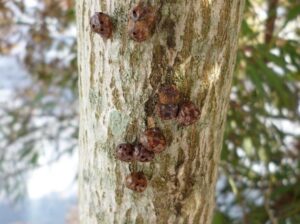
Evidence of valuable biological controls. The numerous exit holes indicate parasitoid wasps have successfully destroyed these mature calico scales. (Photo Credit: Steven K. Rettke, Rutgers Coop. Ext.) Parasitoids are specialized beneficial insects whose larvae develop inside or on a single host insect, ultimately killing it. This is a diverse group and includes microscopic wasps (Encarsia, Aphidius, Trichogramma) and tachinid flies.
- Target Pests and Prey:
- Parasitic wasps: Aphids, armored and soft scale insects, whiteflies, wood-boring beetle larvae, and caterpillar eggs and larvae.
- Tachinid flies: Caterpillars, sawfly larvae, stink bugs, and adult beetles.
- Description and Life Stages:
- Parasitic wasps: Range from microscopic (~0.5mm Encarsia) to larger species (~20 mm Ichneumonids) with long ovipositors.
- Tachinid Flies: Medium to large grayish black flies that resemble house flies, covered in stiff abdominal hairs.
- Signs of Parasitism:
- Aphid mummies: Swollen, rigid, tan or black hardened aphid shells with circular exit holes cut by emerging wasps
- Scale exit holes: Tiny holes on mature scale covers, observable with a hand lens.
- Tachinid eggs: Oval, white eggs stuck to the back of caterpillars or stink bugs.
- Active Windows:
- Active in Spring through Fall, throughout the entire growing season.
- Parasitoid life cycles are often synchronized with the life cycles of specific host insects.
- Active in Spring through Fall, throughout the entire growing season.
- Management & Conservation Strategy:
- Conduct field diagnostic checks before applying chemical controls for aphids or scales.
- Inspect colonies with a hand lens.
- If over 20% of aphids are mummified or scale covers have exit holes, delay spraying to allow parasitoids to suppress the population.
- Plant small-sloweded umbelliferous plants (parsley family – yarrow, alyssum, buckwheat) to increase parasitoid longevity and egg production.
- Adult parasitoids feed exclusively on floral nectar.
- Important Regulatory Note: Always strictly adhere to product label guidelines. THE LABEL IS THE LAW.
- For more information, visit our Parasitoid Wasps and Flies Page.
- Conduct field diagnostic checks before applying chemical controls for aphids or scales.
- Additional Resources & Extension Factsheets
- Target Pests and Prey:
-
Dragonflies (Anisoptera spp.)

Dragonfly adult. Photo by CD Armstrong. Dragonflies are very powerful aerial predators in land management and aquatic ecosystems. They are not typically manipulated inside commercial greenhouses, but maintaining aquatic habitats near nursery field borders can support significant levels of natural control for landscape insect pests.
- Target Pests and Prey:
- Adults: Flying insect pests, including mosquitoes, gnats, midges, flying aphids, winged scale crawlers, and moths.
- Nymphs: Mosquito larvae, aquatic midge larvae, and larvae of other water-dwelling pests.
- Description and Life Stages:
- Adults: Large, elongate insects with two pairs of wings that are held horizontally at rest, and large compound eyes.
- Nymphs: Aquatic, robust, hinge-jawed predators living in retention ponds, irrigation basins, and natural waterways.
- Active Windows:
- Active in late Spring through Fall
- Nymphs develop aquatically for months to years.
- Adults emerge in May through September, patrolling field borders and pond edges.
- Active in late Spring through Fall
- Management & Conservation Strategy:
- Avoid pesticide drift into nursery irrigation basins and retention ponds to protect aquatic dragonfly nymphs.
- Retain tell emergent vegetation, reeds, and perimeter fence lines around nursery basins to provide hunting perches for adult dragonflies.
- Important Regulatory Note: Always strictly adhere to product label guidelines. THE LABEL IS THE LAW.
- For more information, visit our Dragonflies Page
- Additional Resources & Extension Factsheets
- Target Pests and Prey: