In late 1956, alcohol researchers, including officials in two Canadian provinces, were asking the same question: what would come next for Dr. E. M. Jellinek?

The portrait of E. M. Jellinek, used on the back cover of his seminal book, The Disease Concept of Alcoholism, was taken in Canada.
At that moment, Elvin Morton Jellinek was the most influential figure in alcohol studies in the world. After leaving the pioneering institute of the field that he helped create, the Yale Center of Alcohol Studies, he had spent years at the World Health Organization, continuing to develop the frameworks that would transform how medicine and public health understood drinking problems: not as moral weakness, not as a character flaw, but as a disease. His influence was enormous. And yet, as his time with the WHO was coming to an end, his professional future was rather uncertain at age 66, despite his significant research potential.
Two men involved in alcohol research saw an opportunity in this moment. J. George Strachan, Executive Director of the Alcoholism Foundation of Alberta, and H. David Archibald, Director of the Alcoholism Research Foundation of Ontario, were both concerned with the state of alcoholism policy in Canada. Provincial programs existed, but they varied widely in philosophy and practice. Formal federal engagement was minimal. Neither province had long‑term access to senior scientific consultation in the emerging field of alcoholism studies.
By early 1957, Strachan and Archibald were in communication about the possibility of inviting Jellinek to Canada in a consulting role.
Developing a Joint Proposal
In a letter dated February 25, 1957, Archibald formally outlined the idea, proposing that Ontario and Alberta cooperate to secure Jellinek’s services. The proposal envisioned a dual appointment that would allow Jellinek to advise both provincial foundations while pursuing scholarly work. Strachan responded within days, reporting that Alberta was interested and would advance the matter to the executive and board of the Alcoholism Foundation of Alberta.
By April 1957, the Alberta Foundation had approved extending an invitation. Discussion followed on whether the federal government might contribute funding to the arrangement, but this option was soon set aside. Both men concluded that relying on federal involvement would delay matters and introduce additional complications. The final agreement remained entirely in the hands of the two provincial organizations.

Letter from Strachan to Jellinek
Ontario and Alberta jointly committed to guaranteeing Jellinek an annual salary of $10,000. At a time when alcoholism agencies operated with limited budgets, this represented a significant financial commitment. The cost was justified by the expectation that Jellinek’s presence would strengthen program development, research capacity, and professional training.
Jellinek responded positively. In a letter dated December 18, 1957, he expressed interest in the proposal and indicated his willingness to accept a definite offer from Archibald. Over the subsequent months, details were finalized. By early 1958, the terms of his appointment were clear: Jellinek would serve as general consultant to both the Alcoholism Research Foundation of Ontario and the Alcoholism Foundation of Alberta. He would also hold an associate appointment in the Department of Psychiatry at the University of Toronto’s Faculty of Medicine, along with an Honorary Professorship at the University of Alberta Medical School.
From the outset, both Strachan and Archibald emphasized that Jellinek’s time should be protected. Archibald stated explicitly that the primary purpose of the appointment was to allow Jellinek to write and consolidate his thinking after decades of research and institutional work. Consulting responsibilities were to remain secondary and flexible.
Arrival in Canada
Jellinek arrived in Canada in September 1958 and established his base at the University of Toronto, where he remained through June 1959. During this period, he consulted with Ontario Foundation staff, met regularly with faculty and students, and continued work on several manuscripts. His schedule was deliberately unstructured, allowing him to decide how to divide his time among writing, consultation, and teaching.
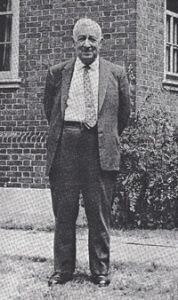
Jellinek at the Yale Summer School in 1959
In July 1959, Jellinek and his wife, Martha, went back to the United States, to New Haven, where the Yale Summer School of Alcohol Studies was held. From there, they traveled west to Alberta. On July 31, 1959, they arrived in Edmonton by train.
Preparations had been made in advance. A private residence had been secured for the Jellineks, and a fully furnished office was provided for Jellinek’s use, along with a personal secretary and the full cooperative assistance of the Foundation’s staff. Arrangements had been made at the University to permit library access and meetings with faculty and students whenever Jellinek wished.
Initially, Jellinek planned to spend August, September, and October in Edmonton, with his schedule arranged so he could join staff sessions as he pleased. These meetings were not part of a fixed agenda but were intended to allow open discussion of clinical practice, research issues, and program philosophy. They proved beneficial to everyone so quickly that similar arrangements were extended to Calgary, enabling staff there to share time with him as well.
He was introduced early on to many faculty members, the incoming Dean of Medicine, Dr. Walter C. MacKenzie, and the University of Alberta’s president, Dr. Walter H. Johns. At a luncheon, he met the Minister of Health, Dr. J. Donovan Ross, and members of the Alcoholism Foundation’s board. Martha Jellinek was similarly welcomed and introduced to Edmonton’s social world.
Strachan later recalled that Jellinek, whom staff affectionately came to know as “Bunky” in Canada, too, had an extraordinary gift for informal intellectual engagement. He showed particular interest in informal exchanges with junior professionals entering the field of alcoholism.
He was really immensely helpful because he gave me a crash course in alcoholism at an early stage in my research in that field, and the breadth of his knowledge was inspiring. – Interview with Harold Kalant, M.D., Ph.D., professor emeritus in 2016 at the University of Toronto.
His humor, his depth of awareness, and his willingness to sit with anyone and discuss any subject they cared to raise made every encounter an education. Those who associated with him, as Strachan put it simply, benefited and grew. These interactions, though rarely documented in formal reports, were remembered as an important part of his influence during this period.
Scholarly Work and Consultation
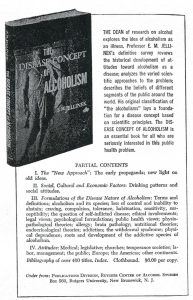
Jellinek was working on his seminal book in Canada.
Throughout his years in Canada, Jellinek’s intellectual output was remarkable. He was simultaneously completing what would become his most influential book, The Disease Concept of Alcoholism, which had begun under a grant from the Christopher D. Smithers Foundation back in 1957. The book was completed and published in 1960, while Jellinek was still serving as a consultant in Alberta, and the photograph on the dust jacket was taken in Strachan’s own office.
Beyond the book, Jellinek’s Canadian work was broad and practical. Jellinek provided advice on program development and research planning. He discussed the application of the disease concept to treatment services, the relationship between education, prevention, and clinical care, and the importance of integrating research into provincial programs. Although his role was advisory rather than administrative and he did not attempt to impose a uniform structure on provincial agencies, he lent scientific legitimacy to the idea that alcoholism was a public health responsibility rather than a moral failing.
Jellinek’s presence also attracted interest beyond Alberta and Ontario. He was consulted informally regarding the development of programs in Saskatchewan and Manitoba, reflecting the limited availability of senior expertise in the field at that time.
In 1960, the University of Alberta Medical School formalized Jellinek’s appointment, and the journal Progress dedicated an issue to him in recognition of his seventieth birthday. His time in Canada also extended beyond the original two-year plan. Correspondence in March 1961 addressed the extension of his stay in Ontario, and it was not until December 1961 that correspondence regarding his appointment to Stanford University marked the formal close of his Canadian chapter.
Documenting the Canadian Years
Much of what is known about Jellinek’s Canadian work survives because of J. George Strachan’s efforts to document it. Following Jellinek’s death in 1963, Strachan drafted an unpublished manuscript titled Dr. E. M. Jellinek Comes to Alberta, Canada (1965). The document describes the origins of the invitation, outlines Jellinek’s activities in the province, and places them within his broader career.

The first page listing dates and events related to Jellinek’s visit
In 1966, Strachan followed this with a meticulous chronological record, Dates of Events Concerning Dr. E. M. Jellinek’s Coming to Alberta and His Stay in Canada. Covering the period from February 25, 1957, through December 13, 1961, the chronology records major correspondence, salary arrangements, appointments, and logistical milestones.
Strachan’s unpublished manuscript,E. M. Jellinek, Sc.D, M. Ed., M. D. (Hon.): His stay in Canada, dated 1989, presenting the history of events before and during Jellinek’s stay, the early history of the Jellinek Memorial Fund, and misc. items related to Jellinek is a treasure trove for Jellinek fans.
These documents provide the primary source base for reconstructing Jellinek’s Canadian years and are foundational to Jellinek’s biography, even though the myths they perpetuated about his early years have been debunked. Without them, this period would appear only indirectly in accounts focused on his earlier work in the United States and at the World Health Organization, or on his later appointment at Stanford, rather than the productive and significant period it actually was.
Jellinek’s Legacy
One tangible monument to Jellinek’s time in Edmonton is the Jellinek Society, a social service organization that serves people experiencing homelessness and addiction. Its origins date back to 1959, when a United Church hostel began operating in the city, the same year Jellinek arrived by train at Edmonton’s station. The organization was formally incorporated under his name in 1964, two years after his death. It continues to operate today, memorializing Jellinek’s Canadian visit for the present.
From a historical perspective, the recruitment of E. M. Jellinek to Canada was a remarkable act of institutional cooperation, illustrating the ambitions and capacity of provincial agencies to shape the development of specialized fields through coordinated action. Without federal sponsorship and within modest financial limits, Ontario and Alberta managed to bring the world’s foremost alcoholism researcher to their country for three years. They protected his time, supported his writing, introduced him to young professionals who went on to shape the field, and ensured that when he left, his ideas stayed behind.
The surviving correspondence and administrative records document not only Jellinek’s activities, but also how expertise in alcohol studies crossed borders in the mid‑twentieth century. Mostly preserved in the Strachan Collection at Rutgers, the documentation provides insight into how ideas were transferred, institutionalized, and adapted within emerging public health systems. They function perfectly as records of Jellinek’s movements, but they also show what it looks like when people who care about a cause recognize an opportunity and refuse to let it pass.
Resources
- Images and documents are available from the Rutgers Digital Alcohol Archives Collection. Click on the individual images for more information.
- Visit the page The Mysterious E. M. Jellinek, a digital exhibit providing a glimpse into Jellinek’s colorful personality and exceptional scholarship through material collected and preserved by the Center of Alcohol Studies.
- See “Jellinek in Canada” in the exhibit for related documents.
- Visit the Jellinek page in the Rutgers Digital Alcohol Archives Collection.
References
-
Jellinek, E. M. (1960). The disease concept of alcoholism. College and University Press in Association with Hill House Press, New Brunswick, N. J.
- Jellinek Society (n.d.) Organizational history. https://www.jellinek.ca/our-history/
- Kalant, H. (2017). Broad Thinking: An Interview With Harold Kalant. Journal of Studies on Alcohol and Drugs, 78(1), 158–165.
- Strachan, J. G. (ca. 1965). Dr. E. M. Jellinek comes to Alberta, Canada (Unpublished manuscript). Rutgers Center of Alcohol Studies Archives.
- Strachan, J. G. (1966). Dates of events concerning Dr. E. M. Jellinek’s coming to Alberta and his stay in Canada (Draft manuscript). Rutgers Center of Alcohol Studies Archives.
- Strachan, J. G. (1989). E. M. Jellinek, Sc.D, M. Ed., M. D. (Hon.): His stay in Canada. Unpublished manuscript. Draft No. 3. Rutgers Center of Alcohol Studies Archives.