Congratulations to Tatevik Yolyan, who successfully defended their dissertation, “Phonological Expressivity and Learning via Boolean Monadic Recursive Schemes,” on September 2. Please see the abstract for the dissertation below.
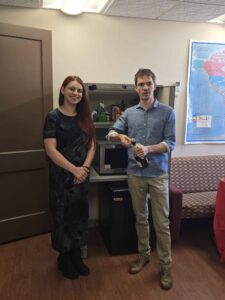
Tatevik’s committee included Adam Jardine (chair), Adam McCollum, Bruce Tesar, and Siddharth Bhaskar (University of Southern Denmark). This research was supported by the Andrew W. Mellon Dissertation Completion Fellowship.
Abstract
This dissertation investigates the representation, expressivity, and computational learning of phonological maps through the model-theoretic framework of Boolean Monadic Recursive Schemes (BMRS). The BMRS framework is used to expresses phonological processes as logical transductions over relational structures. This framework has been proposed as an alternative to finite state transducers (FSTs) in computational phonology by Chandlee & Jardine (2021) because it combines the restrictiveness of FSTs with the descriptive capabilities of model theory. This dissertation presents the BMRS framework with an in-depth discussion of its connections to model theory, formal language theory, and linguistics, and showcases the merits of BMRS for computational phonology by revisiting expressivity and learning from a logical perspective.
With respect to expressivity, this dissertation presents a logical characterization of the weakly deterministic class of functions, which were originally proposed by Heinz & Lai (2013) as a description of the expressivity of natural language phonological maps. Although FST characterizations of this class have been proposed in recent years, these characterizations have not been able to decisively distinguish between weakly deterministic and more complex maps. This dissertation shows that a logical characterization does succeed in correctly identifying weakly deterministic maps, and can be used to reason about what maps are outside this region, thus yielding a testable hypothesis about the expressivity of natural language maps.
With respect to learning, this dissertation develops a learning procedure that adapts phonotactic learning with model-theoretic representations to learning transductions. This learning procedure uses a partially-ordered hypothesis space of feature-based string models, and shows how this structure can be employed to learn phonological generalizations from a small number of data points. The significance of the logical perspective is that the learning procedure can be extended to more complex phonological structures that are otherwise difficult to define FSTs over. This dissertation further shows how this work extends to a procedure for learning non-interacting processes from their composition, which remains an open problem for FSTs.
Together, these contributions advance the research program of model-theoretic phonology by establishing BMRS as a robust theoretical and computational framework for phonology.