Welcome to the 2025–2026 academic year, and a warm welcome to our new cohort of graduate students! We are excited to introduce the four first-years joining the Rutgers Linguistics community. Each of them has shared a short introduction so we can all get to know them a little better. Read on to meet the newest members of our department!
Welcome to Rutgers Linguistics!
Eli Franz
Hi all! I’m Eli. I was born in Fresno, California but we moved to the Pacific Northwest when I was 8. My parents are both instructors at community colleges in the area (my mom teaches English and my dad teaches Economics). I went to school at a community college before transferring to Reed College in Portland, Oregon for my undergraduate degree. I started out as a Classics major but ended up switching to Linguistics, partly because they expected me to read about history and literature in Classics (shocking, I know), but more because of a lecture by one of my undergrad professors on tag questions. It seemed (and still seems) incredible to me that we use complex patterns every day and that those patterns can be precisely characterized by rules. When I figured out that morphological and phonological analysis could look a lot like a puzzle that could be solved by finding a formal characterization of the pattern, I was sold.
In undergrad, I wrote a thesis on an OT account of a process in a variety of South Asian languages known as fixed-segment reduplication, a form of reduplication characterized by apparent replacement of base material in the reduplicant. My main research interest now, though, is computational phonology and the applications of formal language theory to phonology. I don’t have very specific interests yet, but I’d say I’m interested in what processes can be represented using Input Strictly-Local functions, what can’t, why it can’t, and why certain phonological processes are ISL and others aren’t. I think formal language theory is important for linguistics because it lets us state precisely the kinds of patterns we expect or don’t expect to see. On the theoretical side, I’m interested in the process of rhythmic syncope, a non-ISL process that deletes unstressed vowels.
When I’m not doing linguistics, I like to cook, play video games and board games, read poetry, and self-study math (normally pretty poorly).
Jeanet Toppo
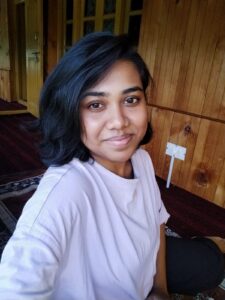 Hi, I’m Jeanet! I grew up in a city in the Himalayan foothills of West Bengal, surrounded by animals—so it’s no surprise I’m passionate about animal welfare. When I’m not diving into linguistics, you’ll find me traveling solo. In 2023, I trekked through the Dhauladhar Range. I completed my master’s degree in Linguistics at Jawaharlal Nehru University in New Delhi, where I discovered my love for syntax. Linguistics opened up a whole new world for me, and since then, I’ve been fascinated by the structure of language.
As a student of Linguistics, I’m particularly interested in theoretical syntax, my focus would be on the Minimalist Analysis of Kurukh Case Licensing. The research would aim to analyse the structural case licensing and determine the nature of each case in Kurukh, including their surface realizations and the semantic significance within the framework of Transformational Generative Grammar. I want to exhibit a many-to-many mapping scheme between instances of m-cases, which would serve as indicators of a multiplicity of Deep cases. I would like to explore different parsing mechanisms for cases proposed by the GB and MP approach. My project will demonstrate how these frameworks would operate in relation to structural cases in Kurukh. I’ll also draw comparisons with other North-Dravidian languages like Malto and Brahui, spoken in central India and parts of Pakistan.
When I’m not studying syntax or traveling, I’m likely scrolling through Pinterest or playing dress-up. Moving to the US away from home was daunting, but the Linguistics department and the Highland Park community has made me feel right at home.
Zachary Helfand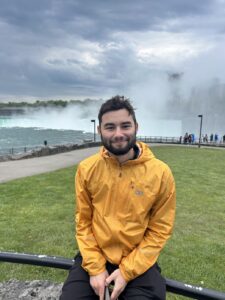
Hello! My name is Zach Helfand, and I was born and raised in Los Angeles, California. I enjoyed the convenient climate of Southern California until shipping off to the Midwest for college. I completed my bachelor’s at Washington University in St. Louis with a major in linguistics and minors in computer science and psychology. I found linguistics by seeing the listing for an introductory course, which I found sufficiently intriguing, so I took it, enjoyed it, and enrolled in another the following semester. After about a year of that, I dove in and realized this was what I wanted to do. What I love about linguistics is twofold. On the one hand, language itself fascinates me. I find it absolutely nuts that we humans can transmit thoughts, intentions, stories, and so on from one person to another by simply manipulating airwaves, and that we do it with such ease all the time. This sense of wonder has steered me towards wanting to study linguistic competence. Additionally, as I’ll sometimes tell friends who don’t totally understand what linguistics is, it is basically a series of puzzles that we get to approach and try to creatively solve. That way of thinking is so intellectually stimulating and fulfilling to me. The subject matter plus the method made linguistics a clear match for me. For my undergraduate thesis, I conducted a laboratory experiment, the findings of which suggest that listeners increase their reliance on top-down processing when listening to a speaker with an unfamiliar accent. Now acquainted with rain and snow from my time in St. Louis, I have ventured further northeast and am settling into life in New Jersey.

At Rutgers, I hope to pursue my interests in computational linguistics as well as the key theoretical bases, which, in my opinion, make up the core of linguistics. My time at WashU also gave me an appreciation for applying experimental methods and staying grounded in cognitive science in my linguistic endeavors. When I delve into theoretical subject matter, I try to consider the cognitive aspect of what we are trying to model and how certain hypotheses might be testable. I look forward to collaborating with so many brilliant faculty and fellow grad students in my time here, learning the unique piece of the pie each of them has to offer.
Outside of linguistics, I love baseball, hiking, watching movies, listening to music, going on road trips, and hanging out with my friends. I’ll have plenty to say if you ask about any of those topics :). I’m super pumped to explore the East Coast, meet some great new people, and do some cool work!
Zoe Katz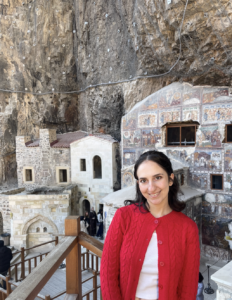
Howdy* I’m Zoe Katz!
I was born & raised in Dallas, Texas, but in 2020 I moved to Houston. While there, I attended Rice University for my undergraduate degree, where I majored in linguistics & computer science. I decided to major in linguistics after I watched the movie Arrival in high school; it was probably one of my best impulse decisions to this day. Computer science, on the other hand, was chosen because my brother knew how to code and I didn’t — classic sibling rivalry. Turns out, I like coding & math, and I’m glad I stuck with it!
For the 2024-2025 academic year, I lived in Erzurum, Turkey teaching English on a Fulbright grant. From this experience, I learned some Turkish, developed a love of Ayran, and discovered I can handle the cold quite well despite my Texan roots. I also picked up some Turkish words & phrases in the local dialect, much to the amusement of my friends. My favorite one, “cırıldım çayı,” is used when you are a guest at someone’s house and find yourself needing a condensed way to say “thank you for all the tea, but I really can’t drink anymore, I am going to explode, so please let this be my last one.” They might still serve you a couple more teas, but it’s worth a shot.
When I’m not doing linguistics, I like to read sci-fi novels, think about going to the gym, and play Stardew Valley. My prized possessions are my (apparently vintage) Owala water bottle, my fun earrings collection, and my obscenely long duolingo streak. I’m excited to meet you all and I can’t wait to start my PhD!
*Unfortunately, I don’t really say “howdy,” but it would be cool if I did.